

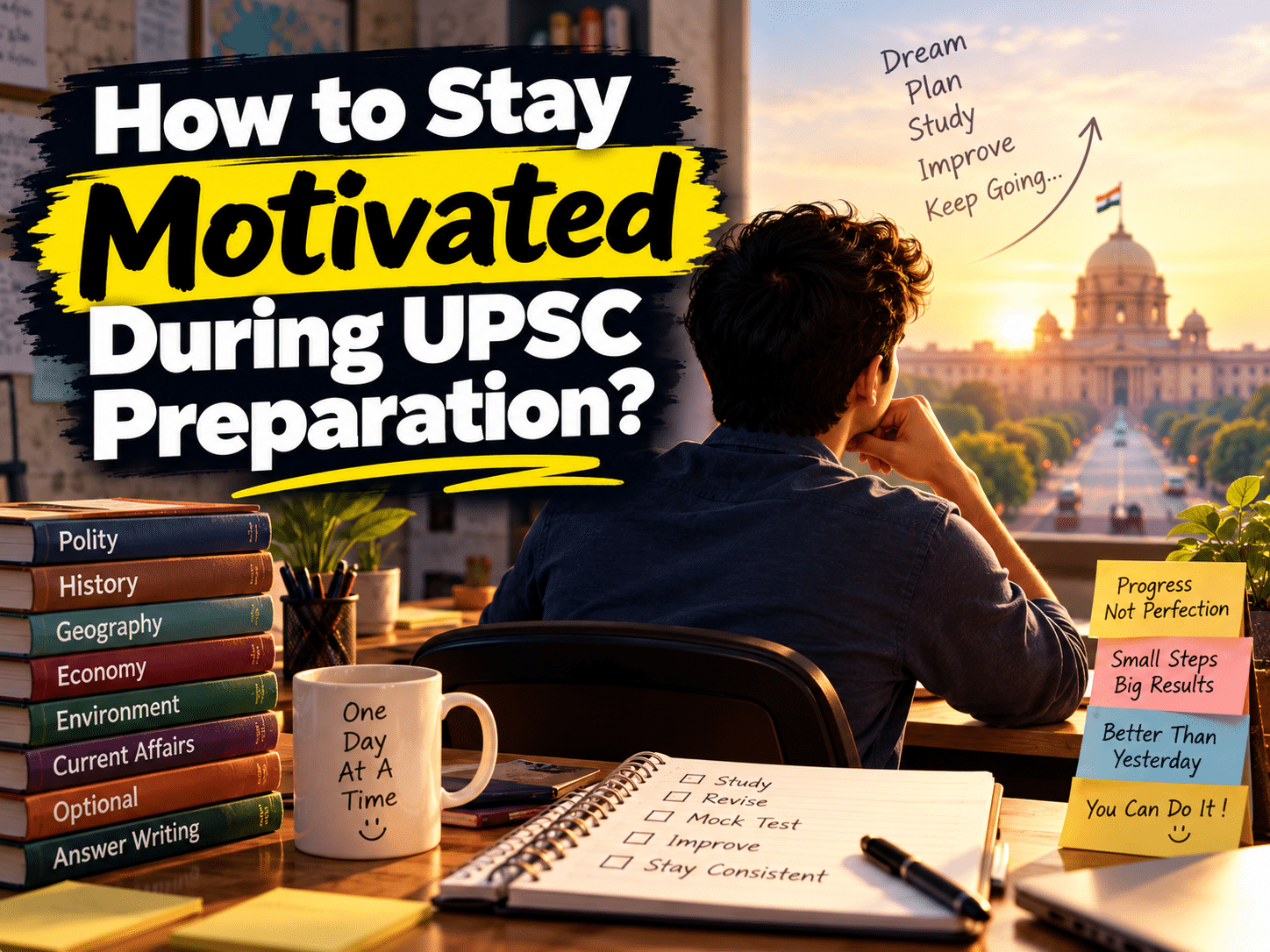

“Sir, I have lost my motivation.”
I hear this quite often from UPSC aspirants.
And usually, when a student tells me this, I don’t immediately start giving them a motivational lecture.
I ask them a few questions.
How long have you been preparing?
What exactly have you completed?
How are your test scores?
Are you revising?
Are you writing answers?
What does your daily routine look like?
Because sometimes the student who says “I have lost motivation” hasn’t actually lost motivation.
He is simply confused.
Sometimes he has been studying for six months without knowing whether he is moving in the right direction. Sometimes he has consumed too much content. Sometimes he has been comparing himself with toppers every day. And sometimes he is simply exhausted.
These are very different problems.
And they cannot all be solved by watching another motivational video.
UPSC preparation is not supposed to feel exciting every day
Let’s be honest.
When you start preparing for UPSC, everything feels exciting.
You buy your books.
You make a timetable.
You imagine your name in the final result.
You watch interviews of toppers.
You start thinking about what your life will look like after becoming an IAS officer.
For the first few weeks, even waking up early feels good.
Then you actually start studying.
Polity has 100 things to remember.
History seems endless.
Economy takes time to understand.
Current Affairs never seems to finish.
You revise something today and forget half of it after a few weeks.
Then comes the first mock test.
Your score is nowhere near what you expected.
That is usually when the honeymoon ends.
And this is where I want aspirants to understand something very important:
UPSC preparation is not supposed to feel exciting every day.
There will be days when you genuinely enjoy studying.
There will also be days when you look at the same book and think, “I don’t want to see this thing anymore.”
That’s normal.
You are preparing for a highly demanding examination. You are not expected to wake up every morning overflowing with inspiration.
The mistake is expecting motivation to remain constant.
It won’t.
I don’t think motivation is the most important thing
Over the years, I have become less interested in motivating students and more interested in helping them build a preparation system.
Why?
Because motivation is temporary.
Suppose I give you a fantastic motivational speech today.
You leave the room excited.
You study for six hours.
Tomorrow morning, you may still feel good.
But what about next Tuesday?
What about after a bad mock test?
What about when your friend gets a job?
What about when your parents ask how much longer this preparation is going to take?
What about when you have been studying for eight months and the finish line still looks far away?
You cannot call me every morning for a motivational speech.
You shouldn’t need to.
You need to reach a point where you know what you have to do even when you don’t feel like doing it.
That’s where discipline comes in.
Not the Instagram version of discipline.
The ordinary version.
Sitting down and finishing the chapter.
Writing the answer even though you know it isn’t very good.
Revising something you studied three weeks ago.
Taking the test even though you’re worried about your score.
That’s preparation.
But before blaming yourself, find out why you’re losing motivation
This is something aspirants often miss.
They think:
“I’m not studying properly. Therefore, I’m lazy.”
Not necessarily.
Maybe your timetable is unrealistic.
Maybe you are studying 10 hours because somebody on YouTube told you that successful candidates study 10 hours.
Maybe you have five different sources for every subject.
Maybe you’re watching three hours of current affairs every day.
Maybe you haven’t revised anything in two months.
Maybe you’re taking tests but never analysing your mistakes.
Maybe you have been preparing completely alone and don’t know whether your strategy is correct.
In all these situations, telling yourself “I need more motivation” doesn’t solve the problem.
You need to fix what’s causing the frustration.
That is why I always tell aspirants to periodically step back and look at their preparation objectively.
Don’t ask only:
“How many hours did I study today?”
Ask:
“What did those hours actually produce?”
Did you complete something?
Did you revise?
Did you improve an answer?
Did you understand a difficult concept?
Did you identify a mistake?
Did you move forward?
That gives you a much more honest picture.
One thing I strongly advise: stop watching endless topper interviews
I have nothing against topper interviews.
They can be useful.
But there is a point beyond which they become counterproductive.
You watch one interview.
Then another.
Then someone tells you that a particular topper studied from a particular book.
You change your book.
Another topper used a different strategy.
You change your strategy.
Someone studied at 4 AM.
Now you feel guilty because you wake up at 7.
Someone studied 12 hours.
You start thinking your six hours aren’t enough.
Someone cleared in the first attempt.
You start worrying about your own attempt.
And eventually, instead of preparing for UPSC, you are studying how other people prepared for UPSC.
That’s not preparation.
Take useful lessons from successful candidates.
Then close YouTube and get back to your own desk.
Don’t compare your preparation with somebody else’s result
This is another trap that has become much worse because of social media.
You see somebody posting:
“AIR 23 — First Attempt.”
What you don’t see is the entire story behind that photograph.
You don’t know:
- their circumstances,
- how long they prepared,
- what kind of guidance they received,
- how many hours they actually studied,
- And you certainly don’t know what happened during the difficult months that never made it into the Instagram post.
Your only job is to make your own preparation better.
If your answer today is better than the one you wrote three months ago, that’s progress.
If your mock score has improved, that’s progress.
If you’re able to eliminate options more accurately in Prelims, that’s progress.
If you can now write a structured Mains answer in the required time, that’s progress.
These small improvements are far more useful than comparing yourself with somebody who has already reached the destination.
There will be days when you don’t study well
Accept this.
You are human.
One day you may have a family issue.
Another day you may fall sick.
Sometimes you will simply have a terrible day.
Don’t turn one bad day into a bad week.
And don’t turn one bad week into:
“My UPSC preparation is ruined.”
I have seen aspirants make this mistake.
They miss two or three days.
Then they feel guilty.
Because they feel guilty, they avoid their books.
The backlog increases.
The guilt increases.
Finally, they decide to restart the entire preparation.
New timetable.
New notebook.
New strategy.
New beginning.
And the cycle starts again.
Don’t do that.
If you miss three days, come back on the fourth.
You don’t need a new strategy.
You just need to resume.
Don’t look at the entire UPSC syllabus every morning
This sounds trivial, but it makes a difference.
If you keep thinking:
“I have to finish History, Geography, Polity, Economy, Environment, Ethics, Essay, Optional, Current Affairs, Prelims…”
of course you will feel overwhelmed.
You are looking at the entire mountain instead of the next step.
Today, perhaps your job is simply to finish one chapter of Polity.
Finish it.
Tomorrow, move ahead.
At the end of the week, look back at what you actually completed.
A large syllabus becomes manageable when you stop carrying the entire thing in your head every morning.
And please don’t underestimate revision
There is another reason aspirants lose confidence.
They keep studying new material.
Every day they learn something new.
But they don’t revise enough.
After a few months, they suddenly realise:
“I have studied so much, but I don’t remember anything.”
That can be very demoralising.
But the problem isn’t necessarily your ability.
It may simply be the absence of revision.
When you revise properly, something interesting happens.
Topics that once seemed difficult start becoming familiar.
Questions that previously confused you become easier.
You begin recognising patterns.
Your confidence improves—not because somebody motivated you, but because you can see evidence that your preparation is working.
That’s a much stronger form of motivation.
A bad test can actually be good news
Suppose you take a mock test and score badly.
Naturally, you feel disappointed.
But don’t immediately conclude that you cannot clear UPSC.
Look at the paper.
Where did you lose marks?
Knowledge?
Conceptual understanding?
Careless mistakes?
Poor elimination?
Time management?
Misreading the question?
If you analyse the paper properly, the test has done its job.
It has shown you where the gaps are.
A test that exposes your weaknesses is useful.
A test that gives you a high score but teaches you nothing may be much less valuable.
So don’t judge your preparation only by the number printed at the top of the scorecard.
Look at what the test is telling you.
Finally, remember why you started
There will be moments when you genuinely question yourself.
That’s part of UPSC.
When that happens, go back to the beginning.
Why did you choose civil services?
What attracted you to this career?
What kind of work do you want to do?
What made you believe that this was worth pursuing?
But don’t spend all day visualising your final selection either.
At some point, the dream has to come back to today’s work.
The result will take care of itself later.
Today’s chapter is in front of you now.
Study it.
Understand it.
Revise it.
Move on.
Tomorrow, do the same thing.
That is how preparation actually happens.
My Advice to an Aspirant Who Has Lost Motivation
If you are going through a low phase right now, don’t immediately decide that UPSC isn’t for you.
First, step back.
Look at your preparation honestly.Maybe :
-You need a break.
-Your schedule needs changing.
-You need fewer resources.-You need better guidance.- You need to start testing yourself.
-You’ve simply been working too hard without enough sleep.
Find the actual problem.
Then solve that problem.
Don’t keep treating everything as a motivation problem.
And don’t expect yourself to feel confident every day.
You won’t.
I certainly wouldn’t expect that from my students.
What I would expect is something much simpler:
When you fall out of rhythm, get back into it.
That is enough.
Because UPSC is not cleared by the person who feels motivated every morning.
It is cleared by the person who can keep doing the right things for a long enough period.
So if today isn’t your best day, that’s okay.
Study whatever you can.
Tomorrow, continue.
And when the difficult phase comes again—as it inevitably will—remember:
You don’t have to love the process every day. You just have to stay committed to where the process is taking you.
Study. Revise. Practise. Improve. Continue.
Eventually, those ordinary days of preparation become the reason an extraordinary result becomes possible.
Rahul Sir’s IAS Academy – 1st Attempt Masterplan
Aspirants often think they need more motivation when what they actually need is clarity about what to do next.
That’s one of the ideas behind the 1st Attempt Masterplan at Rahul Sir’s IAS Academy: creating a structured path so that you aren’t constantly wondering what to study, what to revise, when to practise,whether you’re moving in the right direction.
Because when the path is clear, you don’t have to depend on motivation every single day.
You simply follow the path.
See Also:
What’s the Average Cost of UPSC Coaching in India?
Best UPSC Coaching Institutes: How to Choose?
Is Studying 6 Hours a Day Enough for UPSC Preparation?
How Long Should I Prepare for UPSC CSE?
How to Choose Between Mentorship Programs and Regular Coaching?
Do Top UPSC Rankers Use Coaching or Self-Study?
Best Age to Start UPSC Preparation?
Should I Join Online or Offline UPSC Coaching?
Can I Prepare for UPSC While Working a Full-Time Job ?
Understand Buddhism – At a Glance
Climate of India : Classification and Weather
FAQs:
1. Is Studying 6 Hours a Day Enough for UPSC Preparation?
Yes, six focused hours a day can absolutely be enough. But I would not want you to make the mistake of thinking that six hours is some magic number.
I have seen students study for 10–12 hours and still struggle because a lot of that time goes into watching videos, collecting material, making elaborate notes or simply sitting with a book without a clear objective.
At the same time, a student who has six genuinely productive hours can make very good progress.
What should those six hours include?
You should be covering the syllabus, working through PYQs, practising answer writing, preparing your Optional, solving Prelims questions and, very importantly, revising what you have already studied.
And don’t judge your preparation by what somebody else is doing.
A full-time aspirant may be able to study for eight hours. Someone working a job may have only three or four. A college student may have a completely different routine.
Your circumstances are different.
What I want to see is consistent progress.
If you study six hours today but spend those hours randomly jumping between five subjects, that’s not very useful. If you spend those six hours completing a defined portion of the syllabus, practising questions and revising, you’re moving in the right direction.
So instead of asking me:
“Sir, are six hours enough?”
I would ask you:
“What did you accomplish in those six hours?”
That is a much better measure of preparation.
And one more thing—don’t sacrifice revision simply to increase the number of hours spent on new material. Reading something once gives you familiarity. Repeated revision is what makes it available when UPSC asks you about it.
My advice is simple:
Don’t chase a study-hour record. Build a preparation system you can follow consistently.
Six productive hours every day, sustained over many months, can take you much further than ten unfocused hours that you cannot maintain.
UPSC preparation is not about how long you sit with your books. It’s about how much closer those hours take you to examination readiness.
2. What Should You NOT Do While Preparing for UPSC?
If you ask me this as a student, I would actually say this is more important than asking what you should study.
UPSC preparation can go wrong even when you’re working hard. Over the years, I have seen students lose valuable months not because they were lazy, but because they were doing the wrong things consistently.
Here are a few mistakes I would strongly ask you to avoid.
Don’t keep changing your strategy.
You don’t need a new timetable, new teacher or new set of books every few weeks. Give your strategy enough time to work before deciding that it has failed.
Don’t collect study material endlessly.
One good source that you revise properly is far more useful than five sources that you have barely read. Your phone should not become a warehouse of PDFs.
Don’t watch endless topper interviews.
Take whatever is useful and move on. One candidate studied for 10 hours, another for 8, another used a completely different book. Their journey is not your preparation plan.
Don’t postpone answer writing.
A common thought is, “First I’ll complete the syllabus, then I’ll start writing.” I wouldn’t recommend that. You learn answer writing by actually writing.
Don’t ignore PYQs.
The syllabus tells you what UPSC expects. Previous Year Questions show you how that knowledge is tested. Both deserve your attention from the beginning.
Don’t leave Optional until the last moment.
You don’t necessarily have to devote most of your day to it initially, but identify it early and understand what the subject demands.
Don’t study only for Prelims.
Your preparation should gradually build the foundation for Mains as well. Starting Mains preparation from zero after Prelims is an unnecessary burden.
Don’t compare your daily routine with someone else’s.
You may have a job, college, family responsibilities or a completely different background. What works for another aspirant may be completely unsuitable for you.
And finally, don’t keep giving attempts simply for experience.
If you haven’t completed your preparation, don’t appear just because your friends are appearing. I would rather have you spend additional time preparing properly than rush into an attempt and repeat the entire cycle again.
The biggest mistake of all?
Don’t make UPSC more complicated than it already is.
Understand the syllabus. Analyse PYQs. Choose your resources carefully. Study. Practise. Revise. Test yourself. Correct your mistakes.
You don’t need to do everything.
You need to do the right things consistently.