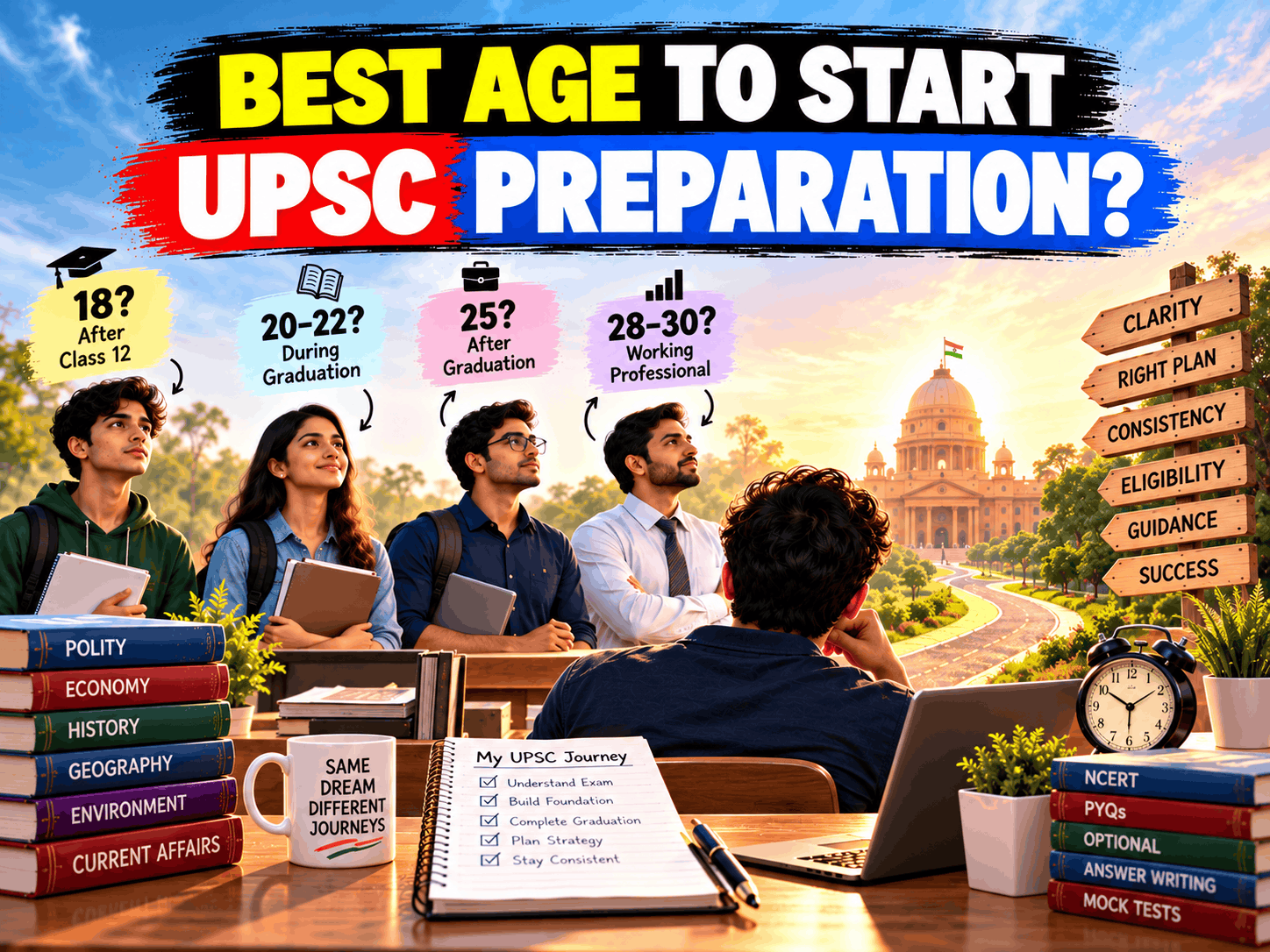
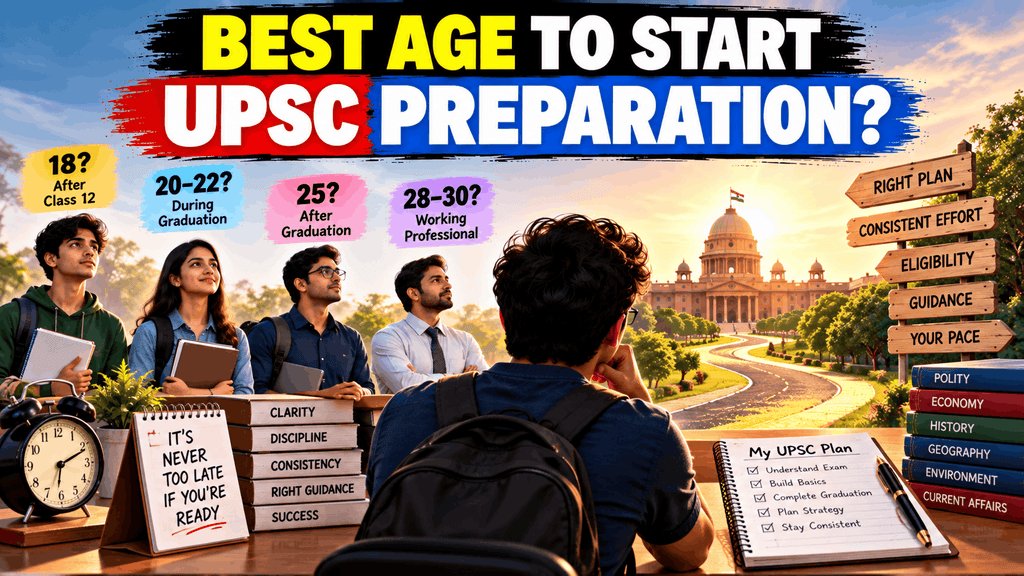
One student comes to me after completing Class 12 and says, “Sir, I want to become an IAS officer. Should I start preparing for UPSC right now?”
Another approaches me at the age of 25 and asks, “Sir, have I started too late?”
And then there are working professionals in their late twenties who have spent several years building a career but are now seriously considering the Civil Services Examination.
All three have the same concern, although their situations are quite different: What is the right age to start UPSC preparation?
Having spent over 14 years teaching and mentoring UPSC aspirants, and having appeared for the UPSC interview three times myself, I can tell you that age alone does not determine whether you are ready for this examination.
Starting early has certain advantages. Starting later can have advantages of its own. What matters is understanding where you stand, how much preparation you need and whether you can approach the examination with a realistic plan.
Let’s look at this question from a practical perspective.
What Is the Best Age to Start UPSC Preparation?
If you ask me for one ideal age, I would say that the undergraduate years are often a good time to begin understanding UPSC and building your foundation.
That does not mean you must start an intensive, full-fledged preparation programme at 18 or 19. There is a difference between becoming familiar with the examination and making UPSC the centre of your life.
During college, you have an opportunity to develop reading habits, understand the syllabus, study relevant NCERT books and gradually become familiar with current affairs. You can do these things without neglecting your graduation.
By the time you complete your degree, you may have a clearer idea of what the examination demands and whether civil services is genuinely the career you want to pursue.
However, someone who discovers UPSC at 23, 25 or even later should not assume that the opportunity has passed them by. Many people come to this examination after completing their education, working in the private sector or exploring other career options.
Your starting point will influence your preparation plan. It does not, by itself, decide your outcome.
Should You Start UPSC Preparation After Class 12?
If you have just completed Class 12 and already dream of becoming an IAS officer, I would encourage you to understand the examination. But I would not recommend rushing into an intensive coaching programme simply because you think an early start guarantees an advantage.
First, remember that you need a recognised bachelor’s degree to meet the educational eligibility requirement for the UPSC Civil Services Examination. You should verify the detailed eligibility conditions in the official notification for the examination you intend to take.
Your immediate priority should be to choose a graduation course that interests you and that you can pursue seriously.
Alongside your degree, you can begin developing a foundation for UPSC.
For example, you can:
- Develop a habit of reading a reliable newspaper.
- Become familiar with the UPSC syllabus.
- Read relevant NCERT textbooks gradually.
- Learn the basics of Indian Polity, History, Geography and Economics.
- Improve your comprehension and writing skills.
- Explore previous years’ UPSC question papers to understand the examination.
Notice that none of these activities requires you to abandon your college life.
You do not have to study for eight or ten hours a day at this stage. Nor do you need to collect every book recommended by a topper.
Give yourself time to learn, explore your interests and build a sound academic foundation. Your preparation should develop alongside your education, not at its expense.
Is 20–22 a Good Age to Start UPSC Preparation?
Yes. For many aspirants, this is a useful stage to begin more structured preparation, particularly if they are in the final years of graduation or have recently completed their degree.
By now, you may have a better understanding of your interests and career goals. You can begin studying the syllabus more systematically, select appropriate resources and work towards completing the subjects required for Prelims and Mains.
This is also a good time to understand an important feature of UPSC preparation: reading is only one part of the process.
You must eventually learn to apply what you study. That means solving multiple-choice questions, analysing previous years’ papers, writing Mains answers and revising the material you have already covered.
I would also encourage you to understand the Optional subject early rather than leaving it until the end of your preparation.
One mistake students make is spending months reading General Studies books without developing a complete preparation plan. They feel productive because they are constantly studying, but they have not considered how all the components of the examination fit together.
A little planning at the beginning can save you considerable confusion later.
Is 25 Too Late to Start UPSC Preparation?
No. Turning 25 does not automatically make you late for UPSC.
Perhaps you were preparing for another career. Perhaps you completed your graduation and began working. Or maybe you only recently discovered that civil services is something you genuinely want to pursue.
There is nothing unusual about these situations.
At 25, you may have a better understanding of your strengths, weaknesses and long-term goals than you did at 19. Work experience may have improved your communication skills, ability to handle responsibility and understanding of real-world issues.
Of course, these advantages do not replace examination preparation. You still need to study the syllabus, practise questions and develop the ability to perform under examination conditions.
The important thing is to assess your available preparation time realistically.
If you can study full-time, you may be able to follow a more concentrated schedule. If you are working, you will need to plan around your job and use weekends effectively.
Do not spend another year worrying about whether you should have started earlier. Work out what you need to do now.
There is, however, one practical matter you must check before committing yourself to the examination: your eligibility.
The UPSC prescribes age limits, attempt limits and other conditions that vary according to category and applicable rules. Check the latest official Civil Services Examination notification to confirm your eligibility rather than relying on general advice from the internet.
What If You Are 28, 29 or 30?
This is where I would ask you to be especially practical.
At this stage, you should not make your decision based on panic or comparisons with younger aspirants. You should examine your eligibility, preparation level, financial situation and the time you can realistically devote to the examination.
If you are eligible and genuinely interested in civil services, you can still plan a serious attempt. But you should be careful about spending years preparing without measuring your progress.
You may have family responsibilities, financial commitments or a full-time job. These circumstances do not automatically rule out UPSC, but they influence how you must prepare.
Begin with a clear assessment:
- How much of the syllabus have you already covered?
- Do you understand the requirements of both Prelims and Mains?
- Have you selected your Optional subject?
- Are you practising questions and writing answers?
- Can you revise the material sufficiently?
- What financial and personal commitments must you account for?
Your answers will help you decide how much preparation you need before appearing.
I generally discourage aspirants from treating an attempt as a trial run simply because the examination is approaching or their friends are appearing. An attempt should be a considered decision, made after assessing your preparation and eligibility.
You cannot control the age at which you discovered UPSC. You can control how intelligently you use the time available to you.
Does Starting UPSC Preparation Early Give You an Advantage?
Starting early can certainly help, but only if you use that time well.
An aspirant who begins understanding the syllabus during graduation may have more time to develop reading habits and become familiar with the subjects. There is less pressure to complete everything immediately.
But there is another side to starting too early.
Some students become so focused on UPSC that they neglect their graduation, social development and other important experiences. Others spend years reading without a clear strategy, repeatedly changing resources and postponing answer writing.
Simply having more years available does not guarantee better preparation.
I would rather see a student spend a year studying with a clear plan, regular revision and meaningful practice than spend three years collecting information without knowing whether it is translating into better performance.
The objective is not to start as early as possible. It is to prepare effectively once you begin.
If you are in college, use the time to build your foundation. If you have graduated, work towards a structured plan. If you have already been preparing for some time, assess your progress instead of restarting your strategy every few months.
How Many Years Should You Give Yourself for UPSC Preparation?
This is a more useful question than asking whether you are too old.
For a full-time aspirant beginning with limited prior preparation, my personal recommendation is to consider a structured preparation period of around 18 months. This is a planning guideline based on my teaching experience, not a fixed requirement for every candidate.
The time you need will depend on your existing knowledge, reading speed, Optional subject, daily availability and the quality of your preparation.
Your plan should account for General Studies, the Optional subject, answer writing, Prelims practice and repeated revision.
For a working professional, the calendar may need to be longer because the number of study hours available each week is limited.
What I would not recommend is deciding in advance that you will appear after six months simply because someone online claims that six months is enough. Nor should you assume that three years of preparation will automatically make you ready.
Track your progress against the actual requirements of the examination.
Can you explain the topics in the syllabus? Have you practised previous years’ questions? Are you able to write relevant Mains answers? Have you revised your material? Can you identify and correct mistakes in mock tests?
These questions tell you much more about your readiness than your age.
Should I Join Online or Offline UPSC Coaching? A Mentor’s honest answer
Should You Prepare for UPSC While Completing Your Degree?
If you are in college and want to prepare for UPSC alongside graduation, an integrated approach can work well.
You do not have to treat your degree and UPSC preparation as competing priorities. With sensible planning, you can build your foundation gradually while ensuring that your academic responsibilities are not neglected.
For example, you might devote some time each week to NCERTs, basic General Studies subjects and newspaper reading. During holidays, you can study more intensively, review previous years’ papers and explore the Optional subject.
As you move closer to graduation, you can decide whether to increase the intensity of your preparation.
The advantage of this approach is that you are not starting entirely from scratch after completing your degree.
However, do not underestimate the importance of your graduation. Your degree is a qualification in its own right, and completing it properly keeps other career options open.
UPSC is competitive and uncertain. A balanced approach allows you to pursue your ambition without unnecessarily narrowing your future choices.
What Should You Do If You Think You Have Started Late?
First, stop comparing your journey with that of someone who began at 18.
You may not have the same educational background, financial circumstances or responsibilities. Copying another person’s schedule without accounting for these differences is unlikely to help.
Instead, start with three decisions.
First, establish your eligibility. Check the latest official notification for the age limit, educational qualifications, number of attempts and applicable category-specific provisions.
Second, assess your preparation honestly. Identify what you already know and what remains unfinished. Do not confuse hours spent studying with subjects completed or skills developed.
Third, make a realistic plan. Set priorities for syllabus coverage, Optional preparation, answer writing, question practice and revision. Make room for your job, family responsibilities and health where applicable.
If you are unsure how to organise these elements, seek guidance from someone who understands the examination and can help you identify the gaps in your preparation.
Do not join a course merely because you feel anxious about your age. First understand what support you need and then decide whether coaching, mentorship, test series or independent study is the best fit.
The purpose of planning is to help you move forward with clarity, not to make you feel that you are running out of time every day.
My Advice to UPSC Aspirants About Age
After working with aspirants at different stages of their journeys, I would not judge someone’s potential based on whether they started at 19, 23 or 28.
I would look at how seriously they understand the examination, whether they are prepared to follow a disciplined plan and whether they are willing to correct their mistakes.
A younger aspirant may have more time but less clarity. An older aspirant may have stronger motivation but more responsibilities. Neither situation automatically makes one person better suited to civil services.
What you need is an honest assessment of your circumstances and a preparation strategy that reflects them.
At Rahul Sir’s IAS Academy in Nagpur, my approach is to encourage aspirants to understand the examination, prepare systematically and focus on improving their performance rather than getting distracted by unnecessary comparisons.
If you are young, do not rush simply because you want to get ahead of everyone else. If you are older, do not give up simply because someone else started earlier.
Check your eligibility. Understand what the examination requires. Build a realistic plan and follow it consistently.
There is no prize for starting UPSC preparation at the youngest age. Your goal is to become ready to compete effectively when you appear for the examination.
Frequently Asked Questions (FAQs)
1. What is the best age to start UPSC preparation?
The undergraduate years are often a good time to build a foundation for UPSC. Many aspirants begin more structured preparation around graduation, but there is no single ideal age for everyone. Your educational stage, preparation level, available time and eligibility matter more than a particular birthday.
2. Is 25 too late to start UPSC preparation?
No. Age 25 is not automatically too late. Check the applicable UPSC age limit and attempt rules, assess how much preparation you need and create a realistic study plan. Your starting age alone does not determine your chances of success.
3. Can I start UPSC preparation after 30?
Whether you can apply depends on the age limits and applicable category-specific rules in the relevant UPSC notification. Check your eligibility first. If you are eligible, assess your available time, preparation needs and personal commitments before deciding on an attempt.
4. Should I start UPSC preparation after Class 12?
You can begin building a foundation after Class 12, but you should also focus on completing your graduation. Develop reading habits, understand the syllabus and study basic subjects gradually instead of rushing into an intensive preparation schedule too early.
5. How many years are required to prepare for UPSC?
The time required varies by candidate. As a planning guideline, I often recommend around 18 months of structured preparation for a full-time beginner, including syllabus coverage, Optional preparation, answer writing and revision. Candidates with different backgrounds or work commitments may need a different timeline.
See also:
How to Choose Between Mentorship Programs and Regular Coaching?
Best UPSC Coaching Institutes: How to Choose?
What’s the Average Cost of UPSC Coaching in India? A Mentor’s Honest answer
Do Top UPSC Rankers Use Coaching or Self-Study?
Can I Prepare for UPSC While Working a Full-Time Job?
How Long Should I Prepare for UPSC CSE?