

One of the first questions students and parents ask me is, “Sir, how much money will we need to spend on UPSC coaching?”
It is a fair question. Preparing for the UPSC Civil Services Examination is already a demanding journey. Add coaching fees, books, test series, accommodation and daily expenses, and the total investment can become substantial.
But here is something I want every aspirant to understand before spending money: expensive coaching does not guarantee selection, and affordable coaching does not mean inferior preparation.
Let us look at the costs involved and how you can decide where your money will actually make a difference.
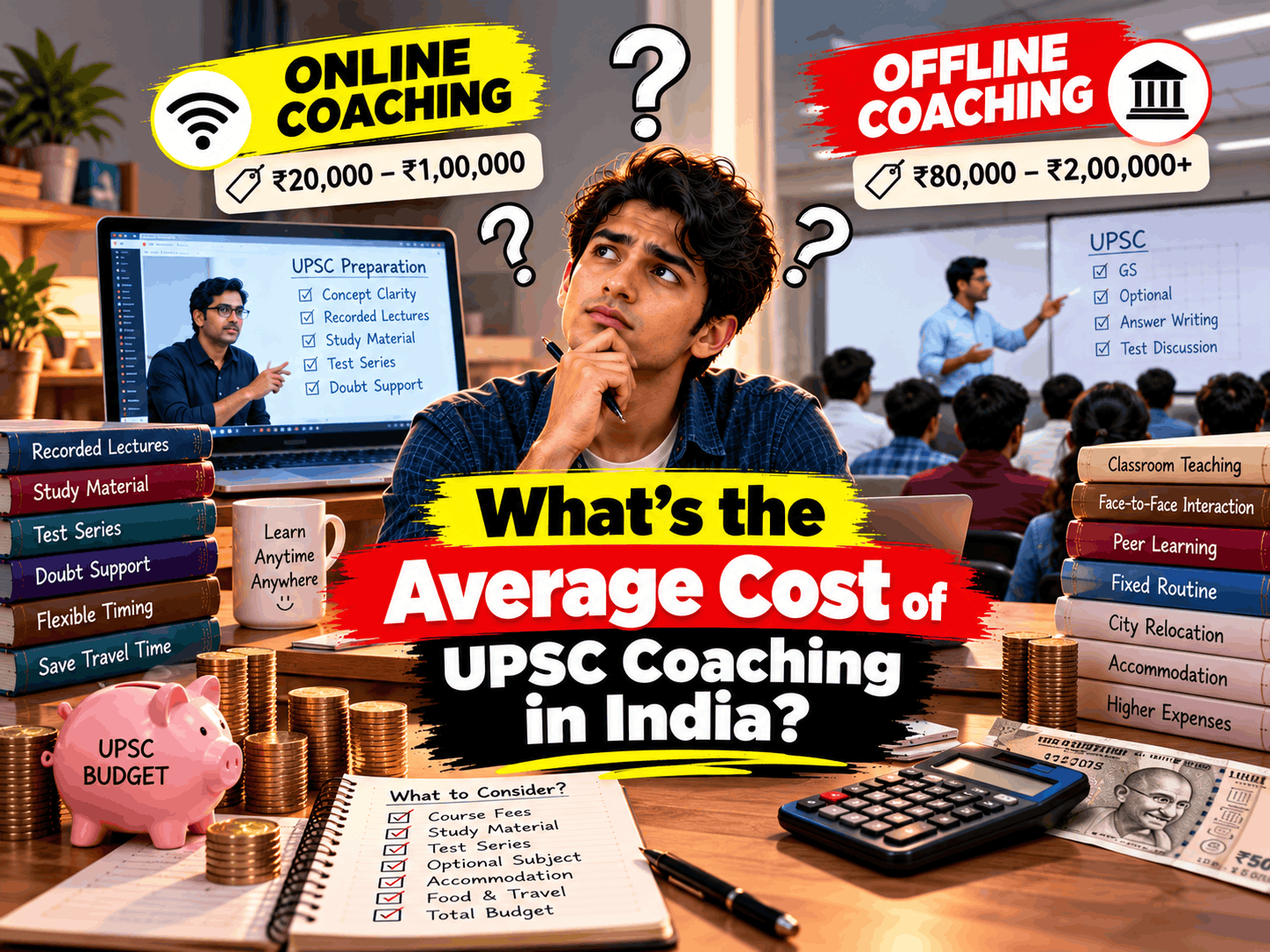
How Much Does UPSC Coaching Cost in India?
The cost depends on the institute, the course you choose, whether you study online or offline, and whether you need a complete programme or only specific subjects.
As a broad indicative estimate, UPSC coaching fees may fall within these ranges:
| Type of coaching or service | Approximate cost |
|---|---|
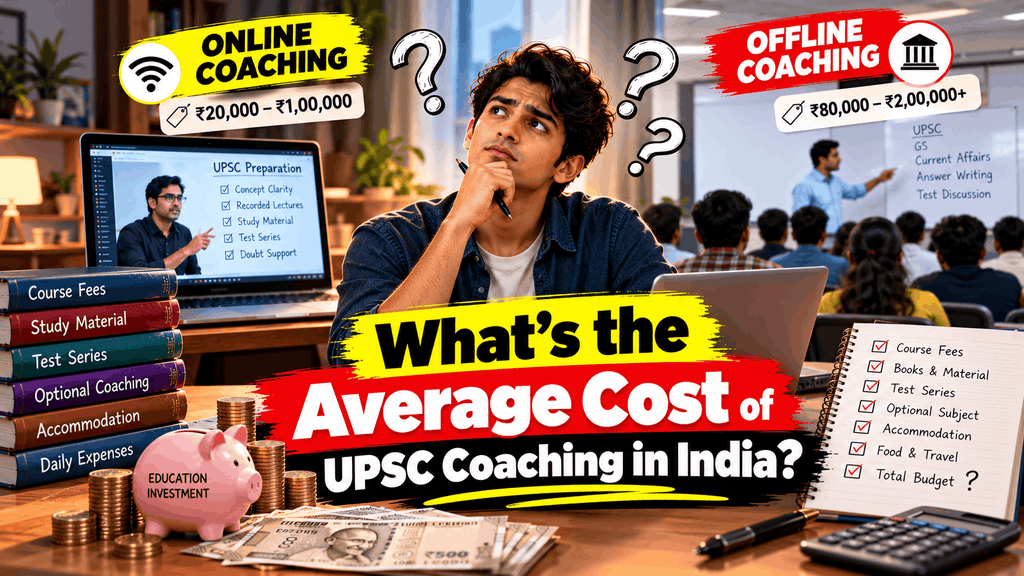
| Online foundation course | ₹20,000–₹1,00,000 |
| Offline foundation course | ₹80,000–₹2,00,000 or more |
| Prelims test series | ₹2,000–₹15,000 |
| Mains test series | ₹5,000–₹25,000 |
| Optional subject coaching | ₹15,000–₹60,000 or more |
| Personal mentorship | ₹5,000–₹50,000 or more |
These are indicative ranges, not fixed market rates. Fees vary considerably between institutes, cities and course formats. Always check the current fee structure and exactly what is included before enrolling.
You should also distinguish between the cost of a foundation course and the total cost of preparing for UPSC. A foundation programme may not include Optional subject classes, answer-writing evaluation, test series or personal mentorship. Those may require separate payments.
Why Does UPSC Coaching Cost So Much?
When you compare two institutes, you may find a significant difference in their fees. Before assuming that the more expensive one must be better, find out what you are actually paying for.
A course fee may cover classroom teaching, recorded lectures, printed study material, mock tests, answer evaluation, doubt-solving sessions and individual guidance. However, not every institute provides all these services.
Some programmes offer extensive personal interaction, while others primarily provide lectures and study material. Both may advertise themselves as complete UPSC courses, even though the experience can be very different.
Here is the question I would ask before paying: Will this programme help me prepare better, identify my mistakes and use my time more effectively?
A long list of features looks impressive in a brochure. What matters is whether those features are useful in practice.
Is Offline UPSC Coaching More Expensive Than Online Coaching?
Generally, offline coaching can involve higher overall expenses, particularly if you have to relocate to another city. But the comparison should not stop at the tuition fee.
Imagine two students. One joins an online course while living at home. The other moves to Delhi for classroom coaching.
The first student may pay for the course, books and test series. The second may have to pay for the same academic resources, along with accommodation, food, local transport and other living expenses.
Over several months, the difference can become significant.
That does not mean offline coaching is a bad investment. Some students benefit from a fixed routine, classroom discussions and regular interaction with teachers. Others study more effectively online because they can revisit lectures and avoid commuting.
Choose the format that helps you learn consistently. Do not relocate simply because you believe every serious UPSC aspirant must study in Delhi.
What Other Expenses Should You Budget For?
Coaching fees are only one part of the preparation budget. Before starting, account for the following expenses:
1. Books and study material: You may need NCERT textbooks, standard reference books, newspapers or current affairs resources. Avoid buying every book recommended in different topper interviews.
2. Test series: Prelims practice and Mains answer-writing tests can be valuable, but select them according to your preparation stage and actual requirements.
3. Optional subject: If Optional coaching is not included in your foundation programme, this can be a significant additional expense.
4. Accommodation and food: Aspirants who move away from home should calculate rent, meals, electricity, transport and other monthly expenses.
5. Travel and miscellaneous costs: These may include commuting to classes, printing notes, stationery and travelling home during breaks.
My suggestion is simple: prepare a budget for the entire preparation period rather than looking only at the advertised course fee.
Is Expensive UPSC Coaching Worth the Money?
It can be, provided the programme solves problems that you genuinely have.
Suppose you struggle to understand the syllabus, cannot decide which resources to follow, have difficulty structuring Mains answers or repeatedly change your strategy. A good coaching programme or mentor may help you address these issues.
Now consider a different student who already understands the syllabus, studies consistently, analyses previous-year questions and writes answers regularly. That student may not need an expensive, full-length foundation course. A focused test series or targeted mentorship might be sufficient.
This is why I would never recommend that every aspirant spend the same amount on coaching.
First identify what is missing from your preparation. Then spend money to address that gap.
Do not pay for an elaborate programme simply because it promises hundreds of lectures. Completing lectures and becoming examination-ready are two different things.
Can You Prepare for UPSC on a Limited Budget?
Absolutely. You do not have to spend lakhs on coaching to become a serious UPSC aspirant.
Start by understanding the syllabus and analysing previous-year question papers. Build your preparation around a limited set of reliable books and resources. Follow current affairs consistently, practise MCQs, begin answer writing early and revise repeatedly.
If you need help, consider targeted support instead of automatically enrolling in a complete course. You may need guidance on Optional selection, feedback on Mains answers or a structured test series rather than coaching in every subject.
However, be careful about confusing saving money with preparing without guidance. A student can spend very little on resources and still lose valuable time by following an unsuitable strategy for months.
The objective is not to spend the least possible amount. It is to make the money and time you invest count.
How Should You Choose a UPSC Coaching Institute?
Before making a payment, speak to the institute and get clear answers to these questions:
- Does the fee include both Prelims and Mains preparation?
- Is Optional subject coaching included?
- How many Mains answers will be evaluated, and who will evaluate them?
- Is personal mentorship available, or is guidance limited to classroom lectures?
- Can you access recorded classes if you miss a session?
- Are test series and study materials included in the advertised price?
- What additional payments might you need to make later?
Also, attend a demo class if possible. Speak to current or former students and assess the quality of teaching rather than relying entirely on promotional claims.
Most importantly, remember that no coaching institute can guarantee your UPSC selection. The institute can provide teaching, structure, resources and feedback, but you must put that support to effective use.
My Advice to UPSC Aspirants
Over the years, I have come to believe that aspirants sometimes focus too much on the amount they spend and too little on how effectively they prepare.
One student may spend a large sum on coaching but fail to revise, practise questions or analyse mistakes. Another may use limited resources intelligently, seek the right guidance and prepare with a clear plan.
The fee alone tells you very little about the eventual outcome.
Before enrolling, ask yourself three questions: What do I already know? Where am I struggling? What kind of support will help me move forward?
Your answers should determine your investment.
At Rahul Sir’s IAS Academy, our approach is to focus on the preparation process, not merely on completing a syllabus. A serious aspirant needs clarity about the examination, the right resources, regular practice, revision and timely guidance.
Do not choose coaching because it is expensive, famous or popular among your friends. Choose it because it addresses your needs and helps you prepare more effectively.
Your goal is not to buy the costliest course. Your goal is to become ready for the examination.
See Also:
The Hydrospere: Everything you want to know
Should I Join Online or Offline UPSC Coaching
FAQs:
1.What are the fees for IAS coaching in India?
IAS coaching fees in India depend on the institute, course format and services included. As a broad estimate, online foundation courses may cost ₹20,000–₹1,00,000, while offline classroom programmes may cost ₹80,000–₹2,00,000 or more.
Specialised courses, such as Optional subject coaching, Prelims and Mains test series, or personal mentorship, may cost extra if they are not included in the main programme.
Before enrolling, check whether the fee covers study material, answer-writing evaluation, mock tests, doubt-solving and individual guidance. My advice is to choose coaching based on the quality of guidance you receive, not simply the amount you pay. Expensive coaching does not guarantee selection, and you may not need a full foundation course if you only require help with specific areas of your preparation.
2.Can I clear IAS in 1 year?
Yes, you can clear the UPSC Civil Services Examination in one year, but it depends on your starting point, available study time and preparation strategy.
If you already have a good foundation and can study consistently, one year can be enough for a serious attempt. If you are starting from scratch while working full-time, you may need more time.
The key is to understand the syllabus, analyse previous-year questions, use limited resources, start answer writing early, complete your Optional subject on time and revise the syllabus multiple times.
My advice is not to spend the entire year collecting study material or endlessly changing your strategy. Focus on becoming examination-ready through structured study, revision, Prelims practice and Mains answer writing.
Instead of asking whether one year is enough, ask yourself: Can I make myself ready for the examination in the time I have? That is the question that should guide your preparation.