


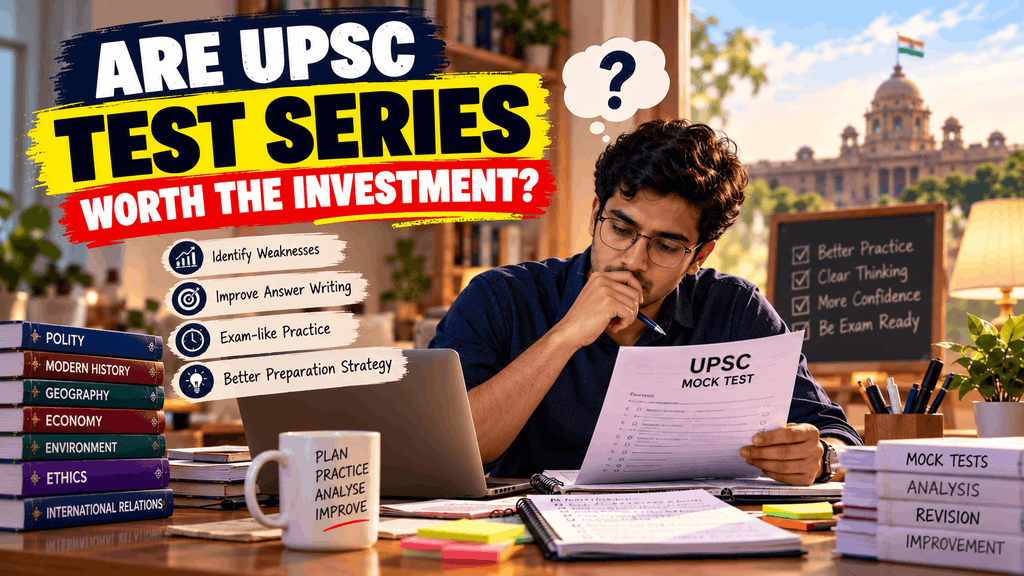
If you have started preparing for the UPSC Civil Services Examination, you have probably come across several test series. Almost every coaching institute offers one. Some promise better performance in Prelims, others focus on Mains answer writing, and many offer a combination of both.
But there is a question worth asking before spending your money: Will a UPSC test series actually improve your chances of clearing the examination?
My answer is yes, provided you use it properly. But enrolling in a test series, appearing for a few tests and checking your marks is not enough. The real benefit comes from understanding your mistakes and working on them.
Let me explain when a test series is worth the money, when it may not be, and how you can get the most out of it.
Why do UPSC aspirants need a test series?
UPSC preparation involves much more than reading books and remembering facts. You need to apply what you have studied under examination conditions, often with limited time and considerable pressure.
This is where tests become useful.
Consider an aspirant who has completed Indian Polity and revised it twice. The subject feels familiar, and the aspirant is confident about the preparation. But when faced with a set of unfamiliar MCQs, the score is disappointing.
What went wrong?
Perhaps the aspirant confused two constitutional provisions. Maybe the options were designed to test a small but important distinction. Or the aspirant knew the facts but made mistakes while eliminating options.
Reading the same chapter again may not solve all these problems. The aspirant needs to identify the specific weakness and work on it.
A well-designed test can reveal that gap.
The same applies to Mains. You may understand a topic well but struggle to explain it within the word limit. You may spend too much time on the introduction, miss important dimensions of the question or fail to complete the paper.
These are problems that regular answer-writing practice can help you identify and address.
Read also: Should I Join Online or Offline UPSC Coaching?
Are UPSC Prelims test series worth it?
For most serious aspirants, a good Prelims test series can be a useful investment, especially as the examination approaches.
The UPSC Prelims is not simply a test of how much you remember. It also tests your ability to interpret questions, eliminate options, manage uncertainty and make decisions under time pressure.
A test series can help you develop these skills.
1. It exposes gaps in your preparation
You may feel comfortable with Modern History after reading your notes, but a test can reveal that you are repeatedly confusing events, dates or the contributions of different personalities.
Similarly, a Polity test may expose confusion between constitutional bodies, statutory bodies and executive bodies.
Such mistakes are valuable because they tell you exactly what needs attention.
Instead of revising an entire subject without a clear purpose, you can focus on the areas where you are losing marks.
2. It improves your question-solving approach
UPSC questions sometimes contain statements that appear correct at first glance but become doubtful when you examine the wording carefully.
Regular practice helps you slow down when necessary, identify absolute statements, compare options and avoid making assumptions that the question does not support.
Over time, you may also learn which types of questions you handle well and where your judgment needs improvement.
Remember, though, that solving more MCQs does not automatically make you better at solving them. You need to examine the reasoning behind your answers, including the ones you got right by guessing.
3. It helps you manage time and negative marking
A candidate who spends too long on a difficult question may lose the opportunity to attempt several easier ones later.
Mock tests give you an opportunity to experiment with question selection, pacing and the order in which you attempt questions.
They also help you understand the consequences of guessing incorrectly under the Prelims marking scheme.
Your aim should be to develop a consistent approach rather than blindly increase the number of questions attempted.
4. It gives you a realistic picture of your readiness
Test scores can help you track whether your preparation is improving, stagnating or becoming inconsistent.
However, one mock test cannot tell you whether you will clear Prelims. The difficulty of the paper, the relevance of its questions to the actual examination and the quality of the answer key all influence your score.
Look at your performance across several tests. More importantly, examine why you are getting questions wrong.
A rising score is encouraging, but a better understanding of your mistakes is often more useful than a single impressive result.
Read also: How to Stay Motivated While Preparing for UPSC Exam?
Are UPSC Mains test series worth the money?
Mains test series can be particularly useful for aspirants who have studied the syllabus but need to improve the way they present their knowledge.
In Mains, knowing the subject is only part of the job. You must understand the demand of the question, organize your thoughts, select relevant examples and complete the answer within the available time.
Here are some areas where a good test series can help.
Answer writing under time pressure
Many aspirants write thoughtful answers when they have unlimited time. The difficulty begins when they have to answer several questions within a fixed examination duration.
Timed practice helps you develop a realistic sense of how much you can write, how long you can spend on each question and when you need to move on.
Understanding the demand of the question
Consider a question that asks you to critically examine a policy. An answer that merely describes the policy will not fully address the question.
Likewise, a question asking you to discuss an issue may require a broader treatment than one asking you to justify a particular position.
A test series can help you practise interpreting these directive words and structuring your responses accordingly.
Identifying weaknesses in your answers
Perhaps your answers lack examples. Maybe you write long introductions but leave little space for the main analysis. You may overlook social or economic dimensions of a question, or struggle to provide a balanced conclusion.
Good feedback can bring these habits to your attention.
But the quality of evaluation matters. A generic remark such as “improve your answer” does little to help. Useful feedback should explain what is missing, what needs to change and how you can approach a similar question next time.
For Mains, the value of a test series depends heavily on the quality of its evaluation and what you do with the feedback.
Read also: Is Studying 6 Hours a Day Enough for UPSC Preparation?
How much should you spend on a UPSC test series?
There is no single price that suits every aspirant. Fees vary according to the institute, the number of tests, the subjects covered, the evaluation provided and whether the programme includes mentoring or additional resources.
Before comparing prices, decide what you actually need.
If your immediate priority is Prelims, a focused programme with good-quality MCQs, reliable explanations and sufficient practice may be more useful than an expensive package covering everything.
If you are preparing for Mains, check whether the programme includes individual evaluation, meaningful comments on your answers and opportunities to understand recurring mistakes.
Also compare the number of tests with the time you have available. A package containing dozens of tests may look attractive, but it offers little value if you cannot review your performance properly.
Do not buy a test series simply because an institute is popular or because other aspirants have enrolled.
Your money should go towards solving a specific preparation problem.
Read also: What’s the Average Cost of UPSC Coaching in India?
Should you join a test series from a famous coaching institute?
Not necessarily.
A well-known name may offer a useful programme, but the brand alone does not establish the quality of its tests or evaluation.
Before enrolling, examine a sample test and its answer key. For Mains, look at a sample evaluated answer sheet if one is available. Find out how feedback is delivered, whether explanations are detailed and whether you can access the material for long enough to review your mistakes.
You should also check whether the test questions are relevant to the syllabus and the nature of the UPSC examination.
Be careful about treating the difficulty of a mock test as proof of its quality. An unnecessarily difficult paper is not automatically a better paper. Nor is a high score in an easy test a reliable measure of readiness.
The purpose is to prepare for UPSC, not to prove that you can solve unusually tricky questions designed by a coaching institute.
Read also: Best UPSC Coaching Institutes: How to Choose?
When is the right time to join a UPSC test series?
The answer depends on what you have studied and which stage of the examination you are preparing for.
For Prelims, you can begin topic-wise tests as you complete individual subjects. These tests help you check your understanding before moving on.
Full-length mock tests become more useful when you have covered a substantial part of the syllabus and are ready to practise under examination-like conditions. As the examination approaches, use them to refine your strategy and identify remaining weaknesses.
For Mains, answer writing should begin before you feel completely prepared. Waiting until you have mastered every topic can delay the development of an essential skill.
Start with individual answers and gradually move towards sectional and full-length tests as your preparation progresses.
There is no need to rush into every available test. Choose a schedule that allows enough time for revision and correction.
Read also: Best Age to Start UPSC Preparation?
Five mistakes that reduce the value of a test series
Even a good test series can become a waste of money if you approach it incorrectly.
1. Taking tests without analysing the results
Checking your score and immediately moving to the next test misses much of the benefit. Review wrong answers, lucky guesses and questions you answered correctly for the wrong reasons.
2. Collecting test series from multiple institutes
More questions are not always better. If you already have a reliable source of practice, adding several more may create an unnecessary backlog and reduce the time available for revision.
3. Obsessing over marks and ranks
Your score matters, but it should not become the only measure of progress. Mock-test difficulty varies, and the performance of a particular group of test-takers may not represent the entire UPSC candidate pool.
4. Ignoring the syllabus and previous years’ questions
A test series should support your understanding of the examination. It should not replace the official syllabus or the study of previous years’ UPSC questions.
Use PYQs to understand how UPSC frames questions and what it expects candidates to know. Use mock tests to practise and strengthen your preparation.
5. Repeating the same mistakes
Suppose you repeatedly confuse similar constitutional provisions. If you notice the mistake but never revise the relevant concepts, the next test may expose the same weakness.
Keep a record of recurring errors. Revisit it regularly and check whether your performance improves.
Read also: How to Choose Between Mentorship Programs and Regular Coaching?
How to get the maximum value from a UPSC test series
You do not need a complicated tracking system. A simple process can make your practice more effective.
After every test, divide your mistakes into a few categories:
- Knowledge gaps: You did not know or remember the relevant concept.
- Conceptual confusion: You understood the topic incorrectly or confused it with a related concept.
- Question interpretation: You missed a key word or misunderstood what the question was asking.
- Poor decision-making: You made an avoidable guess or spent too long on a question.
- Execution problems: You struggled with timing, answer structure or completion.
These categories are a practical starting point, not a rigid classification. Some mistakes will fit more than one category.
For each important error, note what caused it and what you will do differently. Revise the relevant topic, practise similar questions or change your answer-writing approach as needed.
Before taking the next test, revisit your previous mistakes. This closes the loop between practice and improvement.
For Mains, keep a few evaluated answers as reference points. Compare your later answers against them to see whether your structure, relevance, examples and time management are improving.
The objective is to make each test contribute to better preparation.
Read also: What Subjects Should I Focus on for UPSC CSE?
Can you clear UPSC without joining a test series?
Yes. A paid test series is not a compulsory requirement for clearing the UPSC Civil Services Examination.
You can practise using previous years’ questions, solve MCQs from reliable sources, write answers independently and arrange for suitable feedback where possible.
However, there is a difference between having access to questions and receiving useful evaluation. Mains aspirants, in particular, should think carefully about how they will identify weaknesses in their answers if they do not join a formal programme.
Self-study requires discipline and an honest assessment of your performance. If you can create a consistent practice schedule, analyse your mistakes and obtain meaningful feedback, you may not need an expensive test series.
If you struggle to maintain that routine or cannot assess your own answers objectively, a structured programme may be worth considering.
The decision should be based on your needs, not on the belief that every serious aspirant must buy a particular product.
So, are UPSC test series worth the investment?
In my view, a good test series is worth considering because it gives you structured practice and helps expose weaknesses that may remain hidden during routine study.
But the purchase itself does not improve your preparation. The improvement comes from what you do after taking each test.
If you are still building your understanding of the syllabus, prioritize learning the subjects and revising them. If you have covered the material but struggle to apply it, a Prelims test series may help. If you know the content but cannot express it effectively within the Mains examination, look for a programme that provides useful answer evaluation.
Before paying, ask yourself three questions:
- What specific problem am I trying to solve?
- Does this programme address that problem?
- Will I have enough time to analyse the tests and work on my weaknesses?
If you can answer these questions clearly, you are in a much better position to decide.
At the end of the day, your preparation should be judged by what you learn, retain and can reproduce in the examination. Choose your resources accordingly, and make sure every test has a purpose.
See also:
How Long Should I Prepare for UPSC CSE?
Can I Prepare for UPSC While Working a Full-Time Job?
Do Top UPSC Rankers Use Coaching or Self-Study?
Should I Move to Delhi for UPSC Coaching?
FAQs:
1. What is the 7/5/3 rule in UPSC?
The 7/5/3 rule in UPSC is an informal answer-writing framework used by some aspirants to structure their Mains answers. It is not an officially prescribed UPSC rule, and its meaning can vary depending on who uses it.For your blog FAQ, it is worth clarifying which version you mean rather than presenting one interpretation as an official standard.A commonly used version of the rule is: 7 minutes, 5 key points and 3 dimensions. Aim to answer a 150-word Mains question in about 7 minutes, include around 5 relevant points, and develop a multidimensional analysis where the question requires it.For example, when discussing a government scheme, you might examine its political, economic and social implications.
Treat the 7/5/3 rule as a practice guideline, not a rigid formula. The structure and depth of your answer should depend on the question, its directive word and the marks allotted.
2. Is 28 too late for UPSC?
No, 28 is not too late to start preparing for the UPSC Civil Services Examination. What matters is whether you meet the age and attempt requirements for your category and how well you plan your preparation.For the general category, the usual upper age limit is 32 years, with age calculated as specified in the official UPSC notification. Eligible candidates from reserved categories may receive age relaxation. Always check the notification for the examination year in which you plan to appear.At 28, however, you should approach preparation with a clear timeline. Avoid spending years reading without a plan or appearing for the examination before you are adequately prepared. Build a realistic schedule that covers the syllabus, optional subject, answer writing and multiple revisions.
Your age does not determine your chances of success. Your preparation strategy, consistency and ability to learn from mistakes matter far more.