If you look at the preparation journeys of UPSC toppers, you will notice something interesting. Not everyone follows the same path.
Some join coaching institutes. Some prepare largely on their own. Some use classroom coaching for General Studies but study their Optional subject independently. Others begin with self-study and seek guidance when they realise they are struggling to make progress.
Yet, every year, aspirants ask me the same question:
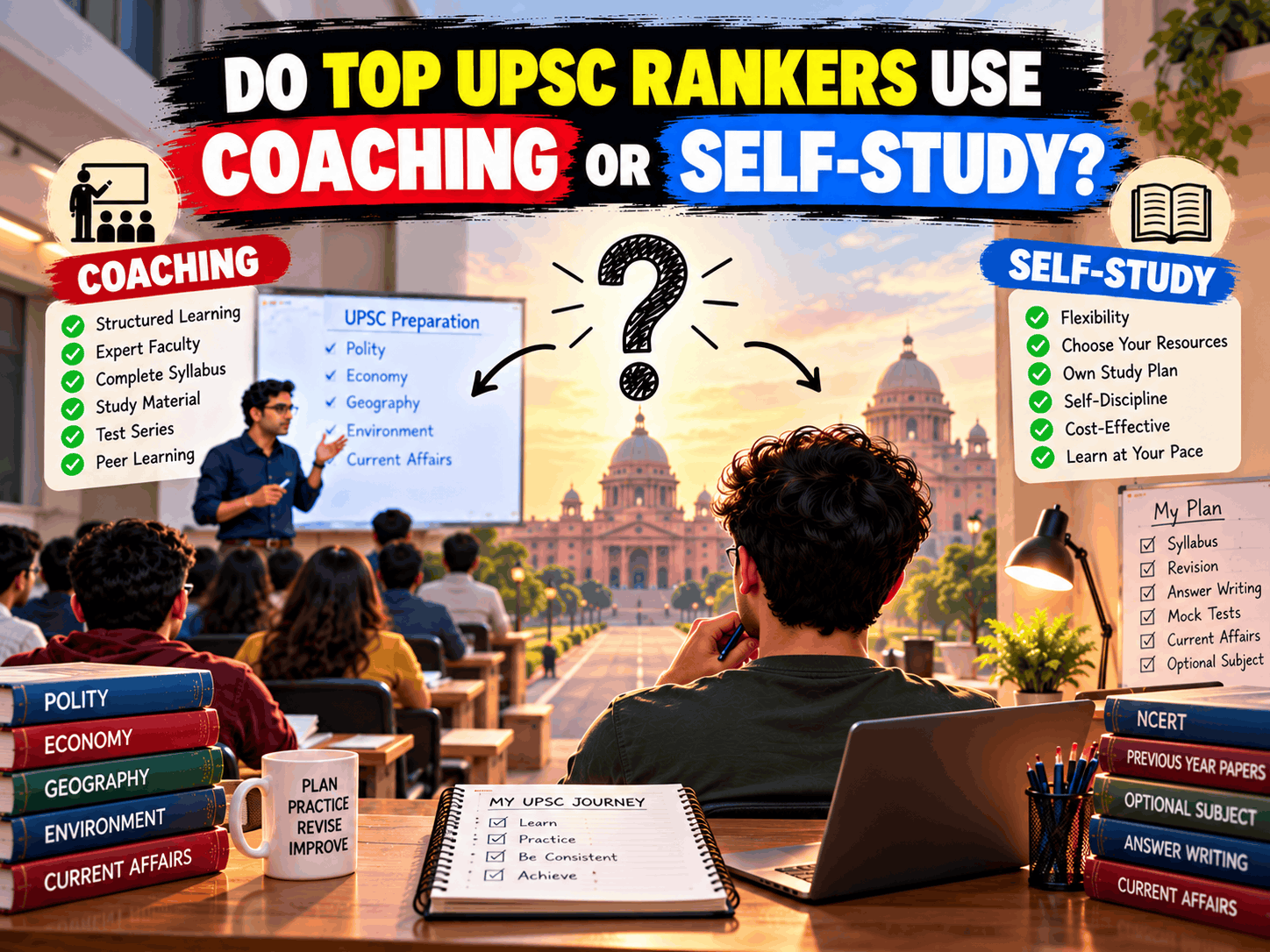
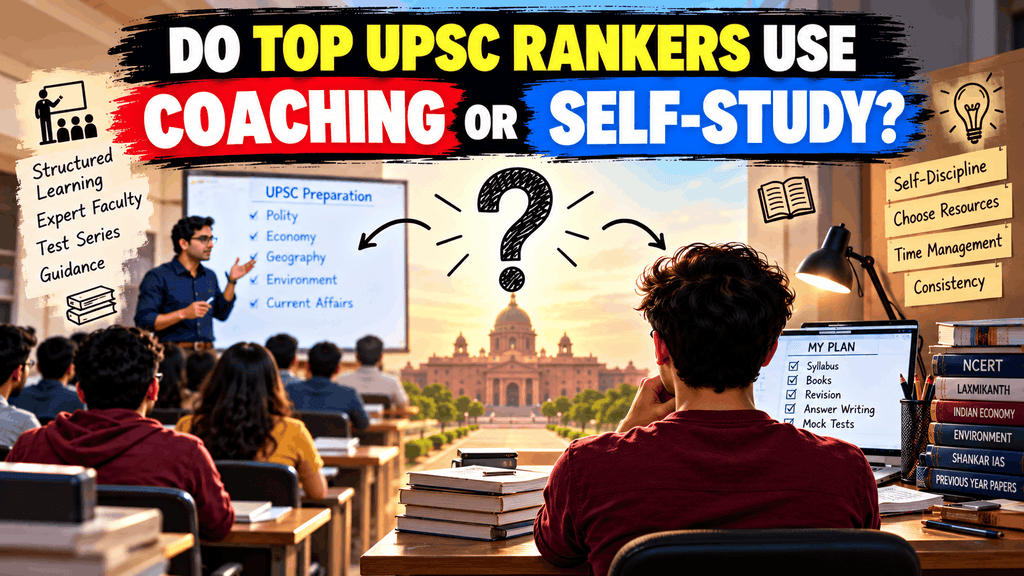
Do UPSC toppers clear the examination through coaching or self-study?
I understand why this question comes up so often. UPSC preparation demands a considerable investment of time, money and energy. Before making that commitment, you naturally want to know which approach gives you a better chance of success.
Having spent over 14 years teaching and mentoring UPSC aspirants, and having appeared for the UPSC interview three times myself, I would suggest looking at this question a little differently.
Instead of asking whether toppers join coaching, ask yourself what helped them prepare effectively and perform well in the examination.
Let’s understand this in detail.
Do UPSC Toppers Join Coaching Institutes?
Yes, many UPSC rankers have taken coaching at some stage of their preparation. Others have relied primarily on self-study. There are also candidates who have combined both approaches.
However, there is an important distinction here.
Knowing that a topper joined a particular coaching institute does not tell you whether that institute was responsible for the person’s success. Similarly, learning that someone cleared UPSC without formal coaching does not mean that everyone can follow the same strategy with equally good results.
Every candidate starts from a different position.
One aspirant may have a strong academic background, good reading habits and the ability to understand difficult concepts independently. Another may need classroom explanations to build a foundation. Someone else may understand the syllabus perfectly well but struggle with answer writing, revision or time management.
Naturally, their preparation strategies will differ.
This is why I would be careful about drawing conclusions from a topper’s journey alone. Their experience can offer useful lessons, but it should not automatically become your preparation plan.
Can You Clear UPSC Through Self-Study?
Absolutely. Formal coaching is not a compulsory requirement for clearing the Civil Services Examination.
I have known candidates who cleared UPSC through self-study, including candidates who secured very high ranks. One example that has stayed with me is that of a close friend who came from a rural background and completed his education in Marathi medium.
He also appeared for UPSC in Marathi medium. He cleared the examination on his first attempt, securing an allied service, and then achieved AIR 70 in his second attempt. He went on to serve in the IAS in the Jammu and Kashmir cadre for more than two decades.
His journey is a reminder that your educational background, medium of instruction or decision not to join an expensive coaching institute does not automatically determine your outcome.
But there is another side to this.
When you hear about someone clearing UPSC without coaching, you may see only the final result. You may not know how the candidate selected books, analysed previous years’ question papers, chose an Optional subject, corrected mistakes or decided when to move from reading to answer writing.
Some candidates figure these things out independently. Others benefit from guidance from teachers, seniors, friends or experienced mentors.
Self-study means studying independently. It does not have to mean figuring out everything independently.
That distinction is worth remembering.
If Self-Study Works, Why Do Aspirants Join Coaching?
The answer is not that coaching automatically makes someone a better candidate. A good coaching programme can, however, solve specific problems that many aspirants encounter.
Consider a beginner who has just decided to prepare for UPSC. The syllabus is extensive, the recommended booklists are long, and every online discussion seems to suggest another resource.
The aspirant starts with one book, discovers another recommendation, watches a few topper interviews and changes the timetable. A few months later, the person has read a considerable amount but is still unsure whether the preparation is moving in the right direction.
I have seen aspirants spend a long time in this cycle.
A structured course can help by providing a sequence for covering the syllabus, explaining difficult subjects and establishing a study routine. Depending on the programme, it may also provide tests, answer evaluation and opportunities to clarify doubts.
The value lies in how well these services address the student’s needs.
Simply attending lectures is not enough. You still have to revise, practise questions, write answers and identify your weaknesses. If you attend classes throughout the day but never make time for these activities, coaching can become another form of information consumption.
That is not what UPSC preparation should be about.
The Biggest Difference Is Often Guidance, Not Coaching
Let me explain something I have observed over the years.
Many aspirants begin preparing for UPSC and appearing for the examination almost simultaneously. They study for a few months, see that the examination is approaching and decide to give it a try. Sometimes they do this because their friends are appearing, or because they feel that taking an attempt will help them understand the examination.
I generally advise against treating an attempt as an experiment when you have not completed your preparation.
The problem is that UPSC is not simply a test of how much you have read. You need to understand the syllabus, select appropriate resources, practise the relevant question formats and revise what you have studied.
Without a clear plan, you can spend months working hard on activities that do not address your actual weaknesses.
For example, an aspirant may keep reading General Studies books while postponing the Optional subject. Another may spend too much time making elaborate notes but hardly practise answer writing. Someone else may complete the syllabus once and move straight to mock tests without revising properly.
All three may be hardworking candidates. Their difficulty is that their effort is not being directed towards the right priorities.
This is where guidance can make a difference.
A knowledgeable teacher or mentor can help you recognise these gaps before they consume too much of your preparation time. That guidance might come from a coaching institute, a personal mentor, a senior who understands the examination or another reliable source.
You do not necessarily have to pay for it. But you should not assume that you can do without it simply because a topper did.
Coaching vs Self-Study: Which Approach Should You Choose?
There is no single answer for every aspirant. Start by looking honestly at your own situation.
| Factor | Coaching may help if… | Self-study may suit you if… |
|---|---|---|
| Understanding concepts | You need explanations and structured teaching | You can understand subjects independently |
| Study routine | You struggle to organise your preparation | You can follow a realistic timetable consistently |
| Resource selection | You are confused about books and study material | You can identify and limit reliable resources |
| Answer writing | You need regular evaluation and feedback | You can obtain meaningful feedback through other channels |
| Revision | You need a structured revision plan | You can plan and monitor revision independently |
| Accountability | External deadlines help you stay on track | You are disciplined without a fixed classroom schedule |
| Budget | The programme offers services you genuinely need and can afford | You prefer to save on formal coaching and arrange support selectively |
Notice that neither column guarantees success.
A student can join a reputed institute and still struggle to complete the syllabus. Another can prepare independently, follow a disciplined routine and perform exceptionally well.
Your decision should depend on what you need, rather than what someone else did.
What Should You Learn From UPSC Toppers?
When you read a topper’s interview, it is tempting to focus on the visible details: the books they used, the number of hours they studied, the coaching institute they joined or the timetable they followed.
These details can be useful, but copying them without understanding the context can be misleading.
Suppose a topper says that they studied for six hours a day. That does not establish that six hours will be sufficient for you. The candidate may have had a strong foundation, may have been revising familiar material or may have used those hours with exceptional concentration.
Similarly, if a topper recommends a particular book, it does not mean that you should collect every book mentioned in every interview.
Instead, look for the principles behind their preparation.
1. They understand the examination. Study the UPSC syllabus and previous years’ question papers. These help you understand what the examination asks and how different subjects are tested.
2. They work with a manageable set of resources. Constantly changing books and study material makes it difficult to revise. Choose resources carefully and use them properly.
3. They revise. Reading something once is not the same as being able to recall and apply it in an examination.
4. They practise. Prelims requires question-solving practice. Mains requires answer writing, structure, relevance and time management.
5. They identify mistakes. A mock test is useful only when you analyse why you lost marks and make changes accordingly.
6. They adapt their preparation. A strategy that works for one person may need modification for another. Your preparation should respond to your own performance.
These principles are more useful than simply copying the timetable of a successful candidate.
Does Joining Coaching Increase Your Chances of Selection?
It would be misleading to give you a percentage without reliable, comparable data.
To make a fair comparison, we would need to know how many candidates prepared through coaching, how many relied on self-study, what each group meant by those terms and how their preparation levels differed. A few success stories cannot establish the success rate of either approach.
Coaching can help when it addresses a genuine gap in your preparation. For example, you may need a teacher to explain difficult concepts, a structured programme to organise the syllabus, or an experienced evaluator to identify weaknesses in your Mains answers.
But if you join a coaching institute expecting the classes themselves to secure your selection, you may be disappointed.
The responsibility for preparation remains yours.
You have to attend to your studies, revise consistently, practise questions, analyse performance and make corrections. A coaching institute can provide support, but it cannot do this work on your behalf.
Before paying for any programme, ask yourself a practical question: What specific problem will this course solve for me?
If you can answer that clearly, you are in a better position to judge whether the investment is worthwhile.
How to Prepare for UPSC if You Choose Self-Study
If you decide not to join formal coaching, do not begin by collecting hundreds of resources or trying to copy a topper’s entire routine. Start with the fundamentals.
Step 1: Understand the syllabus
Read the Prelims and Mains syllabi carefully. Keep them accessible while studying. You should be able to connect the topics you read with the requirements of the examination.
Step 2: Analyse previous years’ question papers
Go through the question papers before building an elaborate timetable. They will help you understand the nature of the questions and the depth of preparation required.
Step 3: Select your resources carefully
Choose a limited set of books and reliable study material for each subject. Avoid changing sources every time someone recommends something new.
Step 4: Plan your Optional subject early
Do not postpone the Optional subject indefinitely while trying to finish every General Studies topic first. Understand its syllabus, available resources and your own interest, then develop a workable plan.
Step 5: Begin answer writing and question practice
Do not wait until you feel completely prepared. Start practising at an appropriate stage and improve through feedback. For Prelims, practise MCQs and analyse your errors. For Mains, work on relevance, structure, examples and time management.
Step 6: Make revision part of the timetable
Your plan should include time to revisit what you have studied. A timetable that leaves no room for revision is unlikely to remain effective for long.
Step 7: Find a way to evaluate your preparation
This is particularly important for self-study candidates. You need some method of checking whether you are improving. Depending on your needs, that could include test series, answer evaluation, discussions with experienced mentors or regular analysis of your own performance.
Self-study requires independence, but it should not mean ignoring feedback.
When Should You Consider Joining Coaching or Mentorship?
You do not have to make this decision based on fear that everyone else is attending classes.
Begin by identifying where you are struggling.
If you are a beginner and cannot understand the syllabus, select resources or organise subjects, a structured coaching programme may be useful.
If you have already covered much of the syllabus but are unable to improve your mock scores, you may need test analysis, answer evaluation or more focused guidance rather than another complete course.
If you understand the subjects but repeatedly postpone revision, a system of accountability and progress reviews may help.
And if your preparation is moving well through self-study, there is no need to join coaching merely because someone tells you that every serious aspirant must do so.
Choose support according to the problem you need to solve.
At Rahul Sir’s IAS Academy in Nagpur, this is the approach I encourage aspirants to take: understand where your preparation stands, identify the gaps and then decide what kind of support would genuinely help you move forward.
The purpose of guidance is not to make you dependent on a teacher. It is to help you develop the understanding and discipline needed to manage your preparation effectively.
Final Thoughts: Don’t Copy a Topper’s Journey Blindly
So, do top UPSC rankers use coaching or self-study?
Both approaches have produced successful candidates. There is no sound basis for claiming that coaching is compulsory or that self-study is automatically superior.
A topper’s journey can inspire you, but your preparation must be built around your own circumstances, strengths and weaknesses.
If you can study independently, choose resources sensibly, revise regularly and evaluate your performance, self-study may work well for you. If you need structured teaching, feedback or help with planning, coaching or mentorship may be a sensible investment.
Remember one thing: Coaching is optional. Guidance is not.
Guidance does not necessarily mean enrolling in an expensive programme. It means having a reliable way to understand the examination, make sound preparation decisions and recognise when something is not working.
Do not spend years collecting information without checking whether it is helping you perform better. Learn to connect your effort with marks.
That is a far more useful lesson to take from UPSC toppers than the name of the institute they attended.
If you are beginning your UPSC journey or feel that your current preparation has lost direction, take an honest look at what you have completed, what remains unfinished and where you need help. Make your next decision on that basis.
At Rahul Sir’s IAS Academy, Nagpur, our focus is on helping aspirants approach UPSC with structured preparation, examination-oriented practice and a clear understanding of the work required. The right path is the one that helps you prepare more effectively—not simply the one followed by someone who has already succeeded.
See also:
1.How to Choose Between Mentorship Programs and Regular Coaching?
2. Best UPSC Coaching Institutes: How to Choose the Right one for you
3.What’s the Average Cost of UPSC Coaching in India?
4.Should I Join Online or Offline UPSC Coaching?
5.Is Studying 6 Hours a Day Enough for UPSC Preparation?
6.How to Stay Motivated During UPSC Preparation?
FAQs:
1.Who cleared UPSC by self-study?
Several successful UPSC candidates have prepared largely through self-study without relying on a full formal coaching programme. However, it’s important to distinguish candidates who avoided classroom coaching from those who used test series, online lectures, mentorship or other forms of guidance.
- Coaching is not compulsory. Candidates have succeeded without enrolling in a full coaching programme.
- Self-study still requires structure. Syllabus analysis, previous years’ questions, revision, mock tests and answer writing remain essential.
- Guidance can come from different sources. A mentor, experienced senior, online course or test series can support preparation without full-time classroom coaching.Here are some inspirational examples:
- Pallavi Mishra — AIR 73
- Radhika Gupta — AIR 18
- Vandana Meena — AIR 331
- Shraddha Shukla — AIR 45
- Anukriti Tomar — AIR 53
- Manoj Madhav — AIR 105
2.Is IAS tougher than IIT?
IAS and IIT are difficult in different ways. Comparing them directly is like comparing a marathon with a technical problem-solving competition. Both demand serious preparation, but they test different abilities.
The IIT comparison usually refers to gaining admission to the prestigious IITs through JEE Advanced, while the IAS route involves clearing the UPSC Civil Services Examination and securing an IAS allocation based on rank, category, preferences and vacancies.
IAS vs IIT: Key differences
| Factor | IAS (UPSC CSE) | IIT (JEE Advanced) |
|---|---|---|
| Main examination | Civil Services Examination | JEE Advanced |
| Eligibility stage | Requires a recognised bachelor’s degree for the usual graduate entry route | Primarily candidates completing or recently completing Class 12, subject to eligibility rules |
| Subjects | General Studies, Essay, Optional subject, aptitude and interview | Physics, Chemistry and Mathematics |
| Skills tested | Analytical thinking, writing, judgement, breadth of knowledge and personality | Mathematical reasoning, conceptual understanding and problem-solving |
| Preparation style | Broad syllabus, repeated revision, answer writing and current affairs | Deep conceptual study, numerical problem-solving and timed practice |
| Examination stages | Prelims, Mains and Personality Test | Entrance examination with two papers |
| Career outcome | Civil services, including IAS subject to allocation | Admission to participating IIT programmes, depending on rank and seat availability |
Which one is harder?
It depends on what you mean by “harder.”
- Competition for a limited number of opportunities: Both involve highly competitive selection, but their candidate pools and available seats differ. Raw selection percentages are not directly comparable.
- Syllabus and preparation: UPSC requires sustained preparation across a wide range of subjects, while JEE Advanced demands substantial depth in Physics, Chemistry and Mathematics.
- Nature of the examination: UPSC tests both factual understanding and the ability to analyse, explain and write. JEE Advanced places a strong emphasis on applying scientific and mathematical concepts to challenging problems.
- Time and consistency: Both reward disciplined preparation, repeated practice and learning from mistakes.
My perspective as a UPSC mentor
In UPSC preparation, I often see students confuse the number of hours studied with the quality of preparation. Reading more books does not automatically translate into more marks. Candidates must understand the syllabus, analyse previous years’ questions, revise repeatedly and practise writing answers.
A student who excels at numerical problem-solving may find JEE Advanced more compatible with their strengths. Someone who enjoys reading widely, analysing public issues and expressing ideas in writing may find UPSC’s demands more suited to them. Both examinations, however, require skills that can be developed through practice.
The bottom line: Neither examination can be declared universally tougher without defining the basis of comparison. IIT admission tests specialised problem-solving ability; UPSC tests a broader combination of knowledge, analytical ability, writing and judgement. The more useful question is which examination aligns with your abilities, interests and long-term career goals.