
One of the first questions students ask when they begin preparing for UPSC is, “Sir, which subjects should I study first?”
Soon, the questions become more specific.
Should I start with History or Polity? Is NCERT enough for Geography? How much time should I give to Economy? Should I begin Current Affairs from the first day? And what about the Optional subject?
If you search online, you will find plenty of booklists and preparation strategies. The problem is that every topper seems to recommend a slightly different combination of books, notes and study routines. Before long, you may end up collecting resources for every subject without knowing where to begin.
Having spent over 14 years teaching and mentoring UPSC aspirants, and having appeared for the UPSC interview three times myself, I would suggest starting with a simpler approach.
Understand which subjects the examination tests, how they are tested and how much attention each requires.
You do not have to master everything about every subject. You need to study the relevant syllabus, understand the concepts, practise questions and revise what you have learned.
Let’s look at the subjects you should focus on for the UPSC Civil Services Examination (CSE) and how to approach them without making your preparation unnecessarily complicated.
1. Understand the Structure of the UPSC Examination
Before deciding which subjects to study, understand the three stages of the Civil Services Examination.
- Prelims: General Studies Paper I and the qualifying CSAT paper.
- Mains: Essay, General Studies Papers I–IV, Optional Subject Papers I and II, and qualifying language papers.
- Personality Test: Assesses the candidate’s suitability for a career in the civil services.
The same broad subject may be tested differently at different stages.
For example, in Prelims, you may need to identify the correct statement about a constitutional provision. In Mains, you may be asked to explain the significance of that provision, analyse a related problem and suggest measures to address it.
Reading the subject is only the beginning. You must also understand how to use that knowledge when answering examination questions.
This is why I recommend keeping the syllabus and previous years’ question papers close to you from the beginning.
They help you distinguish between topics worth studying in depth and details that may not deserve disproportionate attention.
2. Indian Polity and Governance
If I were advising a beginner on where to start with General Studies, Indian Polity would be one of my early recommendations.
Polity helps you understand the Constitution, Parliament, the executive, the judiciary, fundamental rights, constitutional bodies and the functioning of government.
It also provides a foundation for understanding many current affairs topics.
For example, when you read about a Supreme Court judgment, a constitutional amendment or a new parliamentary law, your understanding of Polity helps you make sense of the issue rather than merely memorising the news.
Topics to cover
- Historical background and making of the Constitution
- Preamble and salient features of the Constitution
- Fundamental Rights and Directive Principles of State Policy
- Fundamental Duties
- Union and State governments
- Parliament and State Legislatures
- President, Prime Minister, Governor and Council of Ministers
- Supreme Court and High Courts
- Federalism and Centre–State relations
- Constitutional and statutory bodies
- Local self-government
- Elections and electoral reforms
- Governance, transparency and accountability
How should you study Polity?
Start by understanding the basic concepts. Do not try to memorise every constitutional article during your first reading.
Once you understand the structure of the Constitution, study the relevant details and solve previous years’ questions. Pay particular attention to the way UPSC frames questions around constitutional provisions, institutions and their powers.
For Mains, go beyond definitions. Understand how institutions function, what challenges they face and how governance can be improved.
A useful principle: Study Polity to understand how the Indian political and constitutional system works, not merely to reproduce facts about it.
3. History of India
History is an important part of General Studies, but many aspirants make the mistake of trying to remember every date, ruler, battle and event they encounter.
You need a structured understanding of the major developments rather than an endless collection of isolated facts.
For preparation purposes, divide History into three broad areas.
Ancient India
Focus on the Indus Valley Civilisation, Vedic society, the rise of religious movements, Mahajanapadas, Mauryan and Gupta periods, and important developments in art, architecture, literature and society.
Understand how political institutions, economic activities, religious ideas and social structures developed over time.
Medieval India
Study the major developments under the Delhi Sultanate and Mughal Empire, regional kingdoms, the Bhakti and Sufi movements, and important changes in administration, economy, society and culture.
You do not need to devote equal time to every ruler or event. Use the syllabus and previous years’ questions to guide the depth of your preparation.
Modern India
Give particular attention to British expansion, colonial administration, economic changes under British rule, social and religious reform movements, the Revolt of 1857, the freedom struggle and the development of nationalist politics.
Modern India deserves careful preparation because it provides material for understanding the evolution of Indian nationalism and the circumstances surrounding independence.
How should you study History?
Build a chronological framework. Understand what happened, why it happened and what consequences followed.
For example, while studying the national movement, do not memorise individual movements as disconnected events. Understand how the political situation changed, why different strategies emerged and how participation in the freedom struggle evolved.
For Prelims, practise factual questions. For Mains, develop the ability to explain causes, consequences and historical significance.
4. Geography
Geography becomes easier when you understand the concepts rather than attempting to memorise every location or geographical fact.
It covers physical processes, climate, resources, agriculture, population, industries and the geographical characteristics of India and the world.
Topics to cover
- Earth’s structure and geomorphology
- Plate tectonics, earthquakes and volcanoes
- Atmosphere, winds, pressure belts and rainfall
- Indian monsoon and climatic patterns
- Rivers, drainage systems and water resources
- Soils, natural vegetation and biodiversity
- Agriculture and cropping patterns
- Mineral and energy resources
- Industries and transport
- Population, migration and urbanisation
- World geography and important locations
- Geography-related current affairs
How should you study Geography?
Use maps, diagrams and atlases alongside your textbooks.
Suppose you are studying the Indian monsoon. Rather than memorising a paragraph about rainfall, understand pressure differences, seasonal wind reversal, moisture, relief and the factors that influence rainfall distribution.
Similarly, when studying rivers, locate them on a map and understand their origin, course, tributaries and the regions they influence.
This approach makes it easier to connect static concepts with current affairs.
For Mains, practise explaining geographical processes using simple diagrams wherever appropriate. A clear, relevant diagram can help communicate your understanding efficiently.
5. Indian Economy
Many beginners feel uncomfortable with Economy because they assume they must understand advanced mathematics or finance before starting.
That is not the right way to approach the subject.
Begin with the fundamental concepts and build gradually. Once you understand how the economy works, current affairs and economic policy become easier to follow.
Topics to cover
- National income and GDP
- Inflation and price indices
- Money and banking
- Monetary policy and the Reserve Bank of India
- Fiscal policy, taxation and government expenditure
- Budget and economic planning
- Unemployment and poverty
- Inclusive growth and inequality
- Agriculture and rural development
- Infrastructure and investment
- External trade and balance of payments
- Financial inclusion
- Government economic schemes
- Sustainable and inclusive development
How should you study Economy?
Start by understanding basic terminology. Know what GDP measures, why inflation occurs, how interest rates influence economic activity and how government spending affects the economy.
Then connect these concepts with current developments.
For instance, if you read that the RBI has changed its policy rate, you should understand
- what the rate means,
- why the decision was taken and
- how it may influence borrowing, spending and inflation.
For Mains, learn to analyse economic problems, explain policy choices and discuss their implications. For Prelims, practise questions that test conceptual clarity as well as relevant factual knowledge.
Avoid reading several books on the same topic before you have completed one reliable source. Economy becomes unnecessarily difficult when you encounter advanced discussions without first establishing the basics.
6. Environment and Ecology
Environment is another area that requires a combination of conceptual understanding and current affairs.
You should understand ecosystems and ecological processes, but you also need to follow developments relating to biodiversity, conservation, climate change and environmental policy.
Topics to cover
- Ecosystems and ecological relationships
- Food chains and food webs
- Biodiversity and conservation
- National parks, wildlife sanctuaries and other protected areas
- Threatened species
- Climate change and global warming
- Greenhouse gases
- International environmental conventions
- Pollution and waste management
- Environmental Impact Assessment
- Renewable energy and sustainability
- Environmental laws and government initiatives
How should you study Environment?
Begin with basic ecological concepts. Once you understand ecosystems, habitats, species interactions and biodiversity, environmental news becomes easier to interpret.
Use maps to locate protected areas and understand their geographical context. When studying a species or environmental convention in the news, connect it with the relevant ecological concept.
Avoid treating Environment as a collection of disconnected current affairs facts. Conceptual understanding helps you answer unfamiliar questions.
7. Science and Technology
You do not need to become a scientist to prepare for UPSC Science and Technology. The emphasis is on understanding relevant developments and their applications.
Topics to cover
- Space technology and space missions
- Biotechnology and genetic engineering
- Artificial intelligence and emerging technologies
- Information technology and cybersecurity
- Nanotechnology
- Defence technology
- Nuclear technology
- Vaccines and relevant health technologies
- Robotics and automation
- Applications of science in everyday life
How should you study Science and Technology?
Focus on the basic principle, practical application, benefits and limitations of a development.
For example, if you are studying artificial intelligence, understand what it is, where it is used, the opportunities it creates and the concerns surrounding privacy, bias and accountability.
You generally do not need to study every technical detail of a new device or research discovery. Prioritise topics that connect with the syllabus and significant current developments.
8. Current Affairs
Current Affairs is not simply another subject to be completed through daily newspaper reading. It connects with Polity, Economy, Geography, Environment, Science and Technology, International Relations and other areas of the syllabus.
This is where many aspirants lose time.
They read newspapers for hours, save numerous articles and download large amounts of monthly material. Yet, when they revise, they struggle to remember which information is relevant to the examination.
The problem is often not a lack of information. It is the absence of selection and integration.
How should you study Current Affairs?
Read a reliable newspaper or use a dependable current affairs source. Focus on developments that relate to the syllabus, important public policies, significant judgments, economic issues, international relations and relevant scientific or environmental developments.
For each important issue, ask yourself:
- What has happened?
- Why is it important?
- Which part of the syllabus does it relate to?
- What are the major implications or challenges?
- Is there a relevant constitutional, economic, social or international dimension?
For Mains, practise analysing issues from multiple perspectives. For Prelims, revise relevant facts and practise questions.
Also remember that Current Affairs preparation is not separate from static subjects. If you already understand the relevant Polity or Economy concept, you will find it easier to understand and retain the news associated with it.
9. Ethics, Integrity and Aptitude (GS Paper IV)
Ethics deserves serious attention because it has a distinct approach compared with several other General Studies papers.
It includes ethical concepts, human values, attitude, emotional intelligence, integrity in public administration, probity in governance and case studies.
Topics to cover
- Ethics and human values
- Attitude and aptitude
- Emotional intelligence
- Thinkers and philosophers
- Public service values
- Integrity, impartiality and objectivity
- Empathy, tolerance and compassion
- Accountability and ethical governance
- Probity in public life
- Corruption and transparency
- Ethical dilemmas and case studies
How should you study Ethics?
Do not rely solely on memorising definitions.
Understand the concepts, learn how to explain them clearly and practise applying them to situations. Case studies require you to identify stakeholders, recognise competing values, examine available options and justify a practical course of action.
For example, if an administrator faces pressure to favour a particular individual, the answer should demonstrate an understanding of integrity, impartiality, accountability and the public interest.
I have written Ethics, Integrity and Aptitude – An Ultimate Guide to Score 160+ Marks to help aspirants approach this paper in a structured manner. The central principle remains the same: learn the concepts, practise applying them and improve through feedback.
10. Indian Society and Social Issues
Indian Society is particularly relevant to GS Paper I in Mains. It requires you to understand social structures, diversity and changes taking place in Indian society.
Topics to cover
- Salient features of Indian society
- Diversity of India
- Women and women’s organisations
- Population and demographic changes
- Poverty and developmental issues
- Urbanisation and its challenges
- Globalisation and its social effects
- Communalism, regionalism and secularism
- Social empowerment
- Issues affecting vulnerable sections
How should you study Indian Society?
Focus on understanding social issues rather than memorising isolated facts.
For example, when studying urbanisation, examine why people move to cities, how urban growth affects housing and infrastructure, and what challenges arise in sanitation, transport and access to public services.
For Mains, learn to organise answers logically, use relevant examples and discuss practical measures where appropriate.
Current affairs can provide useful examples, but make sure your understanding of the underlying issue is sound.
11. International Relations
International Relations forms part of GS Paper II in Mains. It covers India’s relations with other countries, regional groupings and international institutions.
Topics to cover
- India’s relations with neighbouring countries
- India and major world powers
- International organisations
- Regional and global groupings
- Bilateral and multilateral agreements
- India’s foreign policy
- International conflicts and their implications for India
- Trade, strategic partnerships and regional security
How should you study International Relations?
Follow major developments, but do not treat every international news story as equally important.
Understand India’s interests, the background to important relationships, areas of cooperation and sources of disagreement.
For example, when studying India’s relations with a neighbouring country, consider geography, trade, security, historical factors and regional developments.
For Mains, practise explaining the significance of a relationship and analysing the opportunities and challenges involved.
12. CSAT: Do Not Ignore It
CSAT is the General Studies Paper II in Prelims. It is qualifying in nature, but you must meet the prescribed qualifying standard.
The paper covers areas such as comprehension, logical reasoning, analytical ability, decision-making, basic numeracy and data interpretation, in accordance with the examination syllabus.
Some aspirants assume that CSAT will be easy because they performed well in Mathematics or English at school. Others postpone preparation because the paper is qualifying.
Both approaches can be risky.
If your comprehension, reasoning or quantitative aptitude needs improvement, begin practising early. Solve previous years’ CSAT papers and identify the areas where you lose marks.
You do not need to spend the same amount of time on CSAT as you do on every General Studies subject. But you should devote enough time to ensure that you can clear the qualifying threshold reliably.
13. Essay Writing
The Essay paper in Mains deserves attention even though it is not a conventional subject like History or Polity.
A good essay requires you to understand the topic, develop a coherent argument, organise your ideas and support them with relevant examples.
Many aspirants postpone essay practice until they have completed the General Studies syllabus. By then, they may have limited time to develop the skill.
You can begin gradually.
Practise outlining essays, developing introductions and conclusions, connecting different dimensions of a topic and supporting arguments with relevant examples.
Reading widely across society, governance, science, philosophy and current affairs can help you develop material for essays. But reading alone will not improve your writing unless you practise.
14. Your Optional Subject: Start Planning Early
The Optional subject carries substantial weight in Mains, with two papers of 250 marks each. Your choice therefore deserves careful consideration.
Do not select a subject simply because a topper scored highly in it. That person’s academic background, interests, preparation strategy and circumstances may differ considerably from yours.
Consider the following factors:
- Your interest in the subject
- Your academic background and existing familiarity
- The syllabus and its length
- Availability of reliable resources
- Access to suitable guidance and answer evaluation
- Your comfort with the subject’s demands
- Previous years’ question papers
Once you select your Optional subject, give it a proper place in your timetable. Do not postpone it indefinitely while trying to finish every General Studies topic first.
A workable preparation plan should allow you to cover General Studies and Optional systematically, practise answer writing and revise both.
15. Which Subjects Should You Prioritise First?
Now that we have covered the major subjects, you may still be wondering where to begin.
There is no universal sequence that every aspirant must follow. Your academic background, current knowledge and available time will influence your starting point.
For a beginner, the following is a practical way to organise the initial phase.
| Area | Initial priority | Main objective |
|---|---|---|
| Indian Polity | High | Build a foundation in constitutional and political institutions |
| Modern Indian History | High | Understand colonial rule and the freedom struggle |
| Geography | High | Develop conceptual understanding and map skills |
| Economy | High | Establish basic economic concepts |
| Environment | High | Understand ecological concepts and relevant current affairs |
| Current Affairs | Begin early | Connect news with the syllabus and static subjects |
| Optional Subject | Plan early | Select the subject and establish a consistent study schedule |
| CSAT | Assess early | Identify strengths and weaknesses before the exam |
| Ethics and Essay | Introduce systematically | Develop conceptual clarity and writing skills |
This table is a starting framework, not a ranking of the subjects by their guaranteed marks potential.
You should adjust the time allocated to each area according to the syllabus, previous years’ questions, your strengths and weaknesses, and the stage of the examination you are preparing for.
16. The Biggest Mistake: Studying Everything Without Revising Anything
I have seen aspirants become so focused on completing the syllabus that revision gets pushed to the end.
They move from Polity to History, History to Geography and Geography to Economy. Meanwhile, the information they studied earlier gradually becomes harder to recall.
Eventually, they return to the first subject and discover that they remember far less than expected.
This is why I would not recommend measuring preparation solely by the number of books completed.
Your goal should be to understand the material, retain it and apply it when answering questions.
For every subject, build revision into your timetable. Solve relevant questions after studying a topic. Review your mistakes and return to difficult concepts.
For Mains, begin answer writing at an appropriate stage rather than waiting until every subject is finished. For Prelims, practise MCQs and analyse why each incorrect option is wrong.
A syllabus that has been studied and revised is more useful than a much larger collection of material that you cannot recall during the examination.
Final Advice: Focus on What the Examination Requires
So, which subjects should you focus on for UPSC CSE?
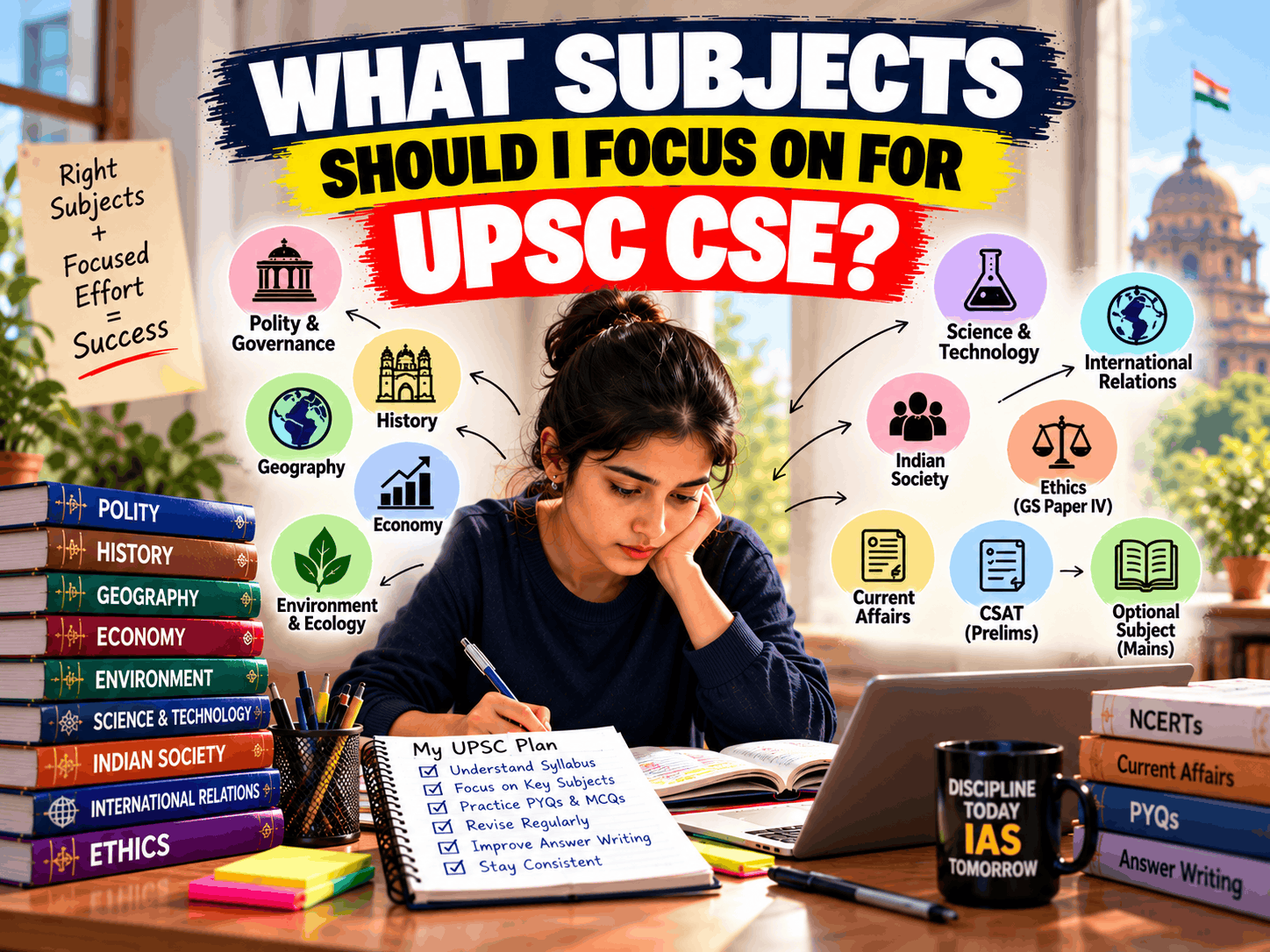
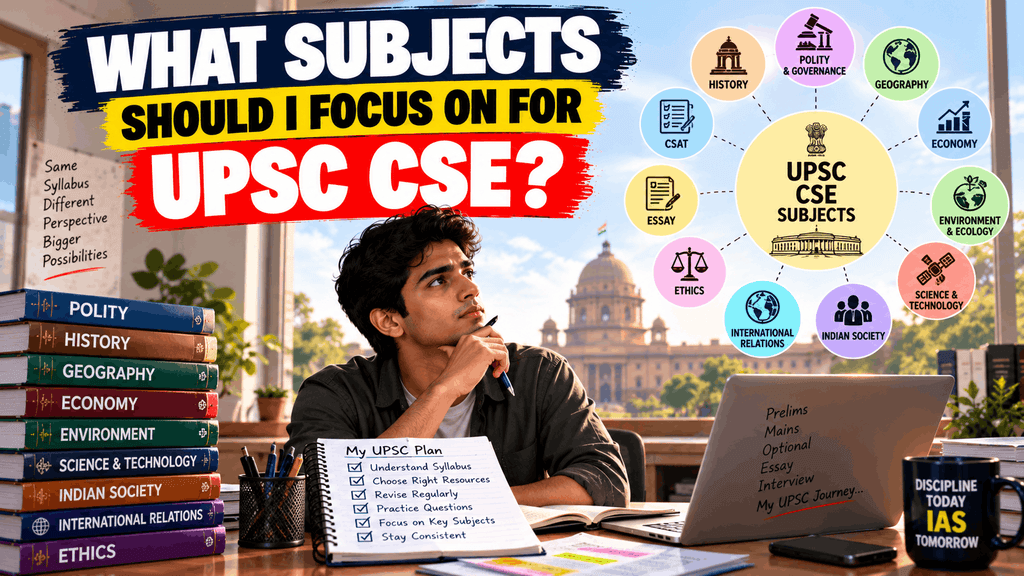
You need to cover the relevant areas of Polity, History, Geography, Economy, Environment, Science and Technology, Current Affairs, Ethics, Indian Society and International Relations. You must also prepare for CSAT, the Essay paper and your Optional subject according to the official syllabus.
But do not turn this list into an excuse to collect more and more study material.
Start by understanding the examination. Study each subject systematically, connect current affairs with static concepts, practise previous years’ questions and revise regularly.
Most importantly, learn to distinguish between studying a topic and being able to answer a question on it. The two are not always the same.
After more than 14 years of mentoring UPSC aspirants, my advice is to focus on preparation that translates into examination performance. You do not need to know everything about everything. You need to know the relevant material well enough to use it effectively.
At Rahul Sir’s IAS Academy in Nagpur, our approach is built around structured preparation, examination-oriented practice and identifying areas for improvement. If you are unsure where to begin, first assess your current level and then build a realistic plan around the syllabus.
Study with purpose. Revise what you learn. Practise applying it. And keep your preparation connected to the examination you intend to clear.
See also:
Should I Join Online or Offline UPSC Coaching?
How to Stay Motivated While Preparing for UPSC Exam?
What’s the Average Cost of UPSC Coaching in India?
Best UPSC Coaching Institutes: How to Choose?
Is Studying 6 Hours a Day Enough for UPSC Preparation?
How Long Should I Prepare for UPSC CSE?
Can I Prepare for UPSC While Working a Full-Time Job?
How to Choose Between Mentorship Programs and Regular Coaching?
Do Top UPSC Rankers Use Coaching or Self-Study?
Best Age to Start UPSC Preparation?
Should I Move to Delhi for UPSC Coaching?
FAQs:
1. Is IAS without maths?
Yes, you can become an IAS officer without having studied Mathematics in Classes 11 and 12. Mathematics is not compulsory as a separate subject in the UPSC Civil Services Examination. However, Prelims includes CSAT, which tests basic numeracy, data interpretation and logical reasoning. CSAT is qualifying, so you must score at least 33% to pass it. If you are weak in Maths, practise the relevant topics regularly, but you do not need advanced Mathematics to prepare for IAS.
2.Who is not eligible for IAS?
A person may be ineligible for IAS if they do not meet UPSC’s eligibility requirements, such as the prescribed educational qualification, age limit, nationality criteria or permitted number of attempts. Candidates must generally hold a recognised bachelor’s degree, and the applicable age limits and attempt restrictions vary by category. Certain medical and service-specific requirements also apply. Check the latest official UPSC Civil Services Examination notification to confirm your eligibility before applying.
3. Is NCERT enough for UPSC preparation?
NCERT textbooks are useful for building basic conceptual understanding, but they are not sufficient for every part of the UPSC syllabus on their own. You will need to supplement them with suitable subject-specific resources, current affairs, previous years’ questions and regular practice, depending on the topic and stage of the examination.
4. How can I decide which UPSC subjects need more attention?
Study the official syllabus, analyse previous years’ questions and assess your performance in topic-wise tests. Give additional attention to subjects or concepts where your understanding is weak, while maintaining regular revision of areas you already know. Avoid allocating time solely on the basis of rumours about which subject is most important.