

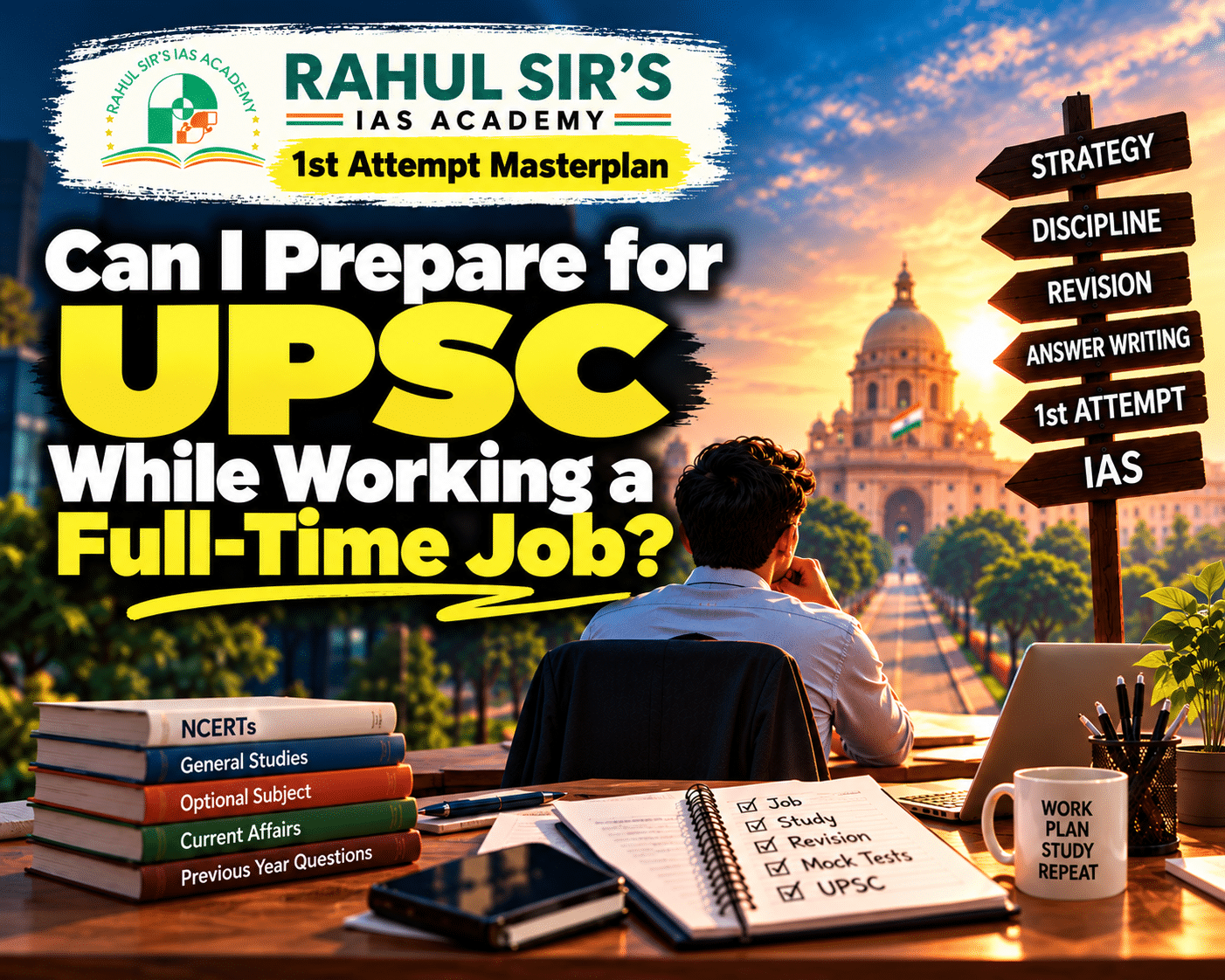
Can you prepare for UPSC CSE while working a full-time job?
Yes, you can.
But let me qualify that answer immediately.
Preparing for UPSC while working is not easy. You have fewer hours, less flexibility and, on many days, very little mental energy left after work. But that does not mean that a full-time job makes UPSC preparation impossible.
Over the years, I have interacted with many working professionals preparing for UPSC. I have also seen examples of candidates who managed to combine their careers with serious UPSC preparation.
One example that has stayed with me is Saurabh Maheshwari, one of my colleagues at Maruti, who secured AIR 1 while working.
So, if you are currently employed and dreaming of becoming a civil servant, don’t begin with the assumption that you must immediately resign.
Begin with a much more useful question:
How can I make the limited time available to me work?
That is where the real challenge—and the real solution—lies.
Do You Really Need to Study 10–12 Hours a Day for UPSC?
This is probably one of the first questions that comes to the mind of a working professional.
You see toppers talking about 10 hours of study.
Someone else says they studied 12 hours.
Another person claims to have studied 14 hours every day.
Then you look at your own schedule.
You leave for work in the morning, spend several hours at the office, travel back home, eat dinner, take care of family responsibilities—and suddenly the day is over.
You may have only two or three genuinely productive hours left.
Does that mean you cannot clear UPSC?
No.
I have never believed that simply sitting at a desk for a particular number of hours guarantees success in UPSC.
In my experience, the more important question is:
What are you doing during those hours?
If you have three focused hours and use them to study the right material, solve PYQs, revise and practise answer writing, those three hours can be far more valuable than spending ten hours jumping between YouTube videos, Telegram PDFs, books and random study material.
UPSC preparation is not a competition to see who can sit with a book for the longest period.
It is a process of understanding the syllabus, selecting the right resources, building conceptual clarity, practising, revising and eventually converting your knowledge into marks.
For a working professional, efficiency becomes even more important.
The Biggest Advantage of a Working Professional
At first, having a job appears to be a disadvantage.
You don’t have the luxury of spending the entire day preparing.
But there is another side to it.
A working professional is often forced to become disciplined about time.
When you have only a few hours available, you cannot afford to spend them casually.
You have to ask:
- What should I study today?
- Which topics are important?
- Which source should I use?
- Should I revise or start something new?
- Should I solve PYQs?
- Should I write an answer?
- What can I postpone?
That kind of prioritisation is extremely valuable in UPSC preparation.
The problem begins when a working aspirant tries to copy the timetable of a full-time aspirant.
That is usually unrealistic.
Your timetable should be designed around your life—not someone else’s life.
How Many Hours Should a Working Professional Study?
There is no universal number.
A person working from 9 to 5 may have a very different situation from someone working in shifts.
Someone with a 30-minute commute has a different schedule from someone who spends three hours travelling every day.
Someone living alone has different responsibilities from someone with children and family responsibilities.
So instead of asking:
“How many hours should I study?”
ask:
“How many productive hours can I consistently give to UPSC?”
For one person, it might be two hours on weekdays and six to eight hours over the weekend.
For another, it might be three to four hours every weekday.
There is no magic number.
What matters is whether those hours are consistent and strategically used.
And remember, preparation doesn’t have to mean reading a book continuously.
One session could be revision.
Next could be PYQs.
After that it could be answer writing.
Sometimes it could be Optional preparation.
The objective is to build the entire preparation system over time.
Don’t Try to Finish Everything at Once
This is where many working professionals make a mistake.
They look at the UPSC syllabus and think:
“I have to study everything.”
Then they start collecting resources.
One book for Polity.
Another for History.
A different PDF for Geography.
Five YouTube playlists for Current Affairs.
Multiple Telegram channels.
Topper notes.
Coaching notes.
And before long, the problem isn’t lack of study material.
The problem is too much study material.
When you have limited time, this becomes particularly dangerous.
You cannot afford to spend two hours every evening deciding what to study.
1.Your resources should be identified in advance.
2. Syllabus should be clearly mapped.
3. Study timetable prepared by you should tell what you need to accomplish.
This is why I repeatedly tell aspirants:
Don’t confuse content consumption with preparation.
Watching another lecture is not automatically preparation.
Downloading another PDF is not preparation.
Buying another book is certainly not preparation.
Preparation happens when the material you have selected is actually studied, understood, practised and revised.
Start With the UPSC Syllabus and PYQs
If you are preparing alongside a job, don’t waste your limited time studying blindly.
Start by understanding the UPSC syllabus.
Then analyse the Previous Year Questions.
This will help you understand what UPSC actually asks and how different subjects are approached.
The syllabus gives you the boundaries.
The PYQs show you how those boundaries are tested.
This combination is particularly important for working professionals because you simply don’t have enough time to read everything available.
You need to develop the ability to distinguish between:
What is important
and
What is merely interesting.
That distinction can save you hundreds of hours over the course of your preparation.
Don’t Ignore Answer Writing
Another common mistake is to postpone answer writing.
A working professional might think:
“I’ll first complete the syllabus. Then I’ll start writing answers.”
The problem is that UPSC Mains requires a completely different skill from simply knowing the subject.
You have to learn how to:
- Understand the demand of the question
- Structure an answer
- Introduce the issue properly
- Present relevant arguments
- Use examples
- Write within the word limit
- Reach a conclusion
- Complete the paper within the available time
These are skills.
And skills require practice.
You don’t have to write ten answers every day while working full-time.
But you should gradually introduce answer writing into your preparation.
Even one or two good answers written consistently are better than postponing the process for six months.
Don’t Leave Your Optional Subject for the Last Moment
Your Optional is another area where working professionals need to be particularly careful.
You have limited time.
So leaving the Optional until the final few months can create enormous pressure.
My advice is to identify your Optional early.
You don’t necessarily have to spend all your time on it from day one, but it should become part of your preparation plan.
Within the first couple of months, you should have clarity about the subject, resources and guidance you intend to follow.
Once your General Studies preparation progresses substantially, your Optional can receive greater attention.
Remember, the objective isn’t simply to “finish” the Optional.
You need to understand the syllabus, analyse PYQs, prepare the content and learn how to write answers.
Use Your Weekends Properly
For a working professional, weekends can make a huge difference.
Your weekday schedule may be restricted.
Perhaps you can study for two or three hours after work.
But weekends provide longer uninterrupted blocks of time.
Use them strategically.
For example, you could use your weekend for:
Revision
Go back to what you studied during the week.
Optional
Spend a longer session on your Optional subject.
Answer Writing
Write answers under timed conditions.
PYQ Analysis
Analyse previous UPSC questions and identify recurring themes.
Tests
Take a subject-wise or full-length test depending on your stage of preparation.
Planning
Review the previous week and plan the next one.
The important thing is not to turn Saturday and Sunday into two exhausting 12-hour study marathons.
You are already working during the week.
Your goal is to create a sustainable system that you can follow for months.
What About Current Affairs?
Current Affairs can become particularly overwhelming for working professionals.
There are newspapers.
Monthly magazines.
Daily videos.
Daily PDFs.
Telegram channels.
Current affairs compilations.
You can easily spend several hours every day consuming current affairs.
Don’t.
Current Affairs should be integrated into your UPSC preparation rather than becoming a separate universe.
Follow a reliable source consistently.
Connect current events with the static syllabus.
Make useful notes where necessary.
Revise them.
And most importantly, understand how current affairs are relevant to the UPSC syllabus and PYQs.
Again, limited time makes prioritisation essential.
Should You Quit Your Job to Prepare for UPSC?
This is a personal decision and there cannot be one answer for everyone.
Some aspirants may eventually find that their job leaves them with insufficient time for serious preparation.
Others may be able to prepare successfully alongside their careers.
Don’t resign simply because someone tells you:
“Nobody can clear UPSC while working.”
That statement is simply too broad.
At the same time, don’t convince yourself that you can work full-time, give UPSC two hours a week and somehow complete the entire syllabus.
Be honest about your circumstances.
Ask yourself:
- How much time can I realistically study?
- Can I maintain that schedule for many months?
- Am I progressing through the syllabus?
- Am I revising?
- Am I practising answer writing?
- Am I preparing my Optional?
- Am I solving PYQs?
- Is my preparation actually moving towards examination readiness?
If the answer to these questions is yes, your job does not automatically make UPSC impossible.
The Dangerous Trap: “I’ll Prepare Properly Next Year”
I have seen working professionals fall into this trap repeatedly.
They keep postponing the examination.
“I’ll prepare this year and appear next year.”
Then another year comes.
“My preparation isn’t complete. I’ll appear next year.”
Then another year passes.
There is nothing wrong with postponing an attempt if you genuinely aren’t ready.
But there is a difference between strategic preparation and endless postponement.
- Have a clear target.
- You should know what you need to complete.
- Know how many revisions you need.
And you should have a realistic assessment of your readiness.
Don’t take an attempt simply because your friends are appearing.
But don’t keep postponing your attempt because you are waiting for some imaginary state of “perfect preparation.”
When Should a Working Professional Actually Give the Attempt?
This is one of the most important questions.
I don’t recommend treating an attempt as an “experience attempt.”
If you are going to invest months of your life preparing for UPSC, your mindset should be:
“My first attempt is my last attempt.”
That doesn’t mean you can control the result.
It means you control the seriousness with which you approach the attempt.
Before appearing, you should have:
- A clear understanding of the syllabus
- Completed your major resources
- Analysed PYQs
- Prepared your Optional
- Practised answer writing
- Prepared for Prelims
- Integrated Prelims and Mains preparation
- Revised the syllabus multiple times
I particularly emphasise three revisions as a serious benchmark.
You should not appear simply because the examination calendar says it is time.
Appear when your preparation says you are ready.
A Practical Strategy for UPSC Preparation With a Job
If I had to simplify the entire approach for a working professional, I would structure it like this:
Phase 1: Understand
Start with the syllabus and PYQs.
Understand the examination before you start consuming study material.
Phase 2: Build
Identify your books, notes, sources and Optional.
Don’t keep changing resources.
Phase 3: Complete
Create a realistic timetable and systematically complete the syllabus.
Don’t try to study everything simultaneously.
Phase 4: Practise
Introduce answer writing, PYQs and MCQ practice into your routine.
Don’t wait until the end.
Phase 5: Revise
This is where many aspirants fall behind.
Finishing the syllabus once does not mean you know it.
Revision is what converts exposure into recall.
Phase 6: Test Yourself
Take tests.
Analyse mistakes.
Improve your answers.
Identify weak areas.
Then revise again.
This cycle should continue until you are genuinely examination-ready.
The Real Advantage Is Not More Time. It’s Better Use of Time.
If you are working and preparing for UPSC, don’t constantly compare yourself with someone who studies full-time.
Their circumstances are different.
You may have only three hours.
Use those three hours properly.
You may have Sunday available for a longer study session.
Use it properly.
You may have a long commute.
Depending on your circumstances, some of that time may be used for revision or listening to relevant material.
Your preparation doesn’t have to look like somebody else’s preparation.
It has to work for you.
And this is where proper guidance becomes extremely valuable.
When your time is limited, you cannot afford to spend six months discovering what you should have known in the first month.
The right guidance can help you understand the syllabus, select resources, analyse PYQs, structure answer writing, choose an Optional strategy and, most importantly, understand where your effort is actually producing marks.
Final Answer: Can You Clear UPSC While Working?
Yes.
Having a full-time job does not automatically prevent you from preparing for UPSC CSE.
But you have to accept one reality:
You cannot prepare like a full-time aspirant if you don’t have the same amount of time.
- Find out a different strategy.
- You need to be selective.
- Plan carefully.
- Avoid unnecessary content consumption.
You need to integrate Prelims and Mains.
- Start answer writing and Optional preparation early.
And above all, you need to be consistent.
Don’t obsess over whether you studied 8, 10 or 12 hours.
Ask yourself every evening:
“Did the hours I studied today actually move me closer to clearing UPSC?”
If the answer is yes, you are moving in the right direction.
And remember the approach I have always advocated:
Study → Revise → Take the Attempt → Get Selected.
“Your job may limit the hours you have, but it does not have to limit the dream you pursue. Use the time you have wisely, stay consistent, and let disciplined preparation turn your ambition into your first attempt.”
— Rahul Sir
Rahul Sir’s IAS Academy – 1st Attempt Masterplan
If you are a working professional preparing for UPSC and are confused about what to study, how to structure your preparation, when to start answer writing, how to handle Optional, or when you are actually ready for your first attempt, a structured preparation system can save you from years of trial and error.
That is the philosophy behind Rahul Sir’s IAS Academy – 1st Attempt Masterplan: not simply giving you more content, but helping you understand the path you need to follow from preparation to examination.
See Also :
Blogs available on our website :
Best Age to Start UPSC Preparation?
Do Top UPSC Rankers Use Coaching or Self-Study?
How to Choose Between Mentorship Programs and Regular Coaching?
Is Studying 6 Hours a Day Enough for UPSC Preparation?
Best UPSC Coaching Institutes: How to Choose?
What’s the Average Cost of UPSC Coaching in India?
How to Stay Motivated While Preparing for UPSC Exam?
How Long Should I Prepare for UPSC CSE?
Understand Jainism : At a Glance
FAQs :
1. Is 30 Too Late for UPSC?
No, 30 is not too late to prepare for UPSC.
I have spoken to many aspirants who begin their preparation in their late twenties or around 30. Some come from jobs, some have already tried other careers, and some simply took longer to decide that civil services was the path they wanted.
So don’t look at your age and immediately conclude that you are late.
What matters much more is how seriously and strategically you use the time available to you.
In fact, someone starting at 30 may have advantages that a 21-year-old doesn’t necessarily have—greater maturity, better understanding of their strengths and weaknesses, and often a much clearer reason for wanting to join the civil services.
But there is one thing I would caution you about.
Don’t use your age as an excuse for delaying preparation.
If you have decided to prepare, understand the syllabus, analyse PYQs, select your resources, build a realistic timetable and start working towards your attempt.
And don’t fall into the trap of comparing your journey with someone who started at 21 or 22.
UPSC doesn’t ask you when you started preparing. It tests what you can deliver in the examination.
So if you’re 30 and asking yourself, “Is it too late?”
My answer is simple:
If you are serious about becoming a civil servant, don’t waste another year worrying about whether you started late. Start preparing properly now.
2. Is 6 Hours a Day Enough for UPSC?
Yes, 6 focused hours a day can be enough for UPSC preparation.
But don’t get obsessed with the number.
I have never believed that UPSC preparation should be measured simply by how many hours you sit at your desk. You can sit for 10 hours and accomplish very little, or study for 6 hours with complete focus and make substantial progress.
What matters is what you do in those six hours.
If your six hours include studying the syllabus systematically, analysing PYQs, practising answer writing, working on your Optional, solving Prelims questions and revising what you’ve already studied, you are doing meaningful preparation.
The other important factor is consistency.
Six hours today, ten tomorrow, and nothing for the next three days is not a strategy. But six productive hours, consistently maintained over months, can take you a long way.
And remember, your circumstances matter. A college student, a full-time aspirant and someone working a 9-to-6 job cannot follow the same timetable.
So don’t ask:
“Am I studying enough hours?”
Ask:
“Am I using the hours I have to move closer to examination readiness?”
If the answer is yes, keep going.
UPSC is not won by counting hours. It is won by making those hours count.
3. Has Anyone Cleared UPSC While Working?
Yes, absolutely.
In fact, I have personally seen working professionals prepare seriously for UPSC and clear the examination. One example I often mention is Saurabh Maheshwari, one of my colleagues at Maruti, who secured AIR 1 while working.
So if you are currently employed, don’t assume that your job automatically puts you at a disadvantage.
The important thing is to understand that you cannot prepare like a full-time aspirant. Your strategy has to fit around your working hours.
You may have only a few hours on weekdays, but you can use your evenings, weekends and holidays intelligently. What matters is having a realistic timetable and following it consistently.
Focus on:
- Limited and relevant study material
- PYQ analysis
- Regular revision
- Answer writing
- Early Optional preparation
- Integrated Prelims and Mains preparation
- Making the best use of weekends
And don’t get trapped by the idea that you must study 10–12 hours every day.
The question is not how many hours you have. The question is how effectively you use the hours you have.
Your job may reduce the time available for preparation, but it does not automatically put UPSC out of your reach.