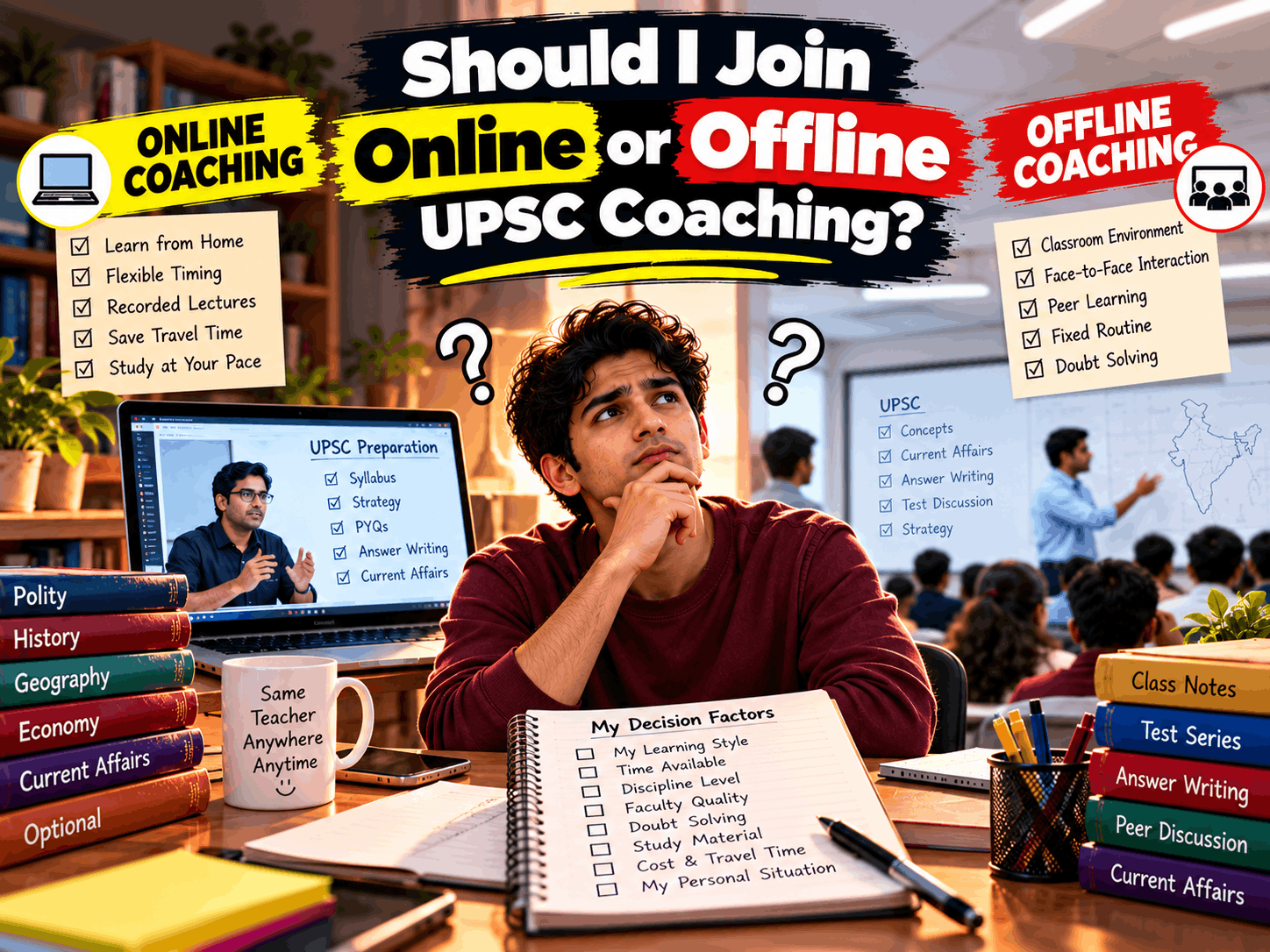
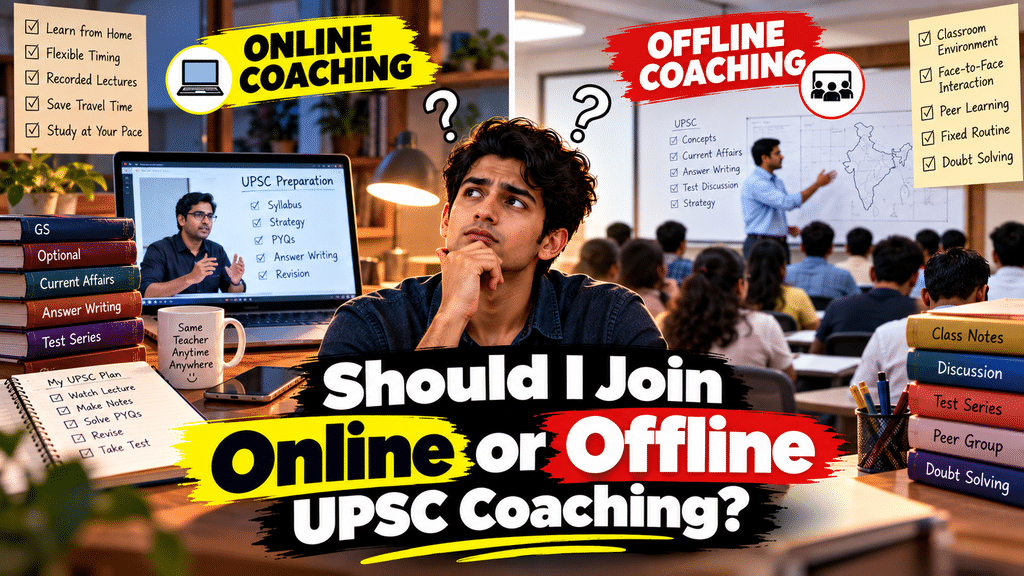
“Sir, should I join online coaching or offline coaching for UPSC?”
This sounds like a simple question.
It isn’t.
I have had this conversation with many aspirants, and the answer is rarely as straightforward as “online is better” or “offline is better.”
Both formats can work.
Both can also fail.
I have seen students sitting in classrooms who were hardly benefiting from the experience. I have also seen aspirants studying from home with remarkable discipline and doing very well.
So before you spend a substantial amount of money—or pack your bags and move to another city—I would ask you to think about something more important:
What kind of learning environment will actually help you prepare better?
That answer depends on you.
Don’t Choose a Mode Just Because Everyone Else Is Choosing It
This is perhaps the first mistake I would like you to avoid.
You speak to a friend.
He says, “I’m joining offline coaching.”
Another friend says, “Online is the future. Everything is available there.”
You watch a few YouTube videos and become even more confused.
Then you start comparing institutes based on classroom size, faculty photographs, study material, hostel facilities and hundreds of reviews.
All of these things may have some relevance.
But the first question should be much more personal:
How do I study best?
If you genuinely enjoy attending classes, asking questions face-to-face and having a fixed daily routine, offline learning may suit you.
If you are comfortable studying independently, value flexibility and can remain disciplined without somebody physically monitoring you, online learning may be a better fit.
There is no medal for choosing the more fashionable option.
What Is the Real Advantage of Offline Coaching?
The biggest advantage of offline coaching isn’t simply that a teacher is physically standing in front of you.
It is the environment.
When you go to a classroom regularly, preparation becomes part of your daily routine.
You wake up. Attend class, meet other aspirants, discuss topics with them, return home and revise
For some students, that structure makes a tremendous difference.
There is also an immediate interaction that many learners appreciate.
If you don’t understand something, you can raise your hand and ask.
You can speak to the faculty after class.
You may get into discussions with other students.
Sometimes even a simple conversation with another serious aspirant can make you realise that you are approaching a topic incorrectly.
That ecosystem can be valuable.
But there is another side.
A classroom does not automatically make you disciplined.
You can attend a three-hour lecture, take notes throughout it and still not revise what was taught.
You can sit in the front row of a famous institute and remain completely passive.
So don’t assume that physically attending classes means you are automatically preparing well.
Online Coaching Gives You Something Offline Cannot
The biggest advantage of online preparation is flexibility.
You don’t have to spend time travelling to class.
You can watch a lecture at a convenient time.
If you didn’t understand something, you can replay it.
If the teacher explains a difficult concept quickly, you can pause.
If you’re already comfortable with a particular topic, you can move through it faster.
And this becomes particularly useful for aspirants who are working, studying in college or living in a city where good UPSC guidance isn’t easily available.
Imagine spending two hours every day travelling to and from a coaching centre.
Over several months, that becomes a considerable amount of time.
Online learning can give some of that time back to you.
But there is a catch.
Your home can be both your classroom and your biggest distraction.
The phone is beside you.
Messages are coming in.
Instagram is one click away.
The bed is in the next room.
Nobody is waiting for you to enter the classroom at 9 AM.
If you are not disciplined, the flexibility that makes online coaching attractive can quickly become its biggest weakness.
Which One Is Better for a Beginner?
This depends on the beginner.
If you are completely new to UPSC and have very little understanding of the examination, I would first focus on finding clarity and proper guidance, rather than becoming obsessed with the delivery format.
You need to understand:
- What the syllabus actually demands
- How Prelims and Mains are connected
- How PYQs should be analysed
- What resources are sufficient
- When to begin answer writing
- How to approach Optional
- How much time to devote to different areas
- How and when to revise
If an online program provides these things effectively, it can be perfectly adequate.
If an offline program provides them better for your learning style, choose offline.
The classroom or screen is secondary.
The quality of the guidance is much more important.
What About Interaction With Teachers?
This is where offline coaching traditionally has an advantage.
There is something different about being able to walk up to a teacher after class and ask a question.
However, don’t assume that every offline institute offers meaningful personal interaction.
A classroom may have hundreds of students.
You may technically have access to the teacher, but that doesn’t necessarily mean you are receiving individual guidance.
The same issue can exist online.
Some programs offer excellent doubt-solving and mentorship.
Others essentially give you recorded lectures and leave you to figure everything else out.
So when evaluating a program, don’t just ask:
“Are the classes live?”
Ask:
“What happens when I get stuck?”
Who answers my doubts?
Evaluates my answers?
Helps me identify mistakes?
Who can tell me whether my preparation is moving in the right direction?
Those questions are much more revealing.
Don’t Underestimate the Cost of Your Time
When comparing online and offline coaching, students usually compare the course fees.
That’s understandable.
But there is another cost that people often forget:
time.
Suppose your offline classroom is one hour away.
You spend an hour going there and another hour returning.
That’s two hours every day.
Add waiting, traffic and other practical delays, and the figure can become even larger.
Now imagine doing that five or six days a week for months.
Those hours could have been spent revising, solving PYQs, writing answers or simply getting enough rest to study effectively the next morning.
I’m not saying commuting makes offline coaching a bad choice.
For some students, the classroom environment is worth it.
I’m saying include travel time when calculating the real cost of offline coaching.
What If I Live in a Small City?
This is one area where online education has changed the UPSC preparation landscape significantly.
You don’t necessarily have to relocate to Delhi or another major coaching hub simply because you believe that serious preparation is impossible elsewhere.
If you have access to good faculty and reliable guidance online, you can prepare from your own city.
And there can be considerable advantages to that.
You remain close to your family.
You avoid relocation expenses.
You don’t have to adapt to a completely new environment.
And you can build a routine around your existing circumstances.
I have always been cautious about the idea that you must move to Delhi to clear UPSC.
The city you prepare from does not write your Mains answers.
You do.
But Don’t Choose Online Coaching Merely Because It Is Convenient
Convenience is useful.
But UPSC preparation cannot be built entirely around convenience.
Suppose you choose an online course because you can watch the lectures whenever you want.
Six months later, you have watched only 40% of them.
What good was the flexibility?
This happens more often than students realise.
They buy courses because they want access.
But access is not the same as completion.
You have to ask yourself honestly:
Can I sit alone and study for several hours?
Can I follow a schedule without someone physically checking on me?
Will I actually complete recorded lectures?
Will I revise them?
Will I practise questions afterwards?
If you already know that you struggle with self-discipline, the structure of an offline environment may be valuable.
And Don’t Choose Offline Just Because It Feels More Serious
There is a psychological effect to going to a physical classroom.
You dress up.
You carry your books.
You sit among hundreds of aspirants.
Everything around you looks serious.
It feels like you are doing something important.
But don’t confuse the atmosphere of preparation with preparation itself.
After the class, you still have to go home and revise.
You still have to :
- solve PYQs.
- write answers.
- study your Optional.
- revise again and again.
The classroom can provide the environment.
It cannot do the preparation for you.
So What Should You Look for in a UPSC Coaching Program?
Whether you choose online or offline, I would evaluate the program on these parameters.
1. Does it teach you the examination or merely the syllabus?
There is a difference.
Completing chapters is not the same as teaching someone how to prepare for UPSC.
2. Is there proper PYQ integration?
PYQs shouldn’t appear only during the final revision.
They should influence how you study from the beginning.
3. What happens with answer writing?
Don’t simply ask whether answer writing is included.
Ask whether your answers are actually evaluated and whether you receive useful feedback.
4. How is Optional handled?
This is an important component of Mains preparation and shouldn’t be treated as an afterthought.
5. Is there mentorship?
And by mentorship, I don’t mean simply receiving motivational messages on WhatsApp.
You should understand what kind of academic and strategic guidance is actually provided.
6. Can you access the material when you need it?
This is particularly important for online programs.
7. What happens if you miss a class?
Life doesn’t always follow your timetable.
A good system should account for that.
What I Would Tell You If You Were Sitting in Front of Me
If you came to me and said:
“Sir, I can’t decide between online and offline.”
I wouldn’t immediately recommend one.
I’d first ask you about your circumstances.
Are you working?
Are you in college?
Where do you live?
How much time do you spend travelling?
How disciplined are you when studying alone?
Do you learn better by listening in a classroom or by studying at your own pace?
Do you need a fixed routine?
Do you already have good guidance?
What exactly are you expecting from coaching?
Your answers would tell me much more than a generic comparison chart.
Online vs Offline: A Simple Way to Decide
Here’s how I would simplify it.
Choose Offline if:
You learn better through face-to-face interaction.
You need a fixed routine to stay disciplined.
You benefit from being surrounded by serious aspirants.
You have access to genuinely good faculty nearby.
Your travel time is manageable.
Choose Online if:
You are comfortable studying independently.
You want flexibility.
You are working or attending college.
Good offline guidance isn’t available in your city.
You want to save commuting time.
You are disciplined enough to follow a schedule without a classroom forcing you to do it.
Neither list makes one method universally superior.
It simply tells you which environment may suit your personality and circumstances.
One More Thing: Don’t Expect Coaching to Guarantee Selection
This is perhaps the most important point in the entire discussion.
Whether you study online or offline, joining coaching is only one part of your preparation.
I have seen aspirants believe that once they join a reputed institute, half the battle is over.
It isn’t.
The classes may give you direction.
The faculty may explain concepts.
The study material may save you time.
The test series may help you practise.
But eventually, you have to sit alone with your books and do the work.
You have to revise when nobody is watching.
You have to write answers even when your first attempts aren’t good.
You have to analyse your mistakes.
You have to keep going when the excitement of joining a new course disappears.
That is where selection is ultimately decided.
My Honest Recommendation
If you are asking me which is better—online or offline—I would say:
Choose the format that gives you the best combination of guidance, discipline, interaction and efficient use of your time.
Don’t choose offline simply because it sounds more serious.
Don’t choose online simply because it is cheaper or more convenient.
And don’t choose an institute merely because everybody around you is talking about it.
Look beyond the delivery format.
Ask what you are actually getting.
Good guidance delivered online is better than poor guidance delivered in a classroom.
And equally, if you know that you need the discipline and interaction of a physical classroom, there is no reason to force yourself into an online program simply because it is fashionable.
The goal isn’t to become an expert at attending classes.
The goal is to become examination-ready.
Final Thought
UPSC preparation already demands a lot from you.
Don’t make the decision between online and offline more complicated than it needs to be.
Understand yourself first.
Then evaluate the coaching.
Look at the faculty.
Look at the mentorship.
Look at answer evaluation.
Look at PYQ integration.
Look at Optional support.
Look at the time you will actually save or spend.
And then make your decision.
Because ultimately, whether the teacher is standing in front of you in a classroom or speaking to you through a screen, the same thing has to happen afterward:
You have to study.
You have to practise.
You have to revise.
And you have to improve.
That’s what takes you closer to the examination.
The mode of learning matters. The quality of preparation matters much more.
Rahul Sir’s IAS Academy – 1st Attempt Masterplan
At Rahul Sir’s IAS Academy, the idea behind the 1st Attempt Masterplan is not simply to put more lectures in front of an aspirant. The larger objective is to provide a structured path—what to study, how to approach it, when to practise, how to revise and how to keep your preparation connected to the actual demands of UPSC.
Because whether you choose a classroom or a screen, you ultimately need a clear path to follow.
See Also:
The Surat Split 1907: Background, Reasons, Fallout and Consequences
Mountains, Plateaus and Plains
FAQs:
1. Has anyone cleared UPSC with online coaching?
Yes. Many UPSC aspirants have cleared the exam using online coaching, including candidates who studied entirely from home.
But I would not say that online coaching itself clears UPSC. The important question is whether the online course gives you proper guidance, structured preparation, quality content, answer evaluation, test practice and doubt support.
I have seen students do very well with online preparation, particularly when they use the flexibility of online learning properly. The advantage is that you can learn from good teachers without relocating to Delhi or another coaching hub.
At the same time, online coaching requires more self-discipline. If you keep postponing lectures, collecting courses and watching videos without revision or answer writing, simply having access to a good online course will not help.
So my answer is: Yes, UPSC can absolutely be cleared through online coaching. But choose the guidance and preparation system first; the mode of delivery—online or offline—comes second.
2. Which coaching is better, offline or online?
Neither is universally better. The better option is the one that gives you the right guidance, discipline, interaction and evaluation in your particular situation.
Offline coaching can be better if you:
- Need a fixed routine and classroom environment
- Learn better through face-to-face interaction
- Benefit from studying alongside serious aspirants
- Tend to procrastinate when studying alone
Online coaching can be better if you:
- Need flexibility because of college or a job
- Want to avoid relocation and commuting
- Prefer recorded lectures and revision at your own pace
- Already have reasonable self-discipline
One mistake I often see is choosing offline coaching simply because it feels more serious, or choosing online coaching simply because it is convenient. Neither format guarantees selection.
Before paying for a course, ask yourself: Who will guide me when I am confused? Who will evaluate my answers? How will my preparation be monitored? What happens when I fall behind?
If an online program answers these questions better than an offline institute, online is the better choice. And if a particular offline institute provides substantially better guidance and accountability for you, choose offline.
My simple rule is:
Good guidance delivered online is better than poor guidance delivered in a classroom.
For UPSC, the quality of your preparation matters more than the mode in which the teaching is delivered.