

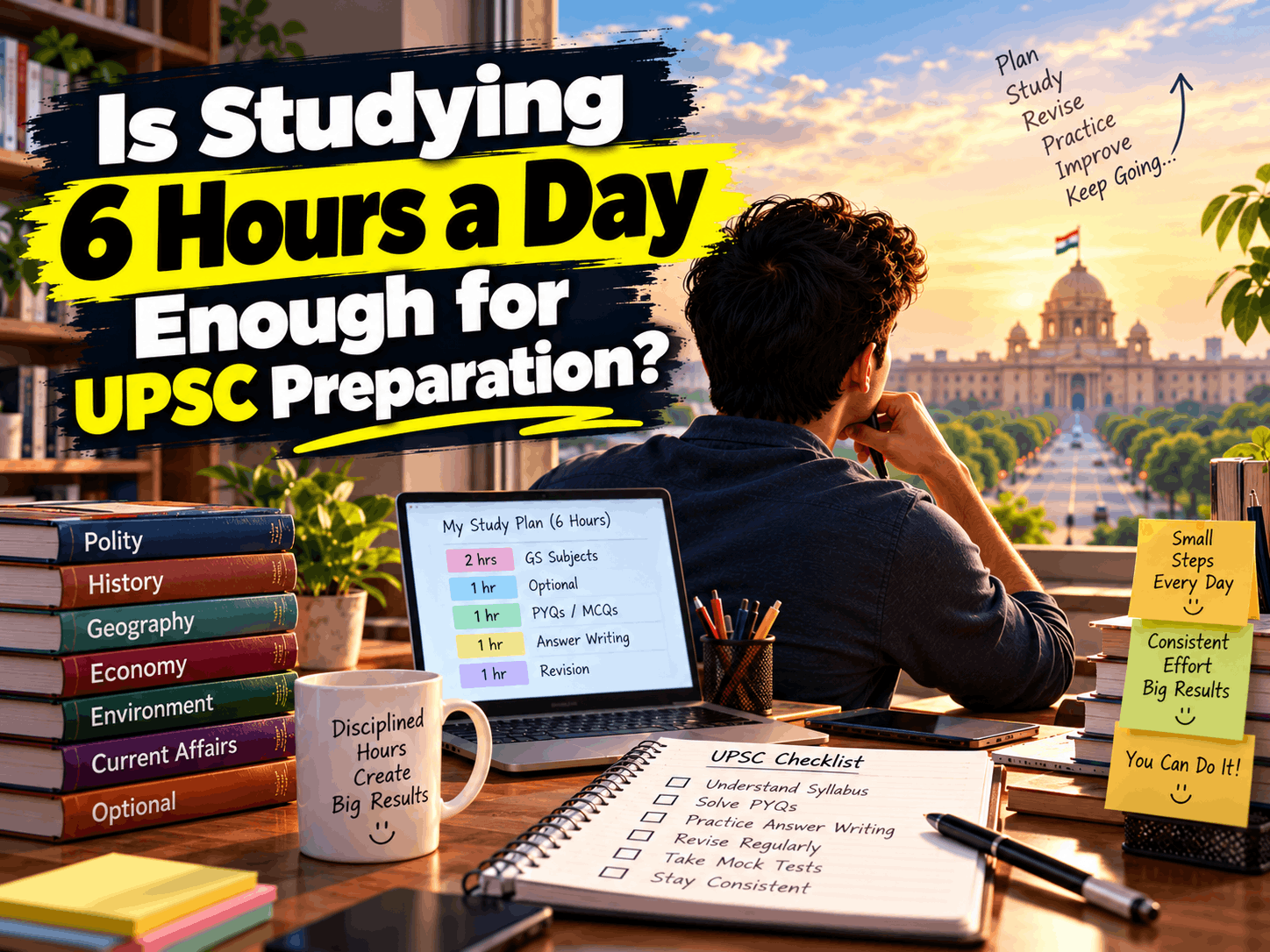
“Sir, I can study for six hours a day. Is that enough to clear UPSC?”
I get questions like this quite often.
And I understand why aspirants worry about it. You open YouTube and hear someone saying they studied for 10 hours. Another topper talks about 12 hours. Someone else claims they woke up at 4 AM and studied until midnight.
Then you look at your own routine and think:
“I can manage only six hours. Am I already behind?”
My answer is no.
Six hours of serious, focused preparation can be enough to make substantial progress in UPSC preparation. But I would not want you to take that statement and turn six hours into another target that you have to chase blindly.
There is no magic number of study hours that guarantees selection.
What you do during those hours matters far more.
Six Hours of What?
This is where I would ask you to pause.
Suppose you sit at your desk for six hours.
During that time, you read a little Polity, check Telegram, watch a current affairs video, look at Instagram for ten minutes, download a new PDF, answer a few messages and then return to your book.
Technically, you were “studying” for six hours.
But how much useful preparation actually happened?
Now consider another aspirant.
For six hours, there is a clear plan.
Two hours of GS.
One hour of Optional.
One hour of answer writing or PYQs.
One hour of revision.
One hour of Prelims practice.
The second student may have spent exactly the same amount of time at the desk, but the quality of preparation is completely different.
This is why I don’t like giving aspirants a fixed number and saying:
“Study X hours and you will succeed.”
UPSC doesn’t work that way.
I Have Seen Students Study for Long Hours Without Making Enough Progress
One thing I have noticed over the years is that aspirants sometimes become obsessed with the number on the clock.
They feel guilty if they study for only six hours.
Then they start stretching their timetable.
Eight hours.
Ten hours.
Twelve hours.
But somewhere along the way, efficiency drops.
You are physically sitting with your books, but your mind isn’t absorbing much.
There is also a danger in this approach. Once you decide that “10 hours” is the definition of a successful day, a five-hour day begins to feel like a failure—even if those five hours were extremely productive.
I would rather see a student complete the right work in six focused hours than spend ten hours simply trying to prove that they worked hard.
UPSC is not a competition in sitting at a desk.
What Should You Actually Accomplish in Those Six Hours?
If you are giving six productive hours to UPSC every day, I would expect your preparation to gradually cover several areas.
You should be moving through the syllabus, rather than studying random topics simply because they happen to be interesting.
Previous Year Questions should become part of your preparation. They help you understand the kind of thinking the examination demands.
Answer writing also needs a place in your routine. Don’t wait until you have completed every subject before you begin writing.
Your Optional deserves attention as well. It shouldn’t suddenly appear in your timetable two months before Mains.
Prelims preparation has to be built alongside your broader preparation, particularly through MCQ practice and revision.
And then there is the part students often underestimate:
revision.
You can read for six hours every day and still struggle in the examination if you don’t revisit what you studied.
So if your six hours are being divided intelligently between learning, practising, testing and revising, you’re doing something much more valuable than simply accumulating study hours.
What If Someone Else Is Studying 10 Hours?
Don’t let that disturb you.
I have seen aspirants become unnecessarily anxious because a friend claims to study 10 or 12 hours every day.
First, you don’t really know how productive those hours are.
Second, your circumstances may be completely different.
A full-time aspirant has a different routine from someone working a job.
A student living at home has different responsibilities from a married aspirant.
Someone with a two-hour commute has a different day from someone who lives five minutes from their study table.
Why should all of them follow the same timetable?
Your preparation should be based on your circumstances and your target, not somebody else’s Instagram routine.
Six Hours Is Different for a Full-Time Aspirant and a Working Professional
This distinction is important.
Suppose you are a full-time aspirant and have the entire day available.
Six focused hours may be a reasonable productive target for you, but you could potentially use additional time for revision, tests, reading or other activities.
On the other hand, if you’re working a full-time job and managing six productive hours outside your professional responsibilities, that’s a substantial commitment.
I have seen people clear UPSC while continuing with their jobs. One example I often mention is Saurabh Maheshwari, one of my colleagues at Maruti, who secured AIR 1 while working.
So don’t assume that a person with fewer available hours is automatically out of the race.
The strategy simply has to be adapted to the situation.
Don’t Turn Six Hours Into a New Obsession
There is a funny irony here.
You may have started reading this article because you wanted reassurance that six hours were enough.
Then you may end up thinking:
“Okay, now I have to make sure I complete six hours every single day.”
That’s not the point.
There will be days when you study for four hours.
There will be days when you manage seven.
Sometimes family responsibilities will interfere. Sometimes you may fall sick. Occasionally, you may simply have a bad day.
Don’t let one imperfect day become a reason to abandon the entire schedule.
Look at your preparation over weeks and months.
Consistency over a long period is much more important than hitting an exact number every day.
What If You Can Study Only 4 Hours?
The same principle applies.
Don’t assume that because you cannot manage six hours, UPSC is no longer possible.
If you are working or studying alongside your preparation, your available time may be limited.
Then your biggest advantage has to be prioritisation.
You cannot afford to read everything.
You cannot follow ten teachers.
You cannot watch every current affairs video.
You cannot make notes from every source.
You have to become selective.
Four productive hours spent on the right things can move your preparation forward.
The real danger isn’t studying four hours.
The real danger is spending four hours on low-value activities and then feeling that you have no time.
Don’t Spend Your Six Hours Only Learning New Things
This is one of the most common mistakes I see.
An aspirant completes one chapter.
Then immediately starts another.
Then another.
Then another.
It feels great because the syllabus appears to be moving.
But ask the same student two months later about the first few chapters.
The recall may be surprisingly weak.
Why?
Because reading something once is not the same as knowing it well enough to reproduce it in an examination.
Your schedule has to leave room for revision.
Go back to older topics.
Solve questions from them.
Try recalling important concepts without looking at your notes.
Write answers.
Take tests.
Revision may not give you the same psychological satisfaction as completing a new chapter, but it is far more important than many aspirants realise.
Don’t Forget PYQs
If I were advising a beginner, I would ask them to become comfortable with Previous Year Questions very early in the preparation.
Why?
Because UPSC preparation can otherwise become an exercise in collecting information.
You may spend weeks reading about a subject without understanding what the examination expects from you.
PYQs change that.
They show you the actual nature of questions.
Help you identify recurring themes.
They also force you to think about the difference between knowing a topic and being able to answer a question on it.
For a person with limited study time, this becomes even more valuable.
You don’t have unlimited hours.
PYQs help you understand where those hours should go.
Answer Writing Should Not Wait Until the Syllabus Is Finished
Another common thought is:
“Let me first complete GS. Then I’ll start answer writing.”
I would advise against waiting that long.
When you first write a UPSC answer, it may be terrible.
That’s perfectly fine.
Your first few answers are supposed to expose what you don’t know.
Perhaps your introduction is weak.
Maybe you aren’t addressing the actual demand of the question.
Perhaps your answer lacks structure.
Maybe you are taking too long.
All of this can improve—but only if you start practising.
If you keep waiting until you’re “fully prepared,” you may discover very late that you have a lot to learn about the skill of writing.
Use a portion of your available study time for practice from the beginning.
Where Does Optional Fit In?
Don’t allow Optional to become a last-minute problem.
I generally advise aspirants to identify their Optional relatively early.
You don’t need to spend half your day on it from the first week.
But understand the syllabus.
Look at the PYQs.
Know what resources you will use.
Find out where you can get reliable guidance.
Then gradually build it into your preparation.
This is especially important if you have limited daily hours.
You don’t want to reach the final stretch and suddenly realise that a large part of your preparation is still untouched.
What About Current Affairs?
Six hours can disappear very quickly if you let Current Affairs take over your preparation.
One newspaper.
One daily video.
Another analysis.
A monthly magazine.
A PDF.
A Telegram compilation.
Before you know it, half your study time has gone into Current Affairs.
Be careful.
Current Affairs is important, but it should support your preparation rather than consume it.
Connect important developments with the static syllabus.
Make concise notes where required.
Revise useful material.
Then move ahead.
You don’t get extra marks simply because you have read every current affairs compilation available on the internet.
How Do I Know Whether My Six Hours Are Being Used Properly?
This is probably a better question than asking whether six hours are enough.
At the end of the week, look back and ask yourself:
What did I actually accomplish?
Did I complete the topics I had planned?
Did I revise older material?
Did I solve PYQs?
Did I write answers?
Did I work on my Optional?
Did I practise Prelims questions?
Did I identify and correct mistakes?
If the answer to most of these is yes, your preparation is moving.
If you have spent 40 hours studying but cannot point to anything substantial that has improved, then simply increasing your study hours won’t solve the problem.
You need to examine how you’re studying.
Stop Measuring Your Preparation Only in Hours
This is something I want aspirants to remember.
Hours are easy to count.
Progress is harder to measure.
That’s why people naturally focus on hours.
“I studied eight hours today.”
Fine.
But what happened during those eight hours?
Did you understand something?
Did you remember something you had forgotten?
Did you improve an answer?
Did you discover a weakness?
Did you complete an important portion of the syllabus?
Those are the things that should give you satisfaction.
Personally, I would much rather hear a student tell me:
“Sir, I completed these two topics, solved the PYQs, wrote three answers and revised last week’s material.”
That tells me much more than:
“Sir, I studied for nine hours.”
So, Is Six Hours Enough?
Yes, it can be.
But don’t interpret that as a guarantee.
UPSC selection depends on the quality of your preparation, your performance in the examination and many other factors. No mentor can honestly tell you that studying for a particular number of hours guarantees selection.
What I can tell you is this:
If your six hours are focused, structured and consistent, they can take you a long way.
Use them to understand the syllabus.
Work with PYQs.
Build your Optional.
Practise answer writing.
Prepare for Prelims.
Revise repeatedly.
Test yourself.
Correct your mistakes.
And keep improving.
That’s a much more sensible approach than worrying whether someone else studied two hours more than you.
My Advice to You as a Mentor
If you came to me and said:
“Sir, I can give six hours every day. Is that enough?”
I wouldn’t immediately tell you to increase it to eight or ten.
I’d first ask:
“What are you doing in those six hours?”
If your preparation is moving systematically, your resources are under control, you’re practising, revising and testing yourself, I would tell you to continue.
If you’re spending those six hours watching random lectures, collecting material and making timetables that you don’t follow, I would tell you that even 12 hours won’t solve the problem.
Don’t become obsessed with the clock.
Build a routine you can sustain.
Make those hours count.
And remember something I tell my students often:
UPSC does not reward the person who simply studies for the longest time. Your preparation has to translate into performance when you finally sit in that examination hall.
So, if six hours is what you can genuinely give, give those six hours your full attention.
Study well. Revise thoroughly. Practise regularly. Keep moving.
That’s far more valuable than spending your preparation worrying about whether your study-hour number is big enough.
See Also:
Indian Councils Act 1861: Provisions, Drawbacks, Implications
The Charter Act 185: Background, Provisions and Implications
FAQs:
1. Is 6 Hours of Sleep Enough for a UPSC Student?
I wouldn’t recommend making 6 hours your regular target just because you are preparing for UPSC.
I understand the temptation. When the syllabus looks enormous, the natural thought is, “If I sleep less, I can study more.” But in my experience, that is not a very good bargain.
You may gain an extra hour or two at the desk, but if you’re tired the next morning, your concentration, recall and ability to understand what you’re reading can suffer. And UPSC preparation isn’t only about covering more pages. You have to remember what you study and reproduce it under examination conditions.
I would rather see an aspirant sleep properly and study with a clear mind than sit with books late into the night simply to increase the number of study hours.
There will obviously be occasional days when your schedule gets disturbed. That’s different from making sleep deprivation a part of your preparation strategy.
So don’t think:
“Successful aspirants sleep less.”
Think:
“I need enough sleep to make tomorrow’s preparation productive.”
UPSC is a long journey. You are not trying to win by squeezing an extra hour out of tonight. You are trying to remain mentally sharp and consistent throughout your preparation.
Study seriously, revise properly, practise regularly—and give your mind the rest it needs to do all three well.
2. How Many Hours Should I Study to Become an IAS?
If you ask me this as a student, I would say: don’t start with the number of hours. Start with what you need to accomplish.
I have seen aspirants become obsessed with this question. “Sir, should I study 8 hours? 10 hours? 12 hours?” They start measuring their preparation with a clock.
That’s not how I would approach UPSC.
There is no fixed number of hours that can guarantee that you will become an IAS officer. Your academic background, grasping ability, available time and stage of preparation are all different.
Someone preparing full-time may be able to give 7–8 productive hours. A working professional may manage 3–4. Another student may study for 6 focused hours. All three can have meaningful preparation if they are using their time properly.
What I would look at instead is:
Are you completing the syllabus?
Are you analysing PYQs?
Are you practising answer writing?
Are you preparing your Optional properly?
Are you solving Prelims questions?
Are you revising regularly?
If you are doing these things consistently, you’re building the kind of preparation that matters.
On the other hand, sitting with a book for 12 hours doesn’t automatically make those 12 hours productive. You can spend an entire day studying and still remember very little if your approach is unfocused.
So don’t chase somebody else’s study-hour record.
Your target should be productive hours, not impressive hours.
And remember, UPSC preparation is a long process. A routine that you can maintain for months is far more valuable than a 12-hour schedule that you abandon after two weeks.
If you can give six genuinely focused hours every day, make those six hours count.
Study smart. Revise repeatedly. Practise consistently. Let your preparation—not the clock—tell you how you’re progressing.
3. Can I Clear IAS in 1 Year?
Yes, it is possible. But I wouldn’t advise you to start with the assumption that one year is automatically enough.
Whenever a student asks me this, I first want to know where they are starting from.
If you already have a decent academic foundation, understand the UPSC syllabus, can study seriously full-time and follow a well-planned strategy, one year can give you a serious opportunity.
But if you’re starting completely from scratch, working full-time, unfamiliar with the examination and still figuring out what to study, trying to force everything into 12 months can create unnecessary pressure.
There is another mistake I see quite often.
An aspirant thinks:
“I have only one year, so I’ll study everything as quickly as possible.”
That usually means more books, more lectures and more material.
I would do the opposite.
With limited time, reduce the clutter.
Understand the syllabus first. Go through the PYQs. Select your resources carefully. Start answer writing early. Identify your Optional within the initial months. Keep Prelims and Mains preparation connected. And, most importantly, leave enough time for revision.
Because completing the syllabus once is not the same as being prepared for UPSC.
If you’re targeting a one-year preparation cycle, I would want you to enter the examination having revised your material properly, rather than having read ten different sources once.
And don’t make the mistake of waiting until the last few months to practise.
You should be solving questions, writing answers and testing yourself throughout the year.
So, can you clear IAS in one year?
Yes.
But don’t treat 365 days as a countdown.
Treat them as a well-planned preparation cycle.
If you use the year intelligently, stay away from unnecessary material, practise consistently and revise thoroughly, one year can be a very serious attempt.
My advice would be:
Don’t ask, “Is one year enough?”
Ask:
“Can I become examination-ready in the year I have?”
If the answer is yes—and you are prepared to work systematically—then don’t waste those months worrying about whether you started late.
Use the year well. Prepare seriously. And make the attempt count.