
Whenever students and parents meet me to discuss UPSC preparation, one question comes up sooner or later: “Sir, which is the best coaching institute for UPSC?”
Having spent over 14 years teaching and mentoring UPSC aspirants, and having appeared for the UPSC interview three times myself, I understand why students ask this question. Choosing a coaching institute is a major decision. It involves money, time and, in many cases, years of a student’s life.
At Rahul Sir’s IAS Academy in Nagpur, I have worked with aspirants at different stages of their preparation. One thing I have noticed is that students often spend more time comparing famous coaching brands than identifying the kind of guidance they actually need.
Let me share a practical way to approach this decision.
The institute with the biggest name is not necessarily the best institute for you. What matters is whether its teaching, mentoring and preparation system suit your requirements.
2. Check the Faculty, Not Just the Institute’s Name
The quality of teaching matters far more than an impressive brochure.
During my years of UPSC mentoring, I have found that understanding a subject and knowing how to prepare for the examination are two different things. A good teacher should explain difficult concepts clearly, connect them with the UPSC syllabus and help students understand how to apply that knowledge when answering questions.
If possible, attend a demo class before enrolling. Notice whether the teacher explains the reasoning behind a topic or simply dictates notes. Ask who will actually teach your batch, how doubts are handled and whether the faculty remains consistent throughout the course.
My own experience of appearing for the UPSC interview has also taught me that preparation cannot be reduced to memorising information. Aspirants must learn to think clearly, develop balanced perspectives and express their understanding effectively.
You do not need a teacher who makes every topic sound complicated. You need someone who helps you understand what matters for the examination and how to prepare for it.
3. Find a Coaching Institute That Teaches You How to Prepare
Completing the syllabus and preparing for the examination are not the same thing.
A student may attend hundreds of lectures and still struggle to answer UPSC questions. Another may study fewer resources but understand the syllabus, practise previous-year questions and revise consistently.
In my mentoring experience, one recurring problem is that aspirants confuse collecting information with making progress. They keep adding books, notes and video lectures without asking whether their preparation is translating into better answers or improved test performance.
This is why I encourage students to examine the preparation system offered by an institute.
Does it integrate previous-year questions into teaching?
Does it explain how to approach Prelims MCQs?
Does it provide regular answer-writing practice?
Does it help students identify weaknesses and correct them?
These questions matter more than the number of lectures advertised.
My approach to UPSC preparation has always emphasised the relationship between effort and marks. You cannot study every available source, nor do you need to. You need to identify relevant material, understand it thoroughly and learn to use it effectively in the examination.
4. Ask About Answer-Writing Practice and Evaluation
If you are joining an integrated Prelims-cum-Mains programme, examine the answer-writing component carefully.
Many aspirants postpone writing answers until they have completed the syllabus. By the time they begin, they discover that knowing a topic and presenting a structured answer within the prescribed word limit are different skills.
I have written Ethics, Integrity and Aptitude – An Ultimate Guide to Score 160+ Marks, drawing on my work with UPSC Ethics preparation. That experience has reinforced the importance of more than just knowing ethical concepts: aspirants must also learn how to structure arguments, apply concepts to case studies and present their reasoning clearly.
When comparing institutes, ask how frequently answers are evaluated, who evaluates them and whether you receive specific feedback. Find out whether you can discuss your mistakes and learn how to improve.
A test series is useful only when you use the results to improve. Simply writing test after test without understanding your mistakes can turn practice into a routine rather than a learning process.
My Final Advice: Choose Guidance Over Hype
After more than 14 years of UPSC coaching and mentoring, my advice to aspirants is straightforward: evaluate an institute by the quality of preparation it helps you build, not merely by its reputation.
At Rahul Sir’s IAS Academy, Nagpur, our approach is centred on understanding the examination, following a structured preparation plan, practising questions, revising effectively and identifying mistakes early. My own UPSC interview experience and years of working with aspirants inform the way I approach these challenges.
But I would give you the same advice even if you chose another institute: ask questions, attend a demo class, verify what the programme includes and make sure the guidance addresses your actual needs.
You will still have to do the hard work yourself. No teacher can revise the syllabus on your behalf, and no institute can guarantee your selection.
Choose a coaching institute that helps you prepare intelligently, correct your mistakes and use your time well. That is a far more meaningful measure of quality than a famous name
See also:
What’s the average cost of UPSC coaching in India? A Mentor’s honest answer
Should I join online or offline UPSC coaching? A Mentor’s honest answer
Is studying 6 hours a day enough for UPSC preparation
FAQs
1. Which coaching institute is best for UPSC?
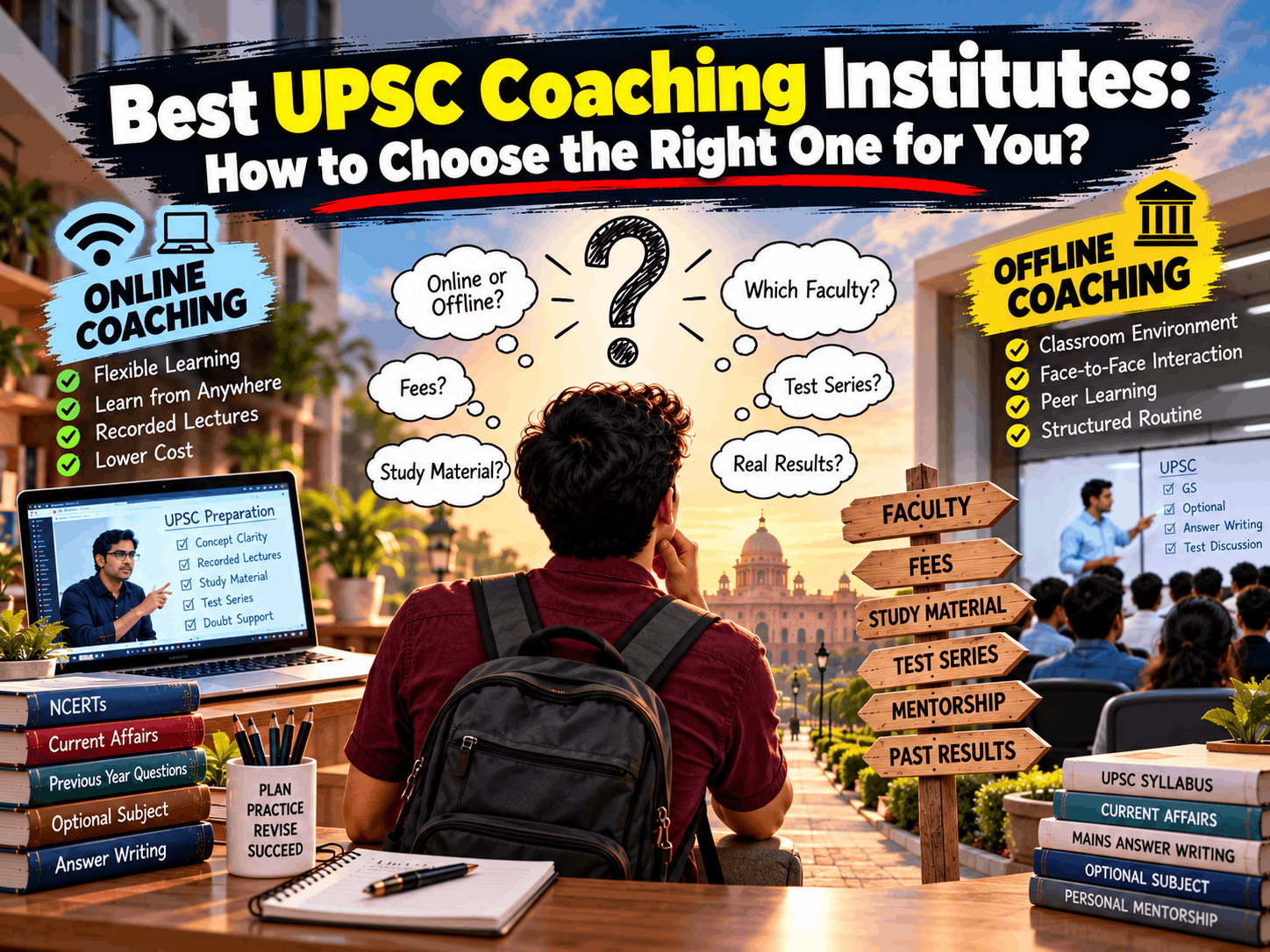
The best coaching institute for UPSC is one that provides good faculty, structured preparation, regular answer evaluation, test practice and reliable mentorship. There is no single institute that is best for every aspirant.
Before enrolling, attend a demo class, check who will teach your batch, ask how doubts are resolved and verify what the course fee includes. Also consider whether online or offline learning suits your schedule, learning style and budget.
At Rahul Sir’s IAS Academy in Nagpur, we bring over 14 years of UPSC teaching and mentoring experience, along with Rahul Sir’s own experience of appearing for the UPSC interview three times. Our approach focuses on understanding the examination, practising effectively, revising consistently and improving performance.
My advice: Don’t choose an institute only because it is famous. Choose one that gives you the right guidance and helps you turn your preparation into marks.
2.Is IAS tougher than IIT?
Is IAS tougher than IIT? The answer depends on what you mean by tougher. Both are highly competitive, but they test different abilities.
IIT-JEE primarily tests conceptual understanding, problem-solving speed and accuracy in Physics, Chemistry and Mathematics. UPSC CSE tests a much broader range of knowledge, analytical ability, answer writing, current affairs and personality through its interview stage.
| Factor | IIT-JEE | UPSC Civil Services |
|---|---|---|
| Main challenge | Solving complex problems accurately | Mastering a vast syllabus and applying knowledge |
| Syllabus | Primarily Physics, Chemistry and Mathematics | General Studies, Optional subject, Essay and other components |
| Preparation style | Conceptual clarity, numerical practice and timed tests | Reading, revision, MCQs, answer writing and analysis |
| Examination stages | JEE Main and, for IIT admission through the usual route, JEE Advanced | Prelims, Mains and Personality Test |
| Key skills | Speed, accuracy and problem-solving | Knowledge integration, analytical writing and judgement |
| Preparation challenge | Developing strong concepts and solving difficult questions under time pressure | Retaining a broad range of information and producing effective answers across subjects |
So, which one is tougher?
There is no objective, universal answer. JEE Advanced can be extremely demanding in mathematical and scientific problem-solving, while UPSC requires sustained preparation across a wider range of subjects and skills.
One important distinction is that UPSC selection involves competing for a limited number of civil-service vacancies, whereas IIT admission depends on JEE performance, rank, seat availability and the admission process.
From my perspective as a UPSC mentor, aspirants sometimes underestimate the examination because it does not rely primarily on advanced mathematics or science. In reality, mastering the syllabus, revising effectively, writing good answers and maintaining consistency over a long preparation cycle are substantial challenges.
My conclusion: Don’t choose between IAS and IIT based on which examination sounds tougher. Consider your aptitude, interests and the kind of work you want to do. Both require serious preparation, but the abilities they reward are different.