

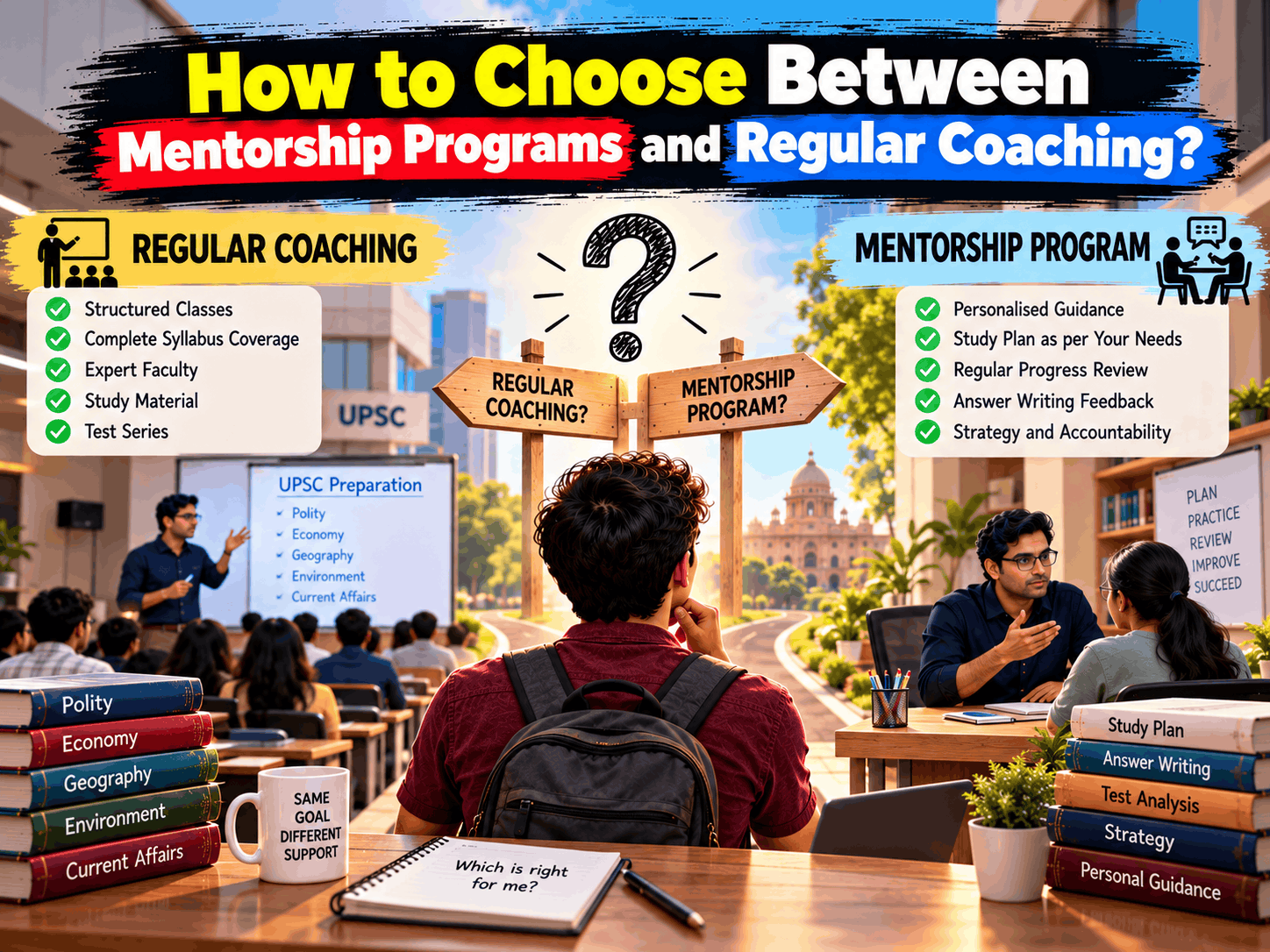

A student once asks me, “Sir, should I join a regular UPSC coaching class or take a mentorship programme? I am confused about which one will help me more.”
It is a reasonable question. Today, aspirants have access to classroom courses, online lectures, test series, personal mentors and several combinations of these services. Every programme promises to make preparation easier, but that does not mean every student needs the same kind of support.
After more than 14 years of teaching and mentoring UPSC aspirants, I have come to believe that the decision should begin with one simple question: What exactly is missing from your preparation right now?
If you do not understand basic subjects, you may need regular teaching. If you already know the syllabus but cannot organise your preparation, a mentorship programme may be more useful. And sometimes, you may need both.
Let us understand the difference before you spend your money.
What Is Regular UPSC Coaching?
Regular coaching generally follows a structured teaching schedule. You attend classes, study the prescribed material, complete the syllabus and practise questions through tests or assignments.
For a beginner, this structure can be valuable. UPSC has a vast syllabus, and a new aspirant may struggle to decide where to start, which books to follow and how different subjects fit together.
A good foundation course helps bring order to that confusion.
For example, if you have just graduated and are beginning UPSC preparation, you may not know how to approach Indian Polity, Modern History, Geography or the Economy. You may also be unfamiliar with the difference between preparing for Prelims and writing Mains answers.
Regular coaching can help you build that foundation under the guidance of teachers.
However, there is one thing you should remember: attending classes is not the same as completing your preparation.
You still have to revise, practise questions, work on answer writing and identify your weak areas. Even after attending every lecture, you may need individual guidance to understand why your preparation is not progressing as expected.
What Is a UPSC Mentorship Programme?
A mentorship programme focuses more on the individual aspirant than on delivering the same lectures to an entire batch.
Depending on the programme, a mentor may help you understand the syllabus, create a realistic timetable, choose resources, plan revisions, analyse mock-test performance and identify mistakes in your preparation.
Think of a student who has already studied most of General Studies but keeps changing books and strategies every few months. The student has plenty of information but lacks direction.
Sending this student to another complete foundation course may not solve the underlying problem. What may help is someone who can examine the preparation, identify the gaps and suggest what needs to change.
That is where mentorship can be useful.
A good mentor should not simply give you a timetable and ask you to follow it. The mentor should help you assess your progress and make adjustments when circumstances or performance demand them.
Of course, the word mentorship is used very loosely in the coaching industry. Some programmes offer regular one-to-one discussions and detailed feedback, while others provide occasional group sessions. Before enrolling, find out exactly what the service includes.
Regular Coaching vs Mentorship: What Is the Difference?
| Factor | Regular coaching | Mentorship programme |
|---|---|---|
| Main purpose | Teach subjects and cover the syllabus | Guide your individual preparation |
| Teaching format | Usually classroom or online lectures | Often individual or small-group interactions |
| Study plan | Generally follows a common course schedule | May be tailored to your preparation level |
| Doubt solving | Depends on the institute’s system | May include personalised discussions |
| Progress tracking | Often linked to classes and tests | May include regular reviews and corrective guidance |
| Best suited for | Beginners and students needing subject teaching | Aspirants who need direction, feedback and accountability |
| Main limitation | Individual needs may receive limited attention | Cannot replace subject teaching when fundamentals are weak |
These are general differences. Actual services vary from one institute to another, so examine the programme rather than relying only on its label.
Who Should Choose Regular UPSC Coaching?
If you are a beginner, start by evaluating how comfortable you are with the syllabus and the basic subjects.
You may benefit from regular coaching if:
- You are starting from scratch and need concepts explained systematically.
- You are unsure which resources to use for different subjects.
- You learn better through scheduled classes and teacher-led explanations.
- You need a structured route through Prelims and Mains preparation.
- You have difficulty understanding topics through self-study alone.
Let me give you a practical example.
Suppose you open the UPSC syllabus for the first time. You see constitutional provisions, economic development, environment, international relations and several other areas. You begin searching online and discover dozens of recommended books, lecture series and study plans.
Within a few weeks, you have accumulated resources but still do not know what to study first.
In this situation, a well-designed foundation course may help you establish direction and understand the subjects systematically.
But do not join a course merely because you are a beginner. First examine the quality of the teaching, the course structure and the guidance available. A poorly organised foundation programme can leave you just as confused as before.
Who Should Choose UPSC Mentorship?
Mentorship can be particularly useful for aspirants who have already started preparing but are struggling to move forward.
Consider whether any of these situations sound familiar:
- You have completed a substantial part of the syllabus but are unsure how to revise.
- You keep changing your timetable, books or preparation strategy.
- Your Prelims mock-test scores are not improving despite studying regularly.
- You understand topics but struggle to write effective Mains answers.
- You are preparing alongside a job or college and need a realistic study plan.
- You need someone experienced to review your progress and point out mistakes.
In these cases, another lecture may not be the answer.
You may need to understand why your current approach is not producing the desired results. Are you revising enough? Are you analysing previous-year questions? Are you spending too much time on one subject? Are you avoiding answer writing because you are afraid of making mistakes?
An experienced mentor can help you examine these questions objectively.
However, mentorship works only when you participate honestly. If you hide your actual study hours, avoid tests or repeatedly ignore agreed targets, even a good mentor will find it difficult to help.
Can You Choose Both Coaching and Mentorship?
Yes. In fact, some aspirants benefit from combining the two.
Regular coaching can help you understand the subjects, while mentorship can help you organise the rest of your preparation.
For example, you may attend an online foundation course for General Studies and simultaneously receive guidance on Optional selection, revision planning, answer writing and mock-test analysis.
But there is no need to purchase both services automatically. First identify whether the mentorship programme offers something your coaching course does not already provide.
If your institute already gives you meaningful individual guidance, regular progress reviews and answer-writing feedback, a separate mentorship programme may add little value.
On the other hand, if your classes provide only lectures and study material, targeted mentorship may address an important gap.
Pay for the support you need, not for the number of features listed in a brochure.
How Do You Identify a Good UPSC Mentor?
This deserves careful attention because a mentorship programme can influence how you spend months of preparation.
Before joining, ask the following questions.
1. Does the mentor understand the UPSC examination?
Look for a sound understanding of the syllabus, examination stages, previous-year questions, answer writing and the demands of preparation. A mentor should be able to explain the reasoning behind recommendations rather than simply handing you a timetable.
2. Will your preparation be reviewed individually?
Ask how often you will meet or speak with the mentor. Will the discussion focus on your actual progress, or will every student receive the same generic advice?
3. Will the mentor help you identify mistakes?
Motivation is useful, but you also need honest feedback. A mentor should be willing to tell you when your strategy is not working and explain how to improve it.
4. Is the programme clear about its services?
Find out whether the fee includes personal calls, written feedback, test analysis, doubt solving and follow-up sessions. Do not assume that all these services are included just because a programme advertises personal mentorship.
5. Does the mentor encourage independent thinking?
The purpose of mentorship is to help you make better decisions, not to make you dependent on someone else for every small choice. Over time, you should become more capable of assessing your preparation yourself.
How Much Should You Spend on Coaching or Mentorship?
The answer depends on the support you need and what the programme actually offers.
A comprehensive coaching course may involve a substantial fee because it includes teaching across several subjects. A mentorship programme may cost less or more depending on its duration, frequency of interaction and level of individual support.
Do not compare the prices without comparing the services.
If you need subject teaching, paying for mentorship alone may leave your conceptual gaps unresolved. If you already understand the subjects but need help with strategy and accountability, an expensive foundation course may be an unnecessary addition.
Before paying, ask yourself: What problem will this programme solve that I cannot currently solve on my own?
If you cannot answer that question, take some time to evaluate your options.
My Advice as a UPSC Mentor
In my 14-plus years of teaching and mentoring aspirants, I have seen how easily students can confuse activity with progress. They attend classes, collect notes, buy test series and follow multiple study plans, yet sometimes struggle to understand what is actually holding them back.
This is one reason I believe the choice between coaching and mentorship should depend on the stage of your preparation.
If you need to learn the subjects, start with quality teaching. If you already have the knowledge but lack direction, look at mentorship. If you need both, consider a programme that combines them without making you pay twice for the same service.
My own experience of appearing for the UPSC interview three times has also shaped the way I look at preparation. Understanding the examination is important, but so is knowing how to use your time, evaluate your performance and correct mistakes along the way.
At Rahul Sir’s IAS Academy in Nagpur, our approach is centred on structured preparation, examination-oriented practice and guidance that helps aspirants identify what needs improvement. Whatever programme you choose, make sure the support is practical and relevant to your needs.
One final point: neither coaching nor mentorship can do the studying for you. You must revise, practise questions, write answers and act on feedback.
Choose regular coaching if you need to learn. Choose mentorship if you need direction. Choose both only when both serve a clear purpose.
That is a more sensible way to invest in your UPSC preparation than choosing a programme simply because everyone else is talking about it.
See also:
Best UPSC coaching institute: How to choose the right one for you?
What’s the average cost of UPSC coaching in India? A mentor’s honest answer
Should I join online or offline UPSC coaching? A mentor’s Honest answer
FAQs:
1. What is the difference between UPSC mentorship and regular coaching?
Regular coaching primarily focuses on teaching the syllabus, explaining concepts and providing structured classes. A UPSC mentorship programme focuses more on individual guidance, study planning, progress tracking, answer-writing feedback and identifying weaknesses. The right choice depends on whether you need help understanding the subjects or improving your preparation strategy.
2. Should I join a UPSC mentorship programme if I have already completed coaching?
Yes, mentorship can be useful if you have completed coaching but are struggling with revision, answer writing, mock-test performance or time management. A mentor can help identify gaps and suggest practical improvements. However, choose a programme that offers personalised feedback and regular progress reviews rather than simply providing another set of lectures or study materials.