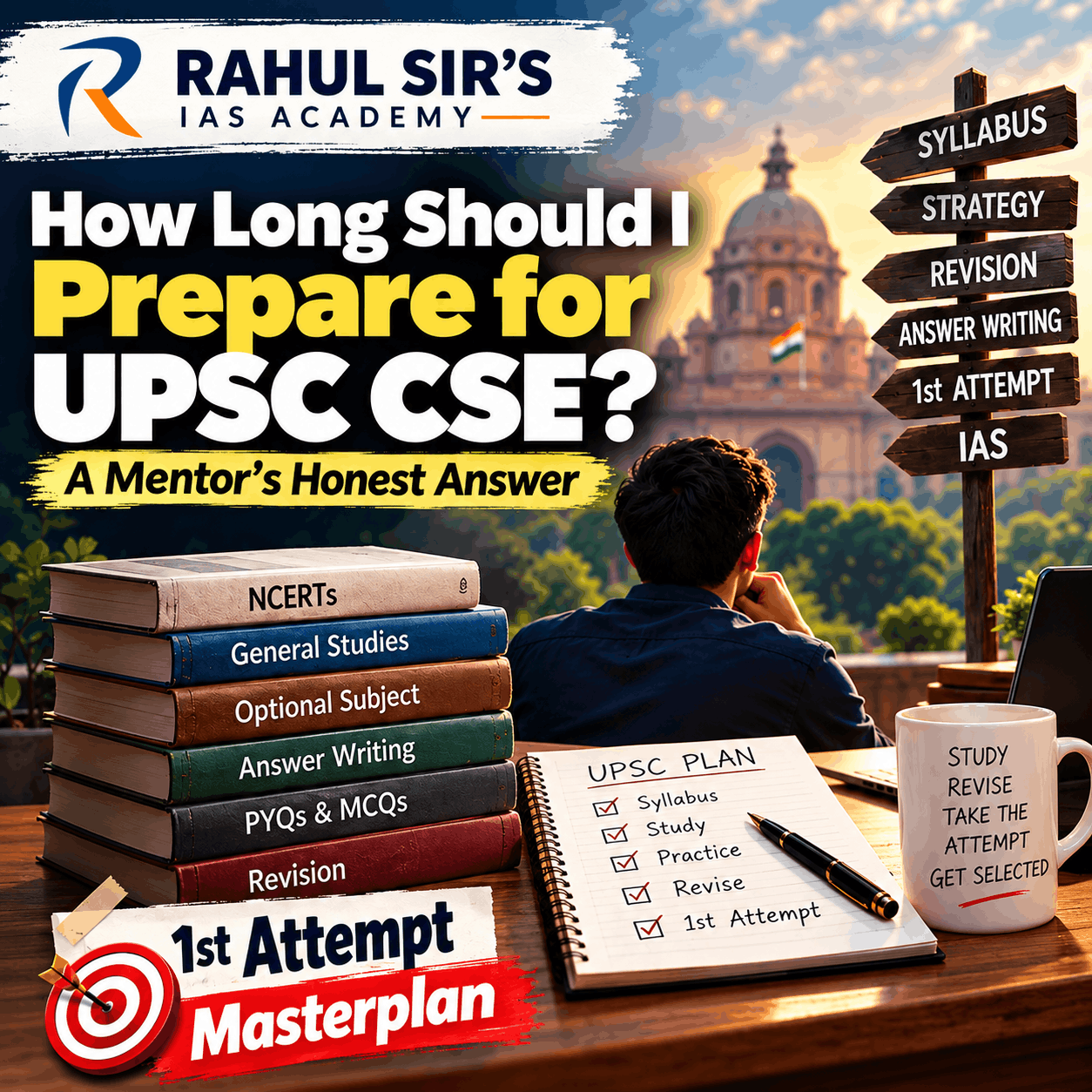
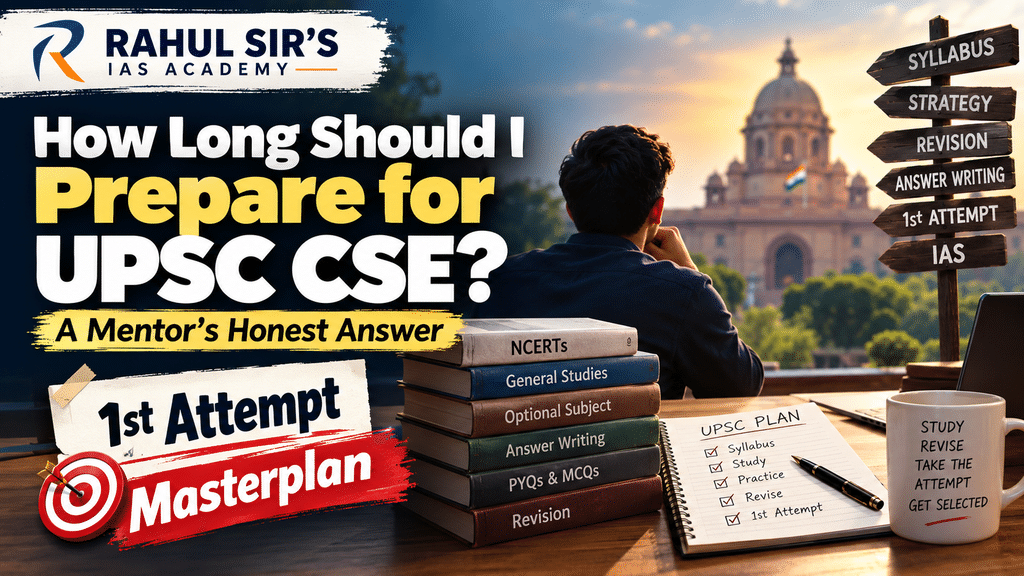
How Long Should I Prepare for UPSC CSE? A Mentor’s Honest Answer
One of the first questions almost every UPSC aspirant asks is: “Sir, how long does it take to prepare for UPSC?”
One year? Two years? Three years?
You will find different answers everywhere. Some people say UPSC can be cracked in one year. Others recommend two or even three years of preparation. And then there are aspirants who keep preparing for years without ever feeling ready to take the examination.
After more than a decade of mentoring UPSC aspirants, I look at this question differently.
The duration of preparation is not the most important question. Your level of preparation is.
If you are ready, you should take the attempt.
If you are not ready, taking an attempt simply because the examination is approaching may do more harm than good.
So rather than asking, “How many months or years should I prepare?”, ask yourself:
“What should I have completed before I take my first serious attempt?”
That is a much more useful question.
Why Join RAHUL SIR’S IAS ACADEMY
There Is No Magic Number of Study Hours
Let me first address another popular myth.
You will often hear that UPSC requires 10, 12 or even 14 hours of study every day.
I don’t subscribe to that idea.
In fact, I think a lot of this is simply donkey work.
UPSC is not an examination where the person who sits at the study table for the longest automatically wins.
The examination is designed to assess a person’s overall personality, awareness, analytical ability, judgment and ability to express ideas. You need to know something about a wide range of subjects, but you also need to understand what UPSC actually asks and how answers need to be written.
And, of course, you need to understand the Previous Year Questions.
I know several people who cleared UPSC while working full-time.
One of my colleagues at Maruti, Saurabh Maheshwari, secured All India Rank 1 while working.
That is a useful reminder that the number of hours spent studying is not, by itself, a measure of your chances of success.
Your grasping ability, planning, quality of study, revision, answer-writing practice and ability to understand the examination all matter.
So don’t make the mistake of thinking:
“If I cannot study for 10 hours a day, I cannot crack UPSC.”
That is simply not how I look at UPSC preparation.
Also Read – IAS Kaise Bane
So, How Long Should a Full-Time Aspirant Prepare?
For a serious, full-time aspirant, my preferred timeframe is around 18 months.
But there is an important qualification.
Those 18 months should not mean 18 months of attending classes, reading books and collecting notes.
By the time you are ready to take your serious attempt, your preparation should ideally include:
- Complete General Studies syllabus
- Complete Optional Subject syllabus
- Answer-writing practice
- Prelims and Mains PYQ analysis
- MCQ practice
- At least three revisions of the syllabus
That last point is particularly important.
Completing the syllabus once does not mean you are prepared for UPSC.
You may have read everything once and still be unable to recall it in the examination hall.
That is why revision is not something you do after preparation.
Revision is preparation.
What About Students Preparing Alongside College or a Job?
This is where you should not compare yourself with a full-time aspirant.
If you are preparing alongside a job or college, your preparation will naturally take longer.
And there is absolutely nothing wrong with that.
The mistake is to think:
“My friends are giving the examination this year, so I should also give it.”
No.
If you are studying part-time, do not rush into an attempt simply because an examination is approaching.
Take the time you need to complete the syllabus properly.
Your target should be the same:
- Complete the syllabus
- Complete the Optional
- Practice answer writing
- Revise properly
- Reach a level where you are genuinely prepared for Mains
The calendar should not decide when you take your attempt.
Your preparation should.
The Biggest Mistake: Giving an “Experience Attempt” (How Long Should I Prepare for UPSC CSE? A Mentor’s Honest Answer)
There is a piece of advice that I strongly disagree with:
“Give one attempt just for experience.”
I have seen this approach create a cycle from which aspirants find it difficult to come out.
Imagine a candidate has completed only 50 or 60% of the syllabus.
The Prelims notification arrives.
Suddenly, the entire preparation changes.
Instead of continuing with an integrated UPSC preparation plan, the candidate starts studying only for Prelims.
The Optional is pushed aside.
Answer writing is pushed aside.
Mains preparation is pushed aside.
Everything becomes:
“Somehow, I should clear this Prelims.”
And after spending several months doing that, the candidate may not even clear Prelims.
What happens next?
The candidate feels frustrated.
Self-doubt starts creeping in.
Another attempt is planned.
And the same cycle begins again.
This is one of the reasons some aspirants spend two, three or even more years appearing for UPSC without ever having made one properly planned, fully prepared attempt.
The problem isn’t necessarily that they didn’t work hard.
They worked hard.
They simply worked towards the wrong immediate objective.
Don’t Give an Attempt Just Because Your Friends Are Giving One
I have had aspirants ask me:
“Sir, my friends are appearing this year. Should I also appear?”
My answer is simple:
No.
Your friend’s preparation has nothing to do with your preparation.
UPSC is not a college examination where everyone in your batch appears together.
If your preparation is incomplete, there is no virtue in appearing merely because everyone around you is appearing.
In fact, you may be better off using that year to prepare properly for the next attempt.
Remember:
Your attempt should be decided by your readiness, not by the UPSC calendar or your friends’ preparation.
The Real Question Is Not “Am I Ready for Prelims?”
This is another mistake I see frequently.
An aspirant completes enough preparation to feel that Prelims is within reach and starts thinking about taking the examination.
But ask yourself a bigger question:
If I clear Prelims tomorrow, am I ready for Mains?
That is the real test.
There is no point in treating Prelims as the final destination.
You have to clear the entire Civil Services Examination.
So before taking your serious attempt, ask yourself:
- Have I completed the syllabus?
- Have I completed my Optional?
- Have I started writing answers?
- Have I analyzed PYQs properly?
- Have I revised the syllabus?
- Can I handle Mains if I clear Prelims?
If the answer to these questions is no, then why are you in a hurry to appear?
How Should You Actually Structure Your UPSC Preparation?
Rather than thinking in terms of “one year” or “two years”, I recommend thinking in terms of milestones.
Here is the broad sequence I suggest.
1. Understand the UPSC Syllabus First
Don’t start your preparation by blindly opening books.
First understand what UPSC actually wants you to study.
The syllabus should be your roadmap.
2. Analyze Previous Year Questions
The syllabus tells you what UPSC can ask.
PYQs tell you what UPSC actually asks.
This distinction is extremely important.
Spend time with Previous Year Questions of both Prelims and Mains.
You will begin to understand the examination much better once you start seeing the pattern yourself.
3. Identify the Resources You Actually Need
Once you understand the syllabus and PYQs, identify the books, notes and other resources required.
And then stop.
Don’t keep adding resources every month.
One of the biggest problems today is information overload.
Aspirants have access to far more material than they can possibly revise.
4. Make a Timetable for Completion
This is an important step that many aspirants skip.
Don’t simply write:
“I will study Polity today.”
Create a realistic timetable for completing the syllabus.
Then follow it.
Your timetable should ultimately take you towards a point where the entire syllabus is covered and you have enough time left for revision.
5. Start With NCERTs
NCERTs can provide a useful foundation, particularly when you are beginning your preparation.
Build your basic understanding first and then move towards your standard resources.
But remember: reading NCERTs is not an end in itself.
The objective is to build understanding that eventually helps you answer UPSC questions.
6. Start Answer Writing Early
Don’t make the mistake of saying:
“I’ll start answer writing after completing the syllabus.”
Start early.
Your first answers may be terrible.
That’s fine.
You are not expected to write perfect answers on Day 1.
Answer writing is a skill. Like any skill, it improves with practice and feedback.
7. Start Exploring Your Optional Within Two Months
Do not leave the Optional Subject for the very end.
Within the first couple of months, start working on it gradually.
You don’t necessarily have to make it your primary focus immediately, but you should begin understanding the syllabus, PYQs, resources and answer requirements.
Once your General Studies preparation is substantially complete, the Optional should become a major focus.
Don’t Forget the Prelims-Mains Connection
Another common mistake is to prepare for Prelims and Mains as if they are two completely unrelated examinations.
They aren’t.
While preparing General Studies, give greater attention to areas that are relevant to both Prelims and Mains.
Use:
- PYQs
- Chapter-wise MCQs
- Mains answer writing
- Revision
The objective should be an integrated preparation rather than:
“First I’ll somehow clear Prelims. Then I’ll think about Mains.”
That approach is exactly what I want serious aspirants to avoid.
How Many Revisions Should You Do?
My answer is simple:
Three revisions before your serious attempt.
Why three?
Because the first reading gives you familiarity.
The second reading gives you better retention.
The third revision begins to give you command over the material.
And UPSC is an examination where recall matters enormously.
You don’t want to enter the examination thinking:
“I have read this somewhere.”
You want to be able to think:
“I know this. I know what UPSC is asking. I know how to answer it.”
That comes from revision.
Your First Attempt Should Be Your Last Attempt
This is the mindset I want every serious aspirant to develop.
Don’t think:
First attempt — experience
Second attempt — serious
Third attempt — selection
Instead:
My first attempt is my last attempt.
That doesn’t mean you should panic.
It means you should prepare properly before taking that attempt.
Don’t enter the examination hoping that you will learn from failure.
Enter the examination prepared to clear it.
So, What Is the Ideal UPSC Preparation Duration?
If you are a full-time aspirant, around 18 months is the timeframe I generally recommend for a comprehensive preparation cycle.
For someone preparing alongside a job or college, it may take longer.
And that’s perfectly fine.
There is no prize for finishing your preparation in the shortest possible time.
The important thing is that, before you appear, you have:
- Completed the syllabus
- Covered the Optional
- Practiced answer writing
- Analyzed PYQs
- Practiced MCQs
- Completed at least three revisions
- Prepared yourself for Mains, not just Prelims
Once you reach that stage, you are ready to take the coming attempt.
The Simplest Way to Look at UPSC Preparation
Honestly speaking, getting selected in UPSC is a simple process.
Not an easy process.
A simple process.
There is a difference.
The process is:
Study → Revise → Take the coming attempt → Get selected.
Aspirants often make it complicated by:
- changing resources repeatedly,
- watching endless topper interviews,
- appearing before they are ready,
- preparing Prelims and Mains separately,
- delaying answer writing,
- postponing the Optional,
- and constantly looking for a new strategy.
You don’t need a new strategy every few weeks.
You need to understand the examination, create a plan and execute it consistently.
Final Advice From a Mentor
If you are wondering whether you need one year, eighteen months or two years, don’t let someone else give you a number and blindly follow it.
Ask yourself:
Have I completed what needs to be completed?
If yes, take the attempt.
If not, keep preparing.
There is nothing wrong with taking another six months or another year if that is what you genuinely need to become ready.
But don’t waste an attempt just because the examination is coming.
And don’t spend three years preparing simply because you never had a clear plan.
At Rahul Sir’s IAS Academy, I have seen both kinds of aspirants—those who worked extremely hard but remained directionless, and those who followed a clear strategy and progressed much faster.
The difference is often not intelligence.
It is not even the number of hours they study.
It is whether they know what to do, when to do it, and when they are actually ready to take the examination.
So remember:
Don’t appear for UPSC until you are ready with three revisions.
And when you finally appear, go with one mindset:
My first attempt is my last attempt.
See Also
How Much Time Does It Take to Prepare for UPSC CSE?
There is no fixed answer. It depends on whether you are preparing full-time, studying alongside college, or working.
For a full-time aspirant, I recommend around 18 months for a serious, integrated preparation. This should ideally include:
Complete GS syllabus
Optional subject preparation
Answer writing
Prelims + Mains integration
At least 3 revisions
If you are working or studying alongside preparation, the timeline may be longer. But don’t measure preparation only by the number of months or hours you study every day.
The real question is:
“Am I ready to face the examination?”
My advice is simple: don’t rush into an attempt just because your friends are appearing. Complete the syllabus, practise PYQs and answer writing, and aim to enter the exam with three solid revisions behind you.
Study → Revise → Take the Attempt → Get Selected.
That is the approach I recommend through Rahul Sir’s IAS Academy – 1st Attempt Masterplan.
Is 300 Days Enough for UPSC?
Yes — 300 days can be enough, but only if you use those 300 days properly.
Don’t think of 300 days as a countdown. Think of it as a structured preparation cycle.
If you are starting from scratch, you need to cover the syllabus, understand PYQs, build your Optional, practise answer writing, prepare for Prelims, and most importantly, revise repeatedly.
The biggest mistake is spending 300 days only studying new material. By the end, you should have completed the syllabus and ideally gone through at least 3 revisions.
So the real question isn’t:
“Are 300 days enough?”
It is:
“Can I complete the syllabus, practise, and revise three times in 300 days?”
With a clear plan, disciplined execution and the right guidance, 300 days is a serious amount of time for UPSC preparation.
Study → Revise → Take the Attempt → Get Selected.
Rahul Sir’s IAS Academy – 1st Attempt Masterplan is built around exactly this approach.
Has Anyone Cracked UPSC With a Job?
Absolutely. Preparing for UPSC while working is difficult, but it is certainly possible.
In fact, I know candidates who have cleared UPSC while continuing with their jobs. One of my former colleagues at Maruti, Saurabh Maheshwari, secured AIR 1 while working.
So don’t make the mistake of thinking that you need to quit your job and study for 10–12 hours every day.
UPSC is not about counting study hours. It is about how effectively you use the time available to you.
If you are working, focus on:
A realistic daily schedule
Limited and relevant study material
PYQ-based preparation
Consistent answer writing
Starting your Optional early
Integrating Prelims and Mains preparation
Using weekends and holidays intelligently
Revising instead of constantly collecting new material
The key is consistency, not the number of hours on your clock.
And one important point: don’t keep postponing your attempt indefinitely because you have a job. Prepare systematically, complete the syllabus, revise thoroughly, and appear when you are genuinely ready.
Your job doesn’t have to be an obstacle to UPSC. With the right strategy, it can coexist with your preparation.
Rahul Sir’s IAS Academy – 1st Attempt Masterplan