

Every year, thousands of UPSC aspirants leave their hometowns and move to Delhi with one dream: to become an IAS officer.
For many students, Delhi represents the beginning of serious preparation. They believe that studying alongside thousands of other aspirants, attending reputed coaching institutes and living in an environment focused on civil services will improve their chances of selection.
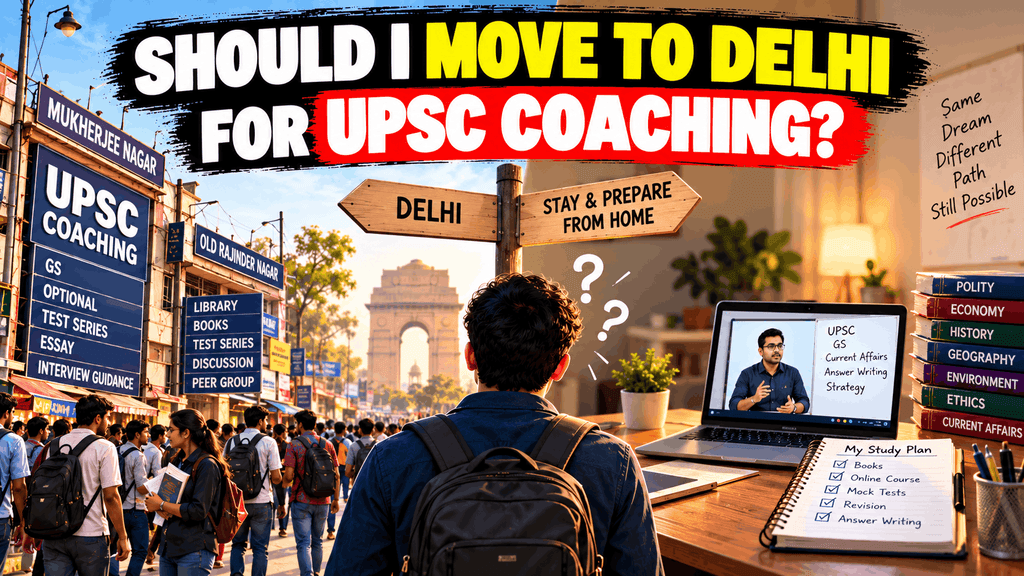
But there is a question worth asking before booking your train ticket or looking for a room in Mukherjee Nagar or Old Rajinder Nagar.
Do you really need to move to Delhi to clear UPSC?
Having spent over 14 years teaching and mentoring UPSC aspirants, and having appeared for the UPSC interview three times myself, I would say that moving to Delhi can be useful for some students, but it is certainly not compulsory.
I have seen aspirants become confused about this decision because they assume that serious preparation is possible only in Delhi. Others move there because their friends are going, or because they believe that living in the same city as successful candidates will somehow improve their own preparation.
Before making such a major decision, you should understand what Delhi can offer, what it will cost you and whether you actually need those advantages.
Let’s look at this practically.
Why Do So Many UPSC Aspirants Move to Delhi?
Delhi has developed a strong ecosystem around civil services preparation. Areas such as Mukherjee Nagar and Old Rajinder Nagar are well known among UPSC aspirants because they offer access to coaching institutes, libraries, bookshops, accommodation and communities of fellow candidates.
For someone who has never prepared for UPSC before, this environment can feel reassuring.
You can attend classes, discuss difficult topics with other aspirants, visit bookshops and learn about preparation strategies from people who are at different stages of the journey.
There is also a certain psychological attraction to being surrounded by people pursuing the same goal. When everyone around you is studying Polity, discussing current affairs or preparing for a mock test, it may become easier to take your own preparation seriously.
However, there is another side to this environment.
Living in an area full of UPSC aspirants does not automatically make you a disciplined student. Attending classes does not guarantee that you will revise what you learn. And discussing preparation strategies with other candidates does not necessarily mean your own preparation is improving.
You can spend months in Delhi attending lectures, collecting notes and discussing books without making sufficient progress on answer writing or revision.
The environment can support your preparation, but it cannot replace the work itself.
What Are the Advantages of Moving to Delhi for UPSC Coaching?
Moving to Delhi can be a sensible decision if you understand what you want to gain from the experience.
1. Access to coaching institutes and teachers
Delhi has a large concentration of UPSC coaching institutes offering classroom courses, test series, Optional subject classes and mentorship programmes.
If you prefer face-to-face teaching, want to interact with teachers directly or need classroom explanations to understand difficult subjects, this access may be valuable.
You can also compare institutes, attend available demo classes and evaluate different teaching approaches before committing to a course.
However, remember that a coaching institute’s location does not establish the quality of its teaching. Evaluate the faculty, course structure, answer evaluation and support available to students before paying the fees.
2. Interaction with other aspirants
Preparing for UPSC can sometimes feel isolating, particularly when you are studying alone in your hometown.
In Delhi, you may find students who understand the demands of the examination and are willing to discuss difficult topics, exchange notes or practise answer writing together.
A good peer group can help you remain accountable and expose you to different ways of approaching questions.
But choose your company carefully.
Some study groups spend more time discussing the latest strategy, comparing mock-test scores and watching topper interviews than actually studying. Others can create unnecessary anxiety by constantly talking about how much they have completed.
Your peer group should help you prepare better, not make you question your preparation every day.
3. A more structured daily routine
For some students, moving away from home creates a useful separation between personal life and study time.
You may establish a routine around classes, library hours, meals, revision and practice tests. If your home environment is noisy or full of interruptions, living independently could provide the quiet space you need.
But this advantage depends on your habits.
If you struggle with discipline, moving to Delhi will not automatically solve that problem. You will still have to manage your time, avoid distractions and follow your study plan.
A disciplined student can prepare effectively in a small town. An undisciplined student can waste time even in the middle of a well-established UPSC coaching hub.
4. Access to libraries and preparation resources
Delhi offers libraries, reading rooms, bookshops and other services that can make preparation more convenient.
These facilities may be especially useful if you need a dedicated place to study or prefer a classroom-and-library routine.
However, most essential UPSC resources are also available online. Books, previous years’ question papers, current affairs material, lectures and test series can often be accessed without relocating.
Ask yourself whether the resources you need are genuinely unavailable where you currently live. If they are available online or through a reliable local institute, moving may not provide enough additional value to justify the expense.
What Are the Disadvantages of Moving to Delhi?
The advantages are real, but so are the costs. Before deciding, consider the complete picture rather than looking only at coaching fees.
1. The financial burden can be substantial
Moving to Delhi involves more than paying for a coaching course.
You may need to pay for accommodation, food, transport, books, a library membership, test series and other preparation-related expenses. There may also be a deposit for your room, travel costs and unexpected monthly expenses.
The total depends on where you stay, your lifestyle and the courses you choose. Costs can vary considerably, so obtain current quotes before making a budget.
More importantly, consider the opportunity cost.
If your family is making a significant financial sacrifice to support your preparation, you should be particularly careful about spending money on facilities you may not need.
The objective is not to spend as much as possible on UPSC preparation. It is to use your available resources intelligently.
2. You may spend time adjusting to a new environment
Moving to another city involves practical challenges.
You need to find accommodation, arrange meals, manage household responsibilities and become familiar with a new environment. If you are not accustomed to living independently, these adjustments may take time.
Some students settle in quickly. Others struggle with loneliness, homesickness or the absence of familiar support systems.
None of this means that moving is a bad decision. It simply means that relocation has a learning curve, and you should account for it when planning your preparation.
3. Competition can create unnecessary pressure
When you are surrounded by other aspirants, it is easy to compare your progress with theirs.
Someone tells you that they have completed the syllabus. Another person claims to have revised three times. A third says they are studying for twelve hours every day.
Suddenly, your own preparation begins to feel inadequate.
You may start changing books, buying additional courses or modifying your timetable because you are worried about falling behind.
Remember that you rarely know the complete story behind another person’s preparation. You do not know how effectively they are studying, how much they remember or how well they perform under examination conditions.
Focus on your own progress.
Are you understanding the subjects? Are your answers improving? Are you revising regularly? Are you learning from your mistakes?
These are more useful indicators than the number of hours someone else claims to study.
4. More study material can become a distraction
Delhi offers access to an enormous amount of study material. That can be helpful, but it can also make resource selection more confusing.
You may begin with one set of notes, discover another institute’s material and decide that you should read both. Then someone recommends a new book, and you add that to your list as well.
Before long, you have more resources than you can reasonably complete.
UPSC preparation requires selective study. You need to understand the syllabus, choose appropriate resources and revise them repeatedly.
Collecting material is not the same as preparing for the examination.
Can You Clear UPSC Without Moving to Delhi?
Yes. Moving to Delhi is not a requirement for clearing the Civil Services Examination.
You can prepare from your hometown using books, online lectures, digital study material, test series and other resources. Depending on your circumstances, you may also join a good local coaching institute or seek mentorship when you need help with planning and evaluation.
What matters is whether your preparation covers the requirements of the examination.
You need to understand the syllabus, analyse previous years’ question papers, build a sound foundation in General Studies, prepare your Optional subject, practise answer writing and revise consistently.
For Prelims, you need regular MCQ practice and careful analysis of mistakes. For Mains, you need to develop the ability to write relevant, well-structured answers within the available time.
You must also find a way to evaluate your progress. If you are preparing independently, test series, answer evaluation and feedback from a knowledgeable mentor can help you identify areas that need improvement.
The challenge of preparing outside Delhi is not that success becomes impossible. It is that you must create a reliable preparation system using the resources available to you.
That is entirely achievable.
Online Coaching vs Moving to Delhi: Which Is Better?
This is where you should examine your own learning preferences.
Suppose you need a teacher to explain difficult concepts and want regular interaction. You could join a classroom programme in Delhi, but you might also find a suitable offline institute in your own city.
Alternatively, you could choose an online course that provides structured lectures, tests and doubt support.
Online learning offers flexibility. You can revisit recorded lectures, avoid daily commuting and study from home. It may also reduce the additional expenses associated with relocating.
However, online preparation requires self-discipline. If you repeatedly postpone lectures or allow a backlog to accumulate, the flexibility becomes a disadvantage.
Classroom coaching provides a fixed schedule and face-to-face interaction, but you still need to revise, practise and evaluate your performance outside the classroom.
Neither format guarantees selection.
Good guidance delivered online can be more useful than poor teaching delivered in a classroom. Similarly, a student who needs the structure of a physical classroom should not choose online coaching merely because it appears more convenient.
Select the format that helps you learn and prepare consistently.
When Should You Consider Moving to Delhi?
I would consider moving if several of the following conditions apply to your situation.
- You have identified a specific coaching programme in Delhi that offers something you genuinely need.
- You learn significantly better through face-to-face teaching and direct interaction with faculty.
- You need a dedicated study environment that is difficult to arrange at home.
- You have compared suitable local and online alternatives and found that relocating offers a meaningful advantage.
- You have calculated the total cost and can afford it without creating unreasonable financial pressure.
- You have a clear plan for how you will use the facilities, classes and resources available there.
Notice that the decision begins with identifying your needs, not with assuming that Delhi is essential.
You should also investigate the particular institute rather than choosing it simply because it is located in a famous coaching area. Attend a demo class if available, speak to current students where possible and understand exactly what the course includes.
Do not pay a large fee based solely on advertisements, selection posters or claims that an institute is the best.
When Is It Better to Stay in Your Hometown?
Staying where you are may be the better decision if you can study effectively in your current environment.
For example, you may already have access to suitable online courses, books, a quiet study space and reliable internet. You may also have family support that allows you to focus on preparation without worrying about accommodation or daily expenses.
If you are working or completing your degree, relocating may create additional complications without providing a clear benefit.
You might also be at a stage where you need to understand the syllabus and establish your basic preparation strategy before committing to a full coaching programme.
In such cases, begin with the resources available to you. Assess your progress after a reasonable period and identify any gaps.
If you later discover that you need classroom teaching, specialised Optional subject guidance or better answer evaluation, you can reconsider your options.
You do not have to make the most expensive decision at the beginning of your preparation.
A Practical Way to Make Your Decision
Before deciding whether to move to Delhi, sit down with a notebook and answer these five questions.
1. What exactly do I need?
Do you need classroom teaching, a disciplined study environment, a test series, answer evaluation or help choosing resources? Be specific.
2. Can I get the same support locally or online?
Compare the actual services offered, not just the mode of delivery. A course that provides personalised feedback may be more useful to you than a large classroom programme that offers little individual support.
3. What will the complete cost be?
Calculate coaching fees, accommodation, food, transport, study facilities and other expenses. Include the cost of travelling home if you expect to do so regularly.
4. Will moving improve my preparation enough to justify the cost?
Think about the particular benefit you expect. If you cannot identify one, you may be considering relocation mainly because other aspirants are doing it.
5. Am I prepared to use the opportunity well?
Moving cities will not create a study routine for you. Decide how you will manage classes, revision, answer writing, mock tests and rest before you go.
Your answers should make the decision clearer. You may discover that Delhi is a sensible choice for you. Equally, you may realise that you can prepare effectively without leaving home.
Both outcomes are perfectly reasonable.
My Advice to UPSC Aspirants
Over the years, I have met aspirants who believe that moving to Delhi is the first step towards becoming an IAS officer. I would encourage them to reconsider that assumption.
Delhi is a location, not a preparation strategy.
You can move there and still struggle if you do not know what to study, how to revise or how to improve your answers. You can remain in your hometown and prepare effectively if you have the right resources, a workable plan and a reliable way to evaluate your progress.
The important question is not whether you are physically present in a coaching hub. It is whether your preparation is moving in the right direction.
At Rahul Sir’s IAS Academy in Nagpur, my approach is to help aspirants focus on structured preparation, examination-oriented practice and identifying the gaps that prevent them from improving. Students should evaluate coaching based on the guidance and support it provides, not simply on its location.
If you are at the beginning of your journey, take some time to understand the syllabus and your preparation needs. Compare your options carefully before making a major financial commitment.
And if you have already spent months preparing in your hometown, do not assume that your efforts are inadequate simply because you have not moved to Delhi.
Coaching is optional. Guidance is not. You can seek that guidance through different channels, depending on your needs and circumstances.
Your aim is not to study in the city that has the most UPSC aspirants. Your aim is to prepare well enough to compete in the examination.
Make your decision accordingly.
See also:
Best Age to Start UPSC Preparation?
Do Top UPSC Rankers Use Coaching or Self-Study?
How to Choose Between Mentorship Programs and Regular Coaching?
Can I Prepare for UPSC While Working a Full-Time Job?
How Long Should I Prepare for UPSC CSE?
Is Studying 6 Hours a Day Enough for UPSC Preparation?
Best UPSC Coaching Institutes: How to Choose?
What’s the Average Cost of UPSC Coaching in India?
How to Stay Motivated While Preparing for UPSC Exam?
Should I Join Online or Offline UPSC Coaching?
FAQs:
1. Is it necessary to go to Delhi for UPSC preparation?
No, it is not necessary to move to Delhi for UPSC preparation. You can clear the Civil Services Examination while preparing from your hometown, provided you have the right study resources, a structured plan and consistent discipline.
Delhi offers access to coaching institutes, libraries, peer groups and classroom teaching. However, relocating also involves additional expenses for accommodation, food, transport and other living costs. Moreover, living in a coaching hub does not guarantee better preparation or selection.
With online lectures, digital study materials, test series and mentorship, aspirants can access many of the same resources from their hometowns. The key is to understand the syllabus, practise previous years’ questions, revise regularly and evaluate your performance.
My advice: Move to Delhi only if a specific benefit—such as classroom teaching, direct faculty interaction or a dedicated study environment—justifies the additional cost. Otherwise, you can prepare effectively from home.
At Rahul Sir’s IAS Academy, Nagpur, we believe that coaching is optional, but proper guidance is essential. Choose the preparation method that suits your needs, circumstances and learning style rather than relocating simply because other aspirants are doing so.
2. Can I clear UPSC from a small town?
Yes. You can prepare from a small town if you have access to appropriate resources, a realistic study plan and a way to evaluate your progress. Online learning, books, previous years’ papers, mock tests and answer-writing feedback can help you build a structured preparation system without relocating.
3.Can I clear IAS in 1 year?
Yes, you can clear the UPSC Civil Services Examination in one year, provided you have a realistic preparation strategy, consistent discipline and sufficient time to cover the syllabus. If you are starting from scratch, it will be challenging, but not impossible.
Your preparation should include General Studies, the Optional subject, answer writing, Prelims MCQ practice and repeated revision. Avoid collecting too many books or constantly changing your strategy.
As a general guideline, a full-time aspirant may plan around 12–18 months for comprehensive preparation, while someone who has already built a foundation may be able to prepare within a year. The timeline depends on your starting level, available study hours and learning pace.
My advice: Don’t measure your readiness by the number of months alone. Understand the syllabus, practise previous years’ questions, revise thoroughly and assess your performance through mock tests. Aim to make your first attempt a serious, well-prepared attempt rather than treating it as an experiment.