
How to Prepare UPSC Exam Without Coaching
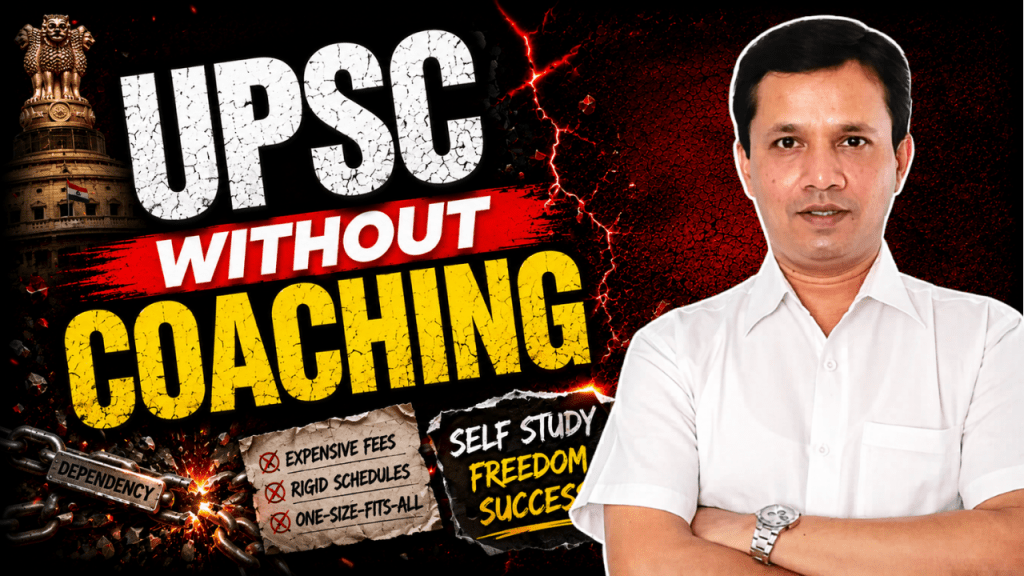
One of the daunting questions many aspirants have is how to prepare UPSC Exam without coaching? Not joining a coaching program can be for a variety of reasons, namely: lack of availability in the city of residence, job, or financial constraints. Every year, thousands of UPSC aspirants ask the same question:
“Can I crack UPSC or how to prepare for UPSC exam without coaching?”
Whenever someone asks me this question, my answer surprises them.
I don’t say “Yes.”
I don’t say “No.”
I say:
“It depends.”
Over the last 14 years, I have interacted with hundreds of UPSC aspirants. Some joined expensive coaching institutes and remained confused. Others prepared largely through self-study and went on to secure excellent ranks.
One of my close friends came from a rural background. He completed his entire education in the Marathi medium and prepared for UPSC in the Marathi medium. In his very first attempt, he secured a rank and got an allied service. Unsatisfied with the result, he appeared again and secured an All India Rank of around 70. Today, he has been serving as an IAS officer in the Jammu & Kashmir cadre for more than two decades. So UPSC preparation is not about location but the right strategy.
Stories like these prove one thing:
UPSC can definitely be cleared without formal coaching.
However, there is another truth that most aspirants fail to understand.
While coaching may be optional, guidance is not.
Let us understand why.
The Real Question Aspirants Should Ask
Most aspirants ask:
“Do I need coaching?”
In my opinion, this is the wrong question.
The better question is:
“Do I understand the right path to crack UPSC?”
The UPSC Civil Services Examination is one of the most comprehensive examinations in the country.
The syllabus is vast.
The preparation process is long.
The number of resources available today is overwhelming.
Without proper direction, an aspirant can easily spend two or three years reading, watching lectures, making notes, and still remain unsure about whether they are actually moving in the right direction.
This is where guidance becomes important.
Also Read – How to Prepare UPSC Ethics: A Complete Strategy to Score 150+ Marks
Coaching and Guidance Are Not the Same Thing
Many aspirants assume that coaching automatically means guidance.
Unfortunately, that is not always true.
Most coaching institutes primarily focus on:
- Completing the syllabus
- Providing study material
- Conducting classes
- Organizing tests
These are useful activities.
But are they enough?
Not necessarily.
True guidance involves helping an aspirant understand:
- What to study
- What not to study
- Which resources to follow
- How to analyze previous year’s questions
- How to choose an optional subject
- How to write answers
- How to plan attempts
- How to maximize marks
- Where to get UPSC preparation Material
- Which UPSC Exam Preparation Books To Read
In short:
Coaching completes the syllabus. Guidance helps you convert preparation into marks.
And UPSC ultimately rewards marks, not effort.
Read My Blogs On Various UPSC Topics
UPSC Is Not a Knowledge Competition. It Is a Marks Competition.
This is perhaps the most important lesson every aspirant must understand.
Many students treat UPSC as a knowledge competition.
They believe that the person who knows the most will get selected.
That is not how the examination works.
UPSC is fundamentally a marks competition.
The Mains Examination carries 1750 marks.
Your rank depends on the marks you score.
Not on the number of books you read.
Not on the number of YouTube videos you watch.
Not on how many coaching classes you attend.
The real objective of preparation should be:
Maximizing marks with intelligent effort.
Unfortunately, most aspirants never learn this principle. If you really want to crack UPSC in 1st attempt, then you must have a proper UPSC Preparation schedule
Why Many Self-Study Aspirants Waste 2–3 Years
One of the most common mistakes I have observed is that aspirants start preparing and appearing for the examination simultaneously.
In my experience:
Nearly 90% of aspirants begin preparation without first deciding their target attempt year.
As a result:
- They keep changing resources.
- They keep changing strategies.
- They keep changing the optional subjects.
- They keep consuming endless content.
After two or three years, they realize that they have worked hard but have not moved significantly closer to selection.
The problem was not a lack of effort.
The problem was a lack of direction.
For Free Daily Current Affairs, Download our Mobile App – Rahul Sirs NextGen Bureaucrats
The Biggest Reason Self-Study Aspirants Fail
People often blame failure on:
- Lack of motivation
- Lack of discipline
- Lack of consistency
While these factors matter, I believe the biggest reason is something else.
Poor guidance.
Poor guidance creates every other problem.
When an aspirant lacks guidance:
- Resource selection becomes difficult.
- The optional selection becomes confusing.
- Answer writing is ignored.
- Revision becomes ineffective.
- Preparation becomes scattered.
Many aspirants spend years acquiring information without understanding how that information will help them score marks.
That is where they lose valuable time.
Understanding the Marks-to-Effort Ratio
This is an aspect of UPSC preparation that receives very little attention.
Most aspirants spend almost all their time on General Studies subjects such as:
- History
- Geography
- Polity
- Economy
These subjects are important.
However, many candidates completely ignore the concept of the marks-to-effort ratio. (Watch This Video)
Certain papers often have a greater impact on the final rank:
- Essay
- Ethics
- Optional Subject
Yet they are frequently neglected.
Aspirants may spend hundreds of hours memorizing facts while spending very little time improving performance in papers that can significantly influence rank.
This is not an efficient strategy.
A good mentor helps aspirants allocate effort according to scoring potential rather than merely syllabus size.
The Biggest Mistake While Choosing an Optional Subject
This may sound controversial.
Most people advise students to choose an optional subject based on interest.
I have a different perspective.
In my experience, the single most important factor should be:
Availability of quality guidance for that optional subject.
Why?
Because UPSC does not reward scholarly expertise.
UPSC rewards well-structured answers written within strict word limits.
Whether the answer is 150 words or 250 words, presentation matters.
Approach matters.
Practice matters.
Guidance matters.
A student may be deeply interested in a subject but still struggle to score well if proper direction is unavailable.
Therefore, before choosing an optional subject, evaluate the quality of guidance available in your city or through reliable online platforms.
Click the link for – UPSC Preparation Course _Online and Offline)
Stop Watching Endless Topper Interviews
This may surprise many beginners.
One of my suggestions to new aspirants is:
Avoid spending excessive time watching topper interviews on YouTube.
There is nothing wrong with learning from successful candidates.
However, many aspirants become addicted to collecting strategies instead of implementing one.
Every topper has a unique background.
Every topper has a unique preparation journey.
Trying to replicate all of them creates confusion.
Instead of watching dozens of interviews, spend time understanding:
- The syllabus
- Previous Year Questions (PYQs)
- The examination pattern
- The scoring system
That investment will provide far greater returns.
For regular UPSC Preparation tips – Subscribe to my YouTube Channel
Who Can Successfully Prepare Without Coaching?
An aspirant can definitely prepare without coaching if he or she:
- Has a disciplined study routine
- Can follow a structured plan
- Is willing to analyze PYQs seriously
- Understands the importance of answer writing
- Avoids information overload
- Has access to proper guidance
Notice that coaching is not on this list.
Guidance is.
That distinction is important.
A Simple Roadmap for Beginners
If you are starting your UPSC journey today, follow these steps:
Step 1: Understand the Syllabus
Do not start reading random books immediately.
Understand what UPSC actually asks.
Step 2: Analyze Previous Year Questions
PYQs reveal the real nature of the examination.
Step 3: Select Limited Resources
Avoid resource overload.
A few good resources are enough.
Step 4: Identify Your Optional Subject Early
You do not need to start studying it immediately, but you should identify it early.
Step 5: Decide Your Target Attempt Year
Preparation without a target attempt often becomes directionless.
Step 6: Focus on Marks, Not Information
Always remember that UPSC is a marks game.
Every study decision should ultimately contribute towards improving your score.
Why I Authored a Book on Ethics
Over the years, I have observed that aspirants often underestimate high-scoring papers such as Ethics.
Many students devote enormous effort to General Studies while overlooking papers that could significantly improve their rank.
This realization inspired me to write my book:
“Ethics, Integrity and Aptitude – An Ultimate Guide to Score 160+ Marks.” (Download My E-Book)
The objective of the book is not merely to teach Ethics but to help aspirants understand how a strategic approach to scoring papers can influence final rank outcomes.
Because in UPSC, knowing more is not always enough.
Scoring more is what matters.
Final Verdict: Can UPSC Be Cracked Without Coaching?
Yes.
UPSC can absolutely be cracked without paid coaching.
Thousands of successful candidates have proved it.
However, there is a crucial condition.
Do not confuse self-study with directionless study.
The real challenge is not the absence of coaching.
The real challenge is the absence of guidance.
Aspirants who understand the syllabus, analyze PYQs, choose the right resources, focus on answer writing, and optimize their preparation for marks can succeed even without formal coaching.
Those who ignore these aspects often spend years working hard without meaningful progress.
Conclusion
At Rahul Sir’s IAS Academy, I often meet aspirants who have already invested one or two years in preparation but still feel confused about their strategy.
The issue is rarely a lack of effort.
The issue is usually a lack of direction.
The purpose of guidance is not to make students study more.
The purpose of guidance is to ensure that every hour of study contributes meaningfully towards improving marks and rank.
If you are beginning your UPSC journey and are unsure about your roadmap, optional subject, answer-writing strategy, or attempt planning, seek guidance early.
It can save you years of confusion and dramatically improve your chances of success.
Because in UPSC, hard work matters.
But hard work in the right direction matters even more.